Absa Reportedly Launching Digital-Asset Custody Service in Africa Using Ripple Technology
Key Takeaways
- •Absa, one of Africa's largest banks, is reported to be launching a digital-asset custody service on the continent using technology from San Francisco-based blockchain payments firm Ripple.
- •The reported partnership concerns the technology layer powering custody and does not necessarily involve XRP being offered as a held asset, with supported assets, architecture, and launch timeline not yet independently confirmed.
- •Ripple expanded its institutional custody offering through its 2023 acquisition of Metaco, a Switzerland-based digital-asset custody technology provider.
- •South Africa's financial sector regulator now treats crypto assets as financial products and has been licensing crypto asset service providers, giving regulated institutions a defined route into the market.
- •Open questions remain over which digital assets will be supported, applicable fees, whether the service targets retail or institutional clients, and whether coverage will extend beyond South Africa to Absa's roughly dozen African markets.
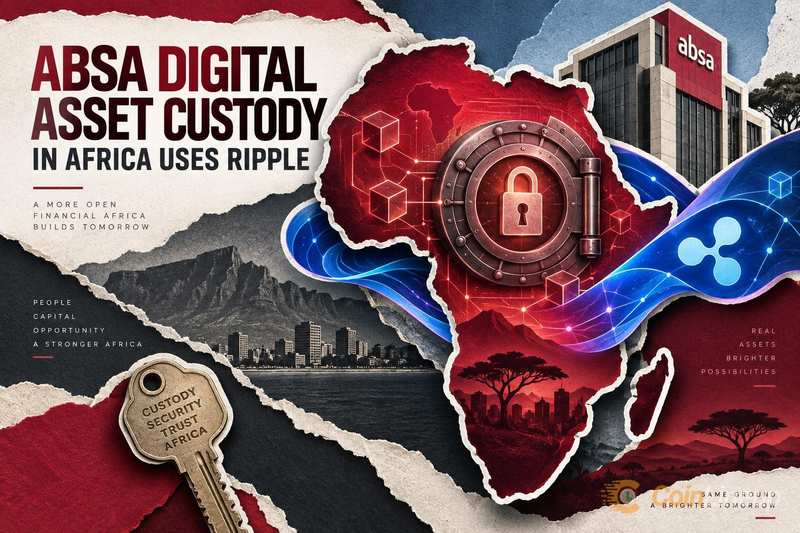
Absa, one of Africa's largest banks, is reported to be launching a digital-asset custody service on the continent using technology from San Francisco-based blockchain payments firm Ripple. If confirmed, the move would mark a significant step toward regulated crypto infrastructure in Africa, giving individuals and institutions a bank-backed way to hold digital assets safely.
What Digital-Asset Custody Involves
Custody, at its core, is safekeeping. When a bank holds a customer's cash or physical gold, it acts as a custodian. Digital-asset custody operates on the same principle, except the bank secures a client's crypto holdings — including the private keys that prove ownership — on their behalf, rather than by the asset holder.
For most people, losing a private key means losing access to their cryptocurrency permanently. There is no "forgot my password" option on a blockchain. A regulated custodian removes that risk by taking professional responsibility for security, much as a bank vault removes the risk of keeping cash under a mattress.
Institutional custody also matters for businesses and investment funds that want exposure to crypto but face legal requirements governing how assets must be stored. Without a regulated custodian, many organisations simply cannot participate. Security concerns around self-custody wallets are real as well, as ongoing wallet vulnerability warnings from security researchers continue to highlight.
How Ripple Technology Fits In
Ripple builds payment and financial infrastructure on top of the XRP Ledger, a blockchain designed for fast, low-cost settlement and commonly associated with its XRP token. Banks and payment providers use Ripple's technology to move money across borders and, increasingly, to manage digital assets within regulated frameworks.
Custody has in fact become a growing part of Ripple's institutional offering. In 2023, the firm acquired Metaco, a Switzerland-based digital-asset custody technology provider, bringing dedicated custody infrastructure into its product lineup.
For a bank launching custody services, a technology partner with regulatory experience and existing relationships with financial institutions carries considerable weight. Ripple has worked with banks and central banks in multiple jurisdictions, making it a practical choice for an institution like Absa that needs compliance guardrails built in from the start.
It is worth being clear about what is reported versus what is assumed. The reported partnership centres on the technology layer powering custody, not necessarily a direct integration of XRP as a held asset. The specific supported assets, custody architecture, and go-live timeline have not been independently confirmed from primary sources at the time of publication.
Why This Matters African Crypto Users
Africa has one of the fastest-growing crypto user bases in the world, driven partly by currency volatility in several countries and the widespread use of mobile money. Most users currently rely on self-custody wallets or offshore exchanges, both of which carry real risks, whether from lost keys or exchange failures.
A bank-backed custody offering from a mainstream institution like Absa could change that calculus. It would bring familiar consumer protections — such as regulatory oversight and recourse mechanisms — to an asset class that has historically lacked them. The shift mirrors what is taking place in other markets, where institutional products are gaining traction and retail confidence is growing alongside them.
The regulatory backdrop in South Africa, where Absa is headquartered, has evolved in the same direction. The country's financial sector regulator now treats crypto assets as financial products and has been licensing crypto asset service providers, giving regulated institutions a defined route into the market.
Practical questions remain unanswered for now. Which digital assets will be supported? What fees will apply? Will the service be available to retail customers or only to institutional clients? And will it be offered across all African markets where Absa operates, or only in South Africa? For scale, Absa operates in a dozen African markets, so the geographic answer alone will shape how widely the service can reach.
Anyone considering using such a service once it launches should verify the regulatory status in their country, understand what insurance or protections apply, and compare custody fees against the cost of managing their own wallet security. The announcement, if confirmed, represents potential progress for African crypto infrastructure, but the details will ultimately determine whether it is accessible to everyday users or limited to large institutions.
Disclaimer: This article is for informational purposes only and does not constitute financial or investment advice. Cryptocurrency and digital-asset markets carry significant risk. Readers should conduct their own research before making any decisions.

