AAOI Is Listed on edgeX: Optical Networking, AI Data Centers, and the Case for Applied Optoelectronics
Key Takeaways
- •edgeX launched an AAOI/USDC perpetual contract providing 24/7 derivative exposure to Applied Optoelectronics without conferring shareholder rights or ownership of the underlying shares.
- •Applied Optoelectronics designs and manufactures fiber-optic networking components including transceivers and optical engines that enable high-speed data transmission across data-center and telecommunications networks.
- •The company's investment thesis hinges on converting technical design wins into recurring production revenue with healthy margins, rather than relying solely on broad AI infrastructure spending sentiment.
- •Customer concentration and competitive pricing pressure from larger rivals such as Coherent, Lumentum, and InnoLight remain key risks that could limit profitability even as unit volumes grow.
- •The current industry transition toward 400G and 800G transceivers, with 1.6T modules on the roadmap, creates potential for higher-value connections but also demands precision manufacturing and supply-chain coordination.
Quick Answer
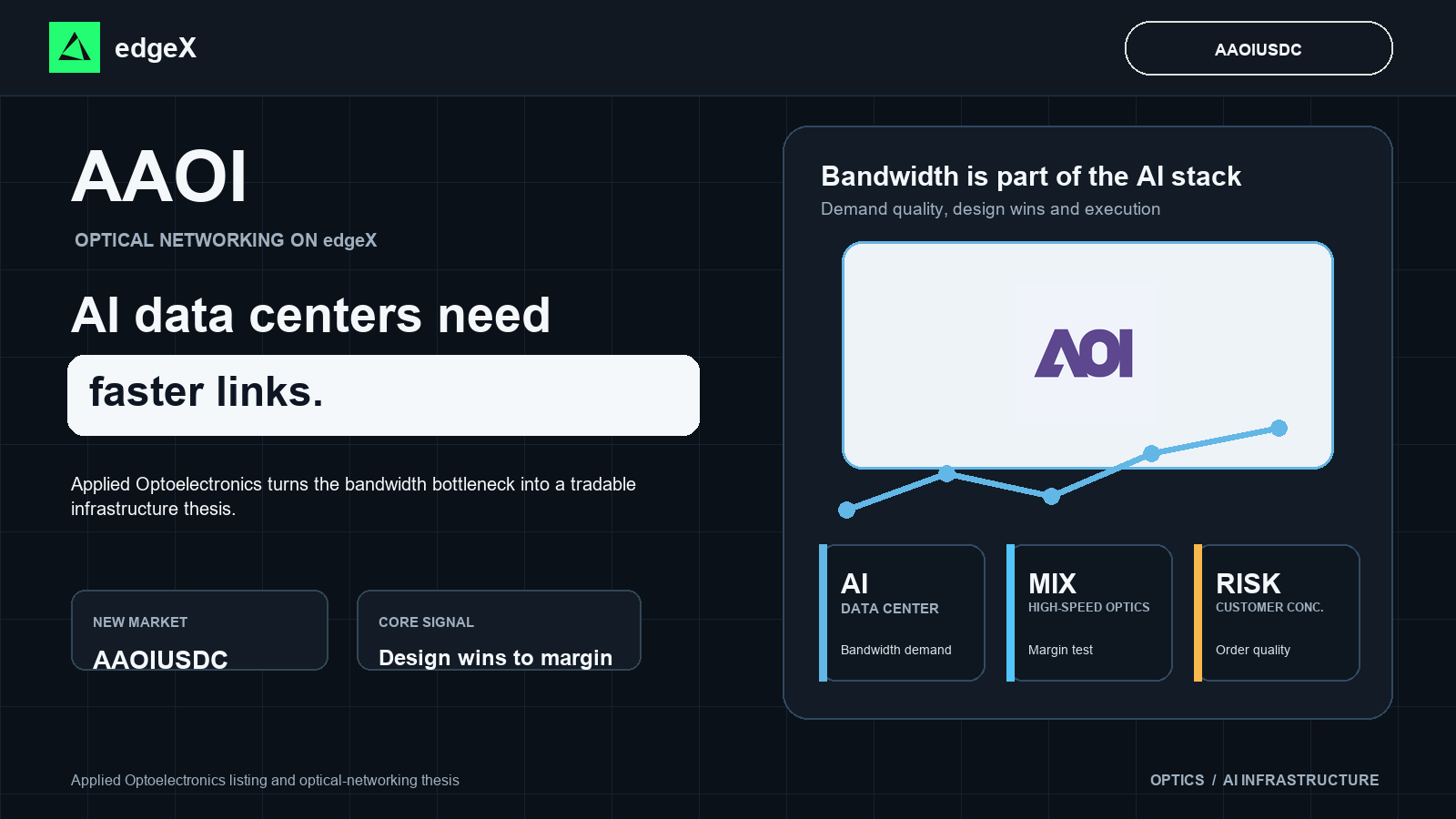
AAOI is Applied Optoelectronics, an optical-networking supplier tied to data-center, telecom and broadband demand. edgeX lists an AAOI/USDC perpetual for continuous derivative exposure to the stock. The thesis is company-specific: design wins must turn into production revenue, and revenue must convert into margin before the AI-infrastructure story becomes durable.
Trade the AAOI/USDC perpetual on edgeX.
https://x.com/edgeX_exchange/status/2087429533532336251
AAOI Joins edgeX as Optical Infrastructure Becomes an AI Bottleneck
edgeX has listed AAOI, bringing Applied Optoelectronics into its V2 TradFi perpetual markets. The company sells optical networking products used to move data through data centers, a less visible but increasingly important part of the AI infrastructure buildout. As accelerators become faster and clusters grow larger, the links between servers can become a constraint on throughput, power use and deployment economics.
That gives AAOI a strong but volatile market narrative. The company can benefit when hyperscalers and data-center operators expand capacity, upgrade bandwidth and adopt higher-speed transceivers. It can also suffer from customer concentration, pricing pressure, manufacturing execution and sudden changes in capital spending. The stock is therefore a high-beta way to trade an infrastructure theme, not a simple proxy for the broader AI market.
What Is Applied Optoelectronics?
Applied Optoelectronics designs and manufactures fiber-optic networking products, including transceivers, optical engines and related components. Its products convert electrical signals into optical signals and back again, allowing information to travel efficiently across data-center and telecommunications networks.
The company's business spans data-center, telecom and broadband markets. Data-center demand is the current center of attention because AI clusters require dense, high-speed connections. Telecom and broadband add diversification, but they also expose AAOI to different investment cycles and customer budgets.
Why optical links matter to AI clusters
An AI server is only as useful as the network that connects it to other servers, storage and switches. Training and inference workloads move large volumes of data between compute nodes. Faster optical links can reduce bottlenecks, but they also raise requirements for quality, power efficiency, testing and supply.
This is where the opportunity becomes financially interesting. A product upgrade can increase the value of each connection even if the number of servers grows more slowly. The risk is that customers may qualify several suppliers and use their scale to negotiate lower prices, leaving the component maker with higher volume but weaker margins.
The AAOI Investment Debate
| Driver | Positive development | Risk to the thesis |
|---|---|---|
| AI data-center demand | More high-speed deployments and larger clusters | Hyperscaler capex slows or projects are delayed |
| Product mix | Higher-speed transceivers carry more value | Qualification shifts toward lower-priced products |
| Customer base | New design wins broaden demand | A concentrated customer changes orders |
| Manufacturing | Capacity supports delivery and utilization | Yield, component or factory problems limit output |
| Financial profile | Revenue growth converts into operating leverage | Growth requires discounts and margins fail to expand |
The bullish case is not simply that AI spending is large. It is that AAOI captures a durable portion of the optical bill of materials as bandwidth requirements rise. That requires design wins to become repeat orders, and repeat orders to produce acceptable economics.
What Could Move AAOI Next?
The next important signals are customer commentary, product qualification, shipment growth and gross-margin direction. A large order can support the stock, but investors should ask whether it is a new customer, a one-time pull-forward or part of a multi-quarter program. A revenue beat is more valuable when it arrives with evidence of healthy pricing and capacity utilization.
AI infrastructure stocks can also move on signals that are not specific to the company. A major hyperscaler may raise capital spending and lift the whole group, while a cautious cloud outlook can pressure AAOI even if its own pipeline remains intact. The edgeX market extends trading hours, but it also means traders can react to headlines before the underlying equity market provides a new official close.
Risks for AAOI Traders
Customer concentration is central. Large customers can create powerful growth and powerful bargaining pressure at the same time. The product cycle is another risk: optical standards move quickly, and inventory can become obsolete when a customer changes architecture. Manufacturing scale, component availability and quality control also determine whether demand becomes revenue.
Valuation adds a final layer. A small company exposed to a large theme can attract expectations that rise faster than its earnings base. When the market moves from “future AI beneficiary” to “prove the next quarter,” volatility can increase sharply. A perpetual trader must add funding and liquidation risk to that equity-risk assessment.
Trade AAOI Perpetuals on edgeX
The AAOIUSDC perpetual on edgeX gives eligible traders 24/7 derivative exposure to the AAOI market. It is not a purchase of Applied Optoelectronics shares and does not grant shareholder rights. Verify current contract terms, funding, liquidity, leverage and index methodology on the live edgeX page before trading.
The Bottom Line
AAOI offers direct exposure to the optical layer of the AI infrastructure cycle. The opportunity is real when bandwidth upgrades, customer expansion and manufacturing execution reinforce one another. A weaker version of the story appears when a promising design win turns into a concentrated, lower-margin program, or when AI capital spending pauses before the company reaches scale. The new edgeX market makes the narrative tradable around the clock, but it does not remove the need to test demand quality and position risk.
AAOI Sits Between the AI Theme and Component Economics
AAOI's attraction is its proximity to a large spending cycle. Cloud operators need faster links as compute clusters scale, and optical components are part of that build. The difficulty is that component suppliers do not automatically capture the same economics as platform owners. Customers qualify alternatives, negotiate pricing and change architectures.
The investment case therefore depends on where AAOI sits in the value chain. A product that solves a difficult bandwidth, power or integration problem can support better margins. A product that becomes standardized may experience strong unit growth and falling price at the same time.
Design wins must become production programs
A qualification or design win proves technical compatibility. It does not establish shipment timing, order size or profitability. Investors should look for follow-through: capacity commitments, recurring revenue, improving utilization and management confidence that extends beyond one customer or quarter.
The quality of growth is visible in gross margin and cash flow. If revenue rises while working capital absorbs cash and margins remain weak, the company may be financing customer expansion without capturing enough value. If scale improves yield and fixed-cost absorption, the operating model becomes more compelling.
Manufacturing Is Part of the Competitive Moat
Optical networking requires precision manufacturing, testing and supply coordination. Rapid product transitions can strain those systems. AAOI must invest before demand is fully certain, yet underinvestment can leave it unable to ship when customers accelerate orders.
Capacity creates leverage only when utilization follows
New capacity can support revenue growth, but empty or poorly yielding capacity raises cost. Investors should compare capital spending with order visibility and margin progression. A factory announcement is less important than evidence that qualified products are moving through it efficiently.
Supply-chain risk is also material. Lasers, semiconductors and packaging inputs can create bottlenecks. A shortage can delay revenue; excess inventory can create write-downs when standards change. These operating details explain why AAOI may react strongly to guidance even when industry demand remains positive.
A Scenario Framework for AAOI
In a bullish scenario, hyperscaler spending remains firm, higher-speed optics move into volume production and AAOI broadens its customer base. Revenue growth produces better utilization and margin. The stock can then behave like an earnings story rather than a theme trade.
In a base scenario, demand grows but is uneven. One customer ramps while another pauses, and higher revenue is offset by transition costs or pricing pressure. The stock remains volatile because each order update carries too much weight.
In a bearish scenario, data-center projects are delayed, customers digest inventory or AAOI misses a product transition. Capacity and operating expenses remain while revenue expectations fall. The equity can reprice sharply because smaller suppliers have less diversification than the hyperscalers they serve.
Reading a 24/7 AAOI Market
AAOI's underlying shares trade during U.S. equity hours, while the edgeX perpetual remains available around the clock. Overnight moves may reflect hyperscaler results, competitor guidance or semiconductor sentiment before AAOI itself opens. Traders should understand when the index receives fresh underlying inputs and how gaps are handled.
The contract can be useful for reacting to sector news, but a broad AI headline may not change AAOI's actual order book. A disciplined trader asks whether the news affects bandwidth demand, a named customer, the product roadmap or only market sentiment.
Position sizing should reflect the stock's volatility and the perpetual's liquidation boundary. Funding and spread can turn a slow thesis into an expensive position. The strongest setup combines identifiable company evidence with contract conditions that allow the position time to work.
The upside case depends on concentration easing
AAOI becomes more interesting if demand broadens beyond one or two hyperscaler relationships. A larger customer base can smooth revenue and make the company less hostage to a single platform timing decision. That does not require AAOI to become huge overnight; it requires the business to show that optical networking is becoming a repeatable revenue engine rather than a one-off opportunity.
The market also cares about how management talks about mix. If higher-speed products gain share while lower-value legacy lines fade, the company may capture more value per shipment. If volume rises only because pricing has been cut aggressively, the top line can look healthier than the economics underneath. Traders using the edgeX perpetual should separate those two pictures before acting on momentum.
Another useful test is customer bargaining power. A large customer can provide scale and visibility, but it can also negotiate aggressively and make AAOI dependent on one procurement calendar. Stronger evidence would be a combination of repeat orders, broader customer participation and stable or improving gross margin. That combination would suggest the company is capturing value from the optical upgrade cycle instead of merely supplying it at the customer's preferred price.
Management's guidance on backlog, lead times and customer qualification can help test whether that improvement is becoming repeatable.
What Would Make the AAOI Setup Stronger
The strongest AAOI setup would show that optical demand is moving from theme to operating leverage. Useful evidence would include repeat orders from large customers, broader customer participation, improving gross margin, stable lead times and management guidance that points to production rather than only qualification. In that environment, AAOI would no longer trade only as a small-cap proxy for AI infrastructure. It would begin to trade as a company converting bandwidth demand into earnings.
The warning sign is revenue without margin
Revenue growth can mislead when pricing is weak or working capital absorbs too much cash. If AAOI ships more products but margins fail to improve, the company may be taking volume without enough economic value. That matters for a perpetual trade because the stock can move quickly on revenue headlines, then reverse when investors inspect quality. The better setup links demand, customer breadth and margin in the same direction.
Trade AAOI/USDC Perpetuals on edgeX
TradFi access no longer has to stop when traditional exchanges close. edgeX gives traders around-the-clock access to selected stock and exchange-traded-product perpetuals through a self-custodial venue. Users retain control of their assets and authorize fund movements themselves, while the platform is built for fast execution and transparent on-chain settlement.
24/7 Access to Listed TradFi Markets
The newly listed AAOI/USDC perpetual lets traders express a long or short view on the referenced market without waiting for the next traditional-session open. A perpetual is a derivative, not ownership of the underlying security. Traders should check the live contract page for current leverage, funding, fees, liquidity, index methodology, contract specifications and regional availability.
Self-Custody and Market Infrastructure
edgeX combines decentralized settlement with an order-book trading experience. The platform describes institutional-grade liquidity, high-speed matching, self-custody and no KYC onboarding. Product availability and performance claims can change, so traders should verify current terms directly on edgeX before trading.
Leverage Changes the Risk Profile
Leverage can magnify both gains and losses. Funding payments, liquidation, spread, slippage, reference-price differences and market gaps can all affect results. A view can be directionally correct and still lose money if position size or timing is poorly managed.
Frequently Asked Questions
What does AAOI sell into the AI infrastructure stack?
AAOI sells optical networking products used to move data across data centers and communication networks. In AI clusters, faster optical links can become more important as compute systems scale.
Why is a design win not the same as profitable revenue?
A design win confirms technical qualification, but it does not guarantee shipment volume, pricing, timing or margin. Investors need evidence of production programs, utilization and cash conversion.
How do customer concentration and pricing affect AAOI?
A large customer can accelerate growth but also create bargaining pressure and revenue volatility. If volume comes with weak pricing, the stock may rise on headlines but the business may not improve enough.
What should traders watch before using the AAOI/USDC perpetual?
Watch customer commentary, backlog, gross margin, capacity utilization, inventory and sector news from large cloud buyers, then check edgeX funding, depth, index rules and liquidation levels.
Does the edgeX perpetual represent ownership of the underlying?
No. It is a derivative contract. It does not provide voting rights, dividends, or a claim on the underlying issuer's assets.
What should traders verify before opening a position?
Check the live edgeX market page for current funding, fees, leverage, liquidity, index methodology, contract specifications, and regional availability.

