They Told Us to Evacuate on 9/11—and We Locked the Doors Instead
Key Takeaways
- •Former Stars and Stripes managing editor D. Earl Stephens marked the 25th anniversary of 9/11 with a firsthand account of his newsroom's response to the attacks.
- •Two Stars and Stripes reporters at the Pentagon survived the crash, helped treat burned victims and recover bodies, and later filed stories about the scene.
- •Roughly 35 editorial staff members refused an evacuation order and stayed to produce six editions of the newspaper on September 11, 2001.
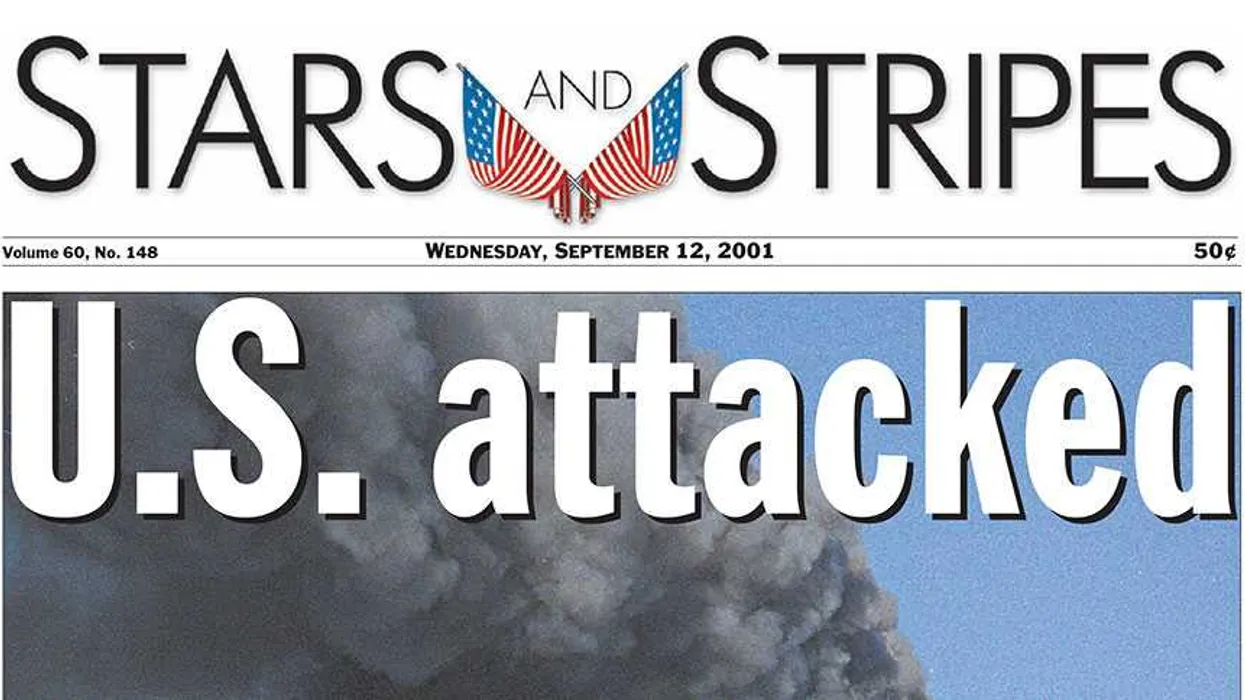
- •The paper ran the front-page headline 'AMERICA ATTACKED' and produced an additional edition for European readers that day.
- •Stephens uses the anniversary to argue that press freedom, the troops' newspaper, and democracy are under siege by the Trump administration.
AUTHOR’S NOTE: Today, on the 25th anniversary of this terrible attack, freedom of the press, the troops’ newspaper and democracy itself are under siege by a Trump administration that views truth as the enemy and lying as a virtue. The 2,977 people who lost their lives that day, and the men and women who fell on the battlefield avenging that attack, deserve far better.
It was just another Tuesday morning in the Stars & Stripes newsroom on the third floor of the National Press Building in Washington, D.C., 25 years ago today.
I had just grabbed a second cup of coffee and was still bleary-eyed after staying up late the night before watching my beloved N.Y. Giants lose again on Monday Night Football. I opened my computer to get a sense of what was happening in the world and the news we would deliver to readers around the globe that day.
As I stepped out of my office, which looked over a windowless sea of cubicles, one of our junior editors, a daughter of Nebraska, made an unusually negative remark, openly challenging the print gods to a duel.
“Man, I am sick and tired of these slow darn news days!”
Almost anyone else in that newsroom would have used stronger language, but that was about as frustrated and angry as Stephanie ever became.
Five minutes later, another editor watching the bank of televisions on the starboard side of the newsroom screamed. A passenger jet had just slammed into one of the towers of the World Trade Center.
All those slow news days began their descent into hell.
Another plane struck the other Trade Center tower. A third crashed into the Pentagon. Still another, which we later learned was headed for the White House and/or the Capitol Building just a few blocks away from us, went down in a Pennsylvania field.
How many damn planes were there?
We had two reporters at the Pentagon and spent what seemed like forever trying to get confirmation that they had survived the blast. When we finally learned they were safe, we also learned that they would be busy pulling bodies from the wreckage.
There were more important jobs to do that day than being a newspaper person.
Sandra and Lisa were two of the finest reporters I have ever worked with, and they were even better people. Sandra, a trained EMT, literally helped save lives.
“I treated one guy, he had second- and third-degree burns over 80 percent of his body, and another guy with less [burns],” Sandra told me by phone. “At first, triage was [chaos], too many people were trying to call the shots, but things have settled a bit.”
“It’s basically a body-recovery operation; nobody has come out for hours … I see them bringing in dogs, I think body-sniffing dogs,” Lisa said.
Many hours later, both filed powerful stories describing that dark, deadly day at their workplace. I could go on all day praising them and their extraordinary work on what may have been the grimmest Tuesday in American history.
For this account, however, they are part of a larger point that needs to be emphasized.
Back in the newsroom, a few miles from the burning Pentagon, we were trying to make sense of the biggest news day of our professional lives.
Stars & Stripes is an editorially independent daily newspaper serving troops and their families overseas. It has news bureaus around the world, two main hubs in Germany and Japan, and remote printing operations in several other countries.
At the time, the Central Office in Washington, D.C., gathered news from bureaus based with U.S. troops and produced six editions of the paper each day. Those editions were supplemented with wire copy targeted to the regions where the troops served.
After the pages had been laid out and approved by many discerning eyes at the Central Office, they were transmitted by satellite to remote printing locations overseas. From there, they were distributed to troops and their families stationed around the world.
No newspaper has a more expansive distribution route than Stripes. When it delivers to war zones—as it was about to do after the 9/11 attack—things become especially demanding.
The irony was overwhelming: The journalists assembling newspapers for troops and their families overseas on that gruesome day were themselves under attack in Washington.
As the hours passed and we slowly began to comprehend the terrible event, I called a meeting of the entire editorial staff in our large conference room.
There were about 35 people in the room—mothers, fathers, daughters, sons, boyfriends, girlfriends and journalists.
I wanted them to understand that, because they were mothers, fathers, daughters, sons, boyfriends and girlfriends, there might be more important places for them to be than in the newsroom, making sense of hell and getting the paper out that day.
It appeared that we were safe for the moment and that no more incoming planes were headed toward the city. But nobody knew for sure. This kind of attack was not supposed to happen on American soil, a country protected by its two largest oceans.
I also remember a brief moment in the city itself that day.
Shortly after the attack, I took a few minutes to leave the building and see what was happening on the street. Standing on 3rd Street and looking toward the White House, I felt as though I had stepped into a scene from a Godzilla movie. People ran in every direction. Some were screaming, most were in despair, and everyone was bewildered. Loudspeakers urged people to remain calm and directed them out of the city.
I drank a third cup of coffee, wished I had a cigarette, shook my head and went back upstairs.
When I reached the third floor, security personnel standing outside the newsroom’s glass doors told me they were ordering the building to be evacuated. I told them we were not going anywhere. We had a newspaper to deliver to the most important readers in the world.
I pushed past them, went through the doors, locked them behind me and never heard from them again.
Back in the conference room with the mothers and fathers, daughters and sons, I made clear that anyone who wanted to go home to loved ones should leave immediately. No one would think less of them for doing so. At that point, we all could have used a hug.
The room fell silent.
Nobody moved.
Not one person.
I later learned that a couple of people had even walked across the 14th Street Bridge from Virginia to get into the office so they could help produce the paper for readers who, as it turned out, were about to put their lives on the line in Iraq and Afghanistan.
Our reporters were about to do the same, because Stars & Stripes goes with the troops to report on the troops.
Journalists receive a great deal of criticism. It comes with the job. But readers should know that the best journalists hold themselves to a higher standard than the people who direct that criticism ever could. The people I worked with in that newsroom and at the Pentagon on that hellish day did not hesitate.
We left the conference room and began cobbling together six editions of the paper, including an extra bulldog edition for readers in Europe.
There were no more planes.
Sandra and Lisa filed their stories, and we checked in with staff members around the world to begin planning coverage of the most serious attack on the American mainland in history.
When the paper was finally put to bed, people quietly began filing out of the newsroom. The slow news day would not return to that newsroom for another decade.
We used the front-page headline “AMERICA ATTACKED.”
I caught the last train out of the city shortly after midnight.
It was now 9/12.
As the Blue Line train of the D.C. Metro system slowly rumbled through Pentagon Station toward my home in Virginia, the smell of smoke and death filled the air. The train would not stop there that night. The adrenaline of the day had finally stopped pumping, and I allowed myself to open the door a crack for reflection.
Then it hit me.
Things would never be the same.
That was when I cried.
D. Earl Stephens is the author of “Toxic Tales: A Caustic Collection of Donald J. Trump’s Very Important Letters” and completed a 30-year journalism career as managing editor of Stars and Stripes.

