Bitquery: 465 Hyperliquid Vaults Where the Leader Wins While Depositors Lose
Key Takeaways
- •Bitquery identified 465 Hyperliquid vaults in which leaders finished ahead while depositors finished behind, with leaders in those vaults gaining roughly $9.5 million including profit share as depositors lost $6.3 million.
- •Leaders as a group fared poorly overall, losing $55.9 million on their own stakes, with $6.1 million in profit share reducing the net loss to $49.8 million.
- •Of the 45,275 wallets in user-run vaults, 64% were in the red and collectively down $32.3 million all-time, though profitable wallets were up a combined $25.8 million.
- •Hyperliquid's HLP vault, which runs market-making and liquidation strategies, had 94,626 depositors up a combined $140.7 million and was excluded from the user-vault figures.
- •Under Hyperliquid's terms, leaders receive a 10% share of profits and must hold at least 5% of the vault, and a leader's outcome can diverge from depositors' through entry and exit timing alone.
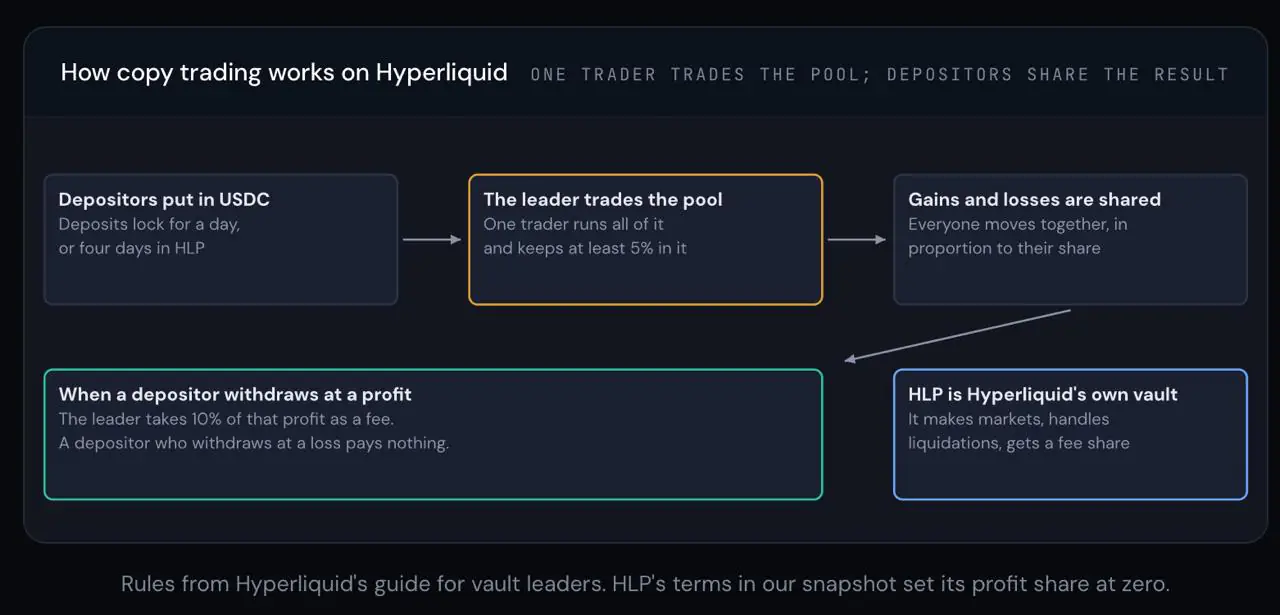
An analysis of Hyperliquid's vault ecosystem by on-chain analytics firm Bitquery has identified 465 vaults in which the leader finished ahead while depositors finished behind. Based on a snapshot taken on November 20, 2026, the Bitquery investigation found that leaders in those vaults gained roughly $9.5 million including their profit share, while their depositors lost $6.3 million.
The 465 vaults represent a small minority of the 9,478 captured in the snapshot, and leaders as a group fared poorly overall. They lost $55.9 million on their own stakes, and the $6.1 million they collected in profit share only reduced the net loss to $49.8 million. Because most leaders lost money alongside their depositors, the 465 exceptions say more about how a vault divides results between participants than about leaders profiting at their followers' expense. For depositors, that distinction matters: a leader's outcome and a depositor's outcome can pull apart through entry and exit timing alone, even when both are following the same vault's trades.
What Bitquery's Snapshot Shows
On the depositor side, the snapshot counts 45,275 wallets in user-run vaults. Of those, 64% were in the red, and together they were down $32.3 million all-time. The aggregate conceals a wide spread: wallets in profit were up a combined $25.8 million, while wallets in loss were down $58.1 million. These depositor figures exclude leaders' own shares.
The protocol's own vault tells a different story. HLP, the Hyperliquidity Provider vault operated by Hyperliquid for market making and liquidations, had 94,626 depositors who were up a combined $140.7 million. Bitquery keeps HLP, its sub-vaults and the Liquidator vault out of its user-vault figures. The two sets of numbers are not a like-for-like score, since HLP runs market-making and liquidation strategies while user vaults track a single leader's trading.
Several limitations apply to all of these numbers:
- The snapshot was taken at 10:25 UTC and covers vaults on Hyperliquid's HyperCore exchange. Vault products on HyperEVM are not included, and Bitquery does not publish a separate count of user vaults, so the 465 cannot be expressed as a precise share of them.
- A wallet does not necessarily belong to one person, and some wallets are bots.
- Open positions are valued at snapshot prices, so part of each result is unrealised.
- The leader's 10% cut is taken when a depositor withdraws, so the gains of depositors who are still invested may read up to 10% higher than they will on exit.
- Hyperliquid records net deposits only, so the data cannot say what share of the money deposited was lost.
- Bitquery's snapshot series began on October 27, and some wallets that withdrew in full before then may be missing.
The data shows outcomes, not motives. It cannot explain why any individual leader came out ahead, and a single snapshot cannot rank vaults as they stand today. Because Bitquery's series is built from snapshots that began on October 27, later instalments are the available way to track whether the 64% red share, the $32.3 million aggregate and the 465-vault count shift.
How a Leader Finishes Ahead of the Depositors
A user vault pools depositors' USDC so that one leader can trade it. Each depositor owns a slice of the pool from the moment they enter and shares in its gains or losses from that point on. Under Hyperliquid's documentation for vault leaders, the leader receives a 10% share of profits and must hold at least 5% of the vault at all times. The leader's own stake rises and falls with everyone else's, but the profit share is separate income. Because the cut is only crystallised when a depositor withdraws, while the leader's stake keeps absorbing every later move, that timing asymmetry is built into the documented terms themselves rather than being specific to any individual vault.
Consider a hypothetical vault. The leader deposits 1,000 USDC and an early depositor, Investor A, adds 10,000. The pool gains 10%, lifting the leader's stake to 1,100 and A's to 11,000. A then withdraws. The leader takes 10% of A's 1,000 profit, so A receives 10,900.
Investor B then deposits 20,000, bringing the vault to 21,100. The leader's 1,100 now represents about 5.2% of the pool — just above the minimum — making B's deposit close to the largest the 5% rule allows at that point. The vault then loses 10%, taking B's stake to 18,000 and the leader's to 990. The 100 USDC taken from A earlier sits outside the vault, untouched by the loss.
The resulting cash flows are:
- Investor A: in 10,000, out 10,900 — net +900
- Investor B: in 20,000, end value 18,000 — net −2,000
- Leader: stake 1,000 → 990 (−10), profit share +100 — net +90
All figures are in USDC. The illustration is Coindoo's hypothetical, not an observed vault. It assumes proportional returns, elapsed deposit locks and profit share held outside the vault, and it excludes trading costs, funding, withdrawal slippage and taxes. B's and the leader's stakes are valued at the end point.
Taken together, the depositors finish 1,100 USDC behind while the leader finishes 90 ahead — yet the leader never takes anything from B. All of the profit share came from A's gain before B arrived.
The example also omits one large cost: Hyperliquid charges 10,000 USDC to create a vault, which would wipe out this leader's 90 many times over. The exercise tracks trading results only. It shows how the gap between leader and depositors can open, not what leaders in Bitquery's data earned overall or why they came out ahead.
One Strategy, Four Different Numbers
Now consider a single unit held from the first day through both moves. It gains 10% and then loses 10%, ending 1% below where it started before any profit share — a −1% result. That per-unit figure is the closest thing to what a strategy chart describes, and it matches nobody in the vault.
Pooled together, the two depositors put in 30,000 USDC and are 1,100 down, a loss of about 3.7%.
Disclaimer
This article is for information only and is not financial, investment or tax advice. The worked example is a simplified illustration, not a record of any real vault or trader. Figures attributed to Bitquery come from its own on-chain analysis at a single point in time and may differ from current data. Coindoo does not endorse any vault, leader or trading strategy. Trading leveraged crypto products carries a high risk of loss, including the loss of all capital deposited. Readers should do their own research and consider independent professional advice before investing.

