Why a 3x Bitcoin ETF Can Lose Money Even When Bitcoin Ends Flat
Key Takeaways
- •Daily 3x Bitcoin ETFs reset their leverage exposure at the end of each trading day, targeting three times Bitcoin's single-day return rather than its return over longer holding periods.
- •Volatility decay occurs because daily gains and losses compound on a changing net asset value, so a fund can post a loss even when Bitcoin's price finishes where it started.
- •In a two-day example, a 3x fund that gained 30% and then lost 27.27% ended more than 5% lower even though Bitcoin returned to its starting price.
- •The SEC's approval of the first U.S. 3x Bitcoin ETFs has expanded retail access, and U.S. regulators have repeatedly cautioned that holding such funds beyond one day can produce returns that diverge sharply from the advertised multiple.
- •Beyond volatility decay, fees, daily borrowing costs, and tracking error can widen the gap between the fund's actual returns and three times Bitcoin's performance.
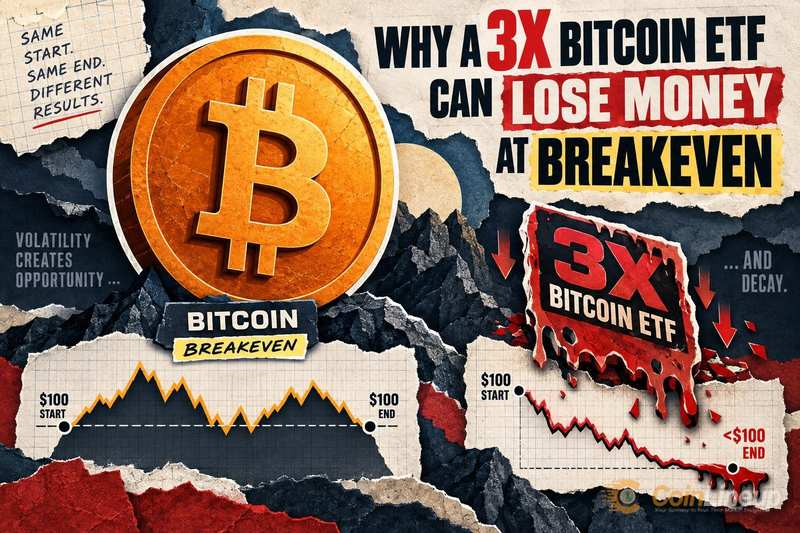
A daily 3x Bitcoin ETF is often pitched as a straightforward wager: if Bitcoin rises 10% in a day, the fund gains 30%. Yet because these products reset their leverage every trading day, a fund can lose money over a multi-day stretch even when Bitcoin's price finishes exactly where it started. The force behind that outcome — volatility decay — is one of the least understood risks in crypto investing.
The core mechanics:
- A daily 3x Bitcoin ETF resets its leverage exposure at the end of every trading day, not over weeks or months.
- When Bitcoin moves up and down without a sustained trend, daily compounding creates a drag — volatility decay — that shrinks the fund's value even if Bitcoin's price is unchanged.
- These products are short-term trading tools, not substitutes for direct Bitcoin exposure over longer holding periods.
The Breakeven Paradox: Bitcoin Flat, the 3x ETF Down
Many investors assume a 3x leveraged fund delivers three times Bitcoin's return over any period they hold it. That assumption is wrong. A daily 3x ETF targets three times Bitcoin's single-day return, then resets its exposure the next morning based on a new starting value.
That daily reset is the pivotal detail. Over a single day, the math works as advertised. But across multiple days of price swings, the sequence of gains and losses matters enormously, and Bitcoin's start-to-finish price comparison says almost nothing about what the leveraged fund did in between.
The SEC's approval of the first U.S. 3x Bitcoin ETFs brought these products to a far wider retail audience. Because ETFs trade in ordinary brokerage accounts just like any listed stock, the new funds can be bought as easily as an index fund — which is precisely what makes the fine print in their prospectuses easy to overlook. That broader availability makes understanding their mechanics more important than ever, because the fund's prospectus — not the ticker name — defines what “3x” actually means. Daily-reset leveraged funds have a long track record in U.S. equity markets, and U.S. regulators have repeatedly cautioned that holding them beyond a single day can produce returns that diverge sharply from the multiple in the fund's name.
How Volatility Decay Turns an Up-and-Down Path Into a Loss
A simple two-day example with round numbers shows the effect. Suppose Bitcoin starts at $100. On Day 1, Bitcoin rises 10%, reaching $110, and the 3x ETF gains 30%, so a $100 investment grows to $130.
On Day 2, Bitcoin falls 9.09%, returning it to almost exactly $100 (110 × 0.9091 = $100.00). The ETF, however, does not fall 30% from $100. It falls 27.27% from its new base of $130 — a drop of $35.45 that leaves the investor with $94.55, a loss of more than 5% even though Bitcoin finished where it started.
This is volatility decay, sometimes called compounding drag or beta slippage. Each day, the fund compounds gains and losses on a shifting net asset value (NAV). A large up day followed by a large down day does not cancel out, because the percentages apply to different dollar bases. Greater daily swings produce wider gaps between what Bitcoin returned and what the leveraged fund returned. As an analysis of leveraged ETF behavior shows, being directionally correct about Bitcoin over a longer period offers no protection against this path-dependent drag.
Path dependence is the technical term for the effect: the order and size of daily moves, not just the starting and ending prices, determine the fund's outcome. Bitcoin is one of the most volatile major assets in the world. Periods in which it swings sharply in both directions without making net progress are common, and those are precisely the conditions that punish daily leveraged funds most.
Fees, financing costs, and tracking differences add to the gap. A 3x ETF must borrow to maintain its leverage, and that borrowing carries a daily cost that compounds against the investor just as the volatility drag does. The headline “3x” multiple does not account for these costs.
Bitcoin's history includes episodes of steep, rapid declines, such as when Bitcoin fell below $81,000 amid crypto liquidations exceeding $1 billion. A volatile two-way market of that kind is the worst possible environment for a daily leveraged fund held over days or weeks.
What to Check Before Holding a 3x Bitcoin ETF
Before buying or continuing to hold a daily 3x Bitcoin ETF, investors can work through a checklist. These are not predictions about Bitcoin's direction; they are structural features of the product that affect returns regardless of which way Bitcoin moves.
- Daily reset confirmed: Read the fund's prospectus or fact sheet and confirm that the leverage resets daily, not monthly or for a fixed term. Most leveraged crypto ETFs currently available in the U.S. reset daily.
- Holding period: These products are designed for short holding windows, often a single day. The longer a position is held through volatile, trendless markets, the more volatility decay accumulates.
- Realized volatility: Bitcoin's daily price swings directly determine the size of the compounding drag; higher volatility means larger decay. Check recent daily move sizes, not just the 30-day trend.
- Fees and financing costs: The expense ratio is only part of the cost. Daily swap or futures financing adds a borrowing cost the fund pays continuously. Review the total cost disclosure in the SEC's regulatory framework for leveraged ETFs.
- Liquidity and tracking error: A thin market in the underlying futures or swaps can cause the fund's actual daily return to differ from the intended 3x multiple. Compare the fund's daily returns against three times Bitcoin's daily moves over the past month.
The clearest practical rule is this: evaluate the full return path, not just Bitcoin's endpoint. A fund that started and ended the same week at the same price may have taken a painful round trip that cost the leveraged investor real money. Investors who want long-term Bitcoin exposure without this drag should consider direct Bitcoin ownership or a spot instead — and holding the two side by side through the same volatile stretch is the most direct way to see how differently a path-dependent fund behaves. As more leveraged crypto products reach the market, every new ticker deserves the same prospectus-first review.
For context, Bitcoin's 84.2% annual gain in one measured period looked impressive on a start-to-finish basis, but the path included numerous sharp reversals. A leveraged fund riding that same path would have delivered far less than the naive 3x multiple, and in some sub-periods it would have underperformed even a simple unleveraged position. The product mechanics, not the direction, determine the outcome.
Disclaimer: This article is for informational purposes only and does not constitute financial or investment advice. Cryptocurrency and digital asset markets carry significant risk. Always do your own research before making decisions.

