US 30-Year Treasury Yield Hits 22-Year High as Bitcoin Slips Toward $84,300
Key Takeaways
- •The 30-year Treasury yield reached approximately 5.44% on Sept. 24, a level last seen around June 2004, while the 10-year yield moved above 5.1%.
- •S&P Global's flash U.S. Composite PMI rose to 58.4 in September from 56.0 in August, marking the fastest business activity expansion in more than five years.
- •The Federal Open Market Committee unanimously raised its target rate by 25 basis points on Sept. 16 to 3.75%-4.00%, and Governor Michael Barr said further adjustments would likely be required under his baseline outlook.
- •The Treasury raised its liquidity-support buyback limit for longer-dated securities from $2 billion to at least $4 billion per operation and estimated $739 billion in privately held net marketable borrowing for the July-September quarter.
- •Bitcoin traded near $84,300 on Sept. 24 after retreating from above $86,000 earlier in the week, though the article did not establish a direct causal link between the yield rise and the decline.
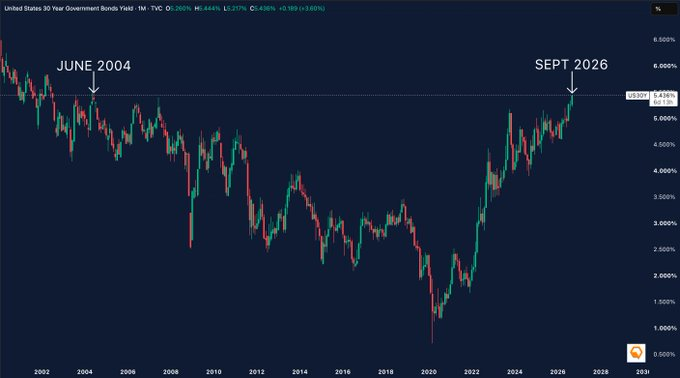
The U.S. Treasury market extended its selloff on Sept. 24, pushing long-term borrowing costs to their highest levels in more than two decades. TradingView data showed the 30-year Treasury yield near 5.44%, while the 10-year yield moved above 5.1%. The advance followed stronger U.S. business activity data and renewed expectations that Federal Reserve policy would remain restrictive.
Long-term Treasury yields serve as a reference point for borrowing costs across the economy, which is one reason the move carried weight for crypto markets: higher government yields increase competition for capital. Bitcoin traded near $84,300 after retreating from levels above $86,000 earlier in the week, according to CoinMarketCap data.
Long-Term Yields Reach Multi-Decade Highs
TradingView showed the 30-year U.S. government bond yield at about 5.44% on Sept. 24. Federal Reserve historical data placed comparable 30-year yields around that level in June 2004, underscoring the scale of the move.
Official U.S. Treasury data showed the yield curve had already moved sharply higher one day earlier. The 30-year par yield reached 5.40% on Sept. 23, up from 5.29% on Sept. 22. The 10-year yield rose to 5.11% from 4.96% over the same period.
Those moves followed a broad repricing across intermediate and long maturities. The five-year yield reached 4.99%, while the 20-year yield climbed to 5.45%.
S&P Global added another macro catalyst on Sept. 23. Its flash U.S. Composite Purchasing Managers' Index rose to 58.4 from 56.0 in August, and the firm said business activity expanded at its fastest rate in more than five years. Readings above 50 on the index indicate expansion, and September's figure sat well above that threshold.
S&P Global also reported faster job creation and higher cost pressures. Those readings strengthened expectations that restrictive monetary policy could persist.
Treasury Buybacks Face Rising Yield Pressure
The U.S. Treasury had already expanded its long-duration buyback program before the latest selloff. On Aug. 19, the department raised maximum liquidity-support purchases for longer-dated nominal securities, increasing the limit from $2 billion to at least $ billion per operation.
The adjustment applied to the 10-to-20-year and 20-to-30-year maturity buckets from Sept. 9 through Nov. 4. The department said the expansion aimed to support liquidity in longer-dated securities. Treasury did not describe the program as an attempt to target specific market yields.
The department's August quarterly refunding statement projected up to $38 billion in liquidity-support buybacks during the quarter. Treasury also expected up to $25 billion in short-dated cash-management purchases.
Separately, the department estimated $739 billion in privately held net marketable borrowing for the July-September quarter. That estimate assumed a $950 billion cash balance at the end of September.
Higher yields therefore developed alongside continued federal financing requirements. Investors also faced another Treasury auction on Sept. 24, with seven-year notes scheduled for sale.
Federal Reserve Policy Adds Pressure
Federal Reserve policy also contributed to the repricing in rates. The Federal Open Market Committee raised its target rate by 25 basis points on Sept. 16, lifting the federal funds target range to 3.75%-4.00%. The committee approved the decision unanimously, according to its official statement.
Governor Michael Barr reinforced the tighter policy message on Sept. 23. Barr said inflation remained above the Federal Reserve's 2% objective and economic growth remained strong. He said further policy adjustments would likely be required under his baseline outlook. His comments came one week after the central bank raised its benchmark rate.
S&P Global's September survey pointed in the same direction. The firm said its combined output, employment and cost measures had moved into territory associated with rate increases.
That combination placed further pressure on U.S. Treasury yields, since higher policy expectations can push yields upward when investors demand greater compensation for holding longer-dated debt.
Bitcoin Slips as Yields Challenge Risk Assets
CoinMarketCap reported Bitcoin near $84,300 on Sept. 24 after renewed selling across leveraged crypto positions. The asset had traded above $86,000 earlier in the week.
The yield move did not establish a direct cause for Bitcoin's decline. However, higher Treasury returns raised the opportunity cost of holding assets without contractual cash flows.
Higher real and nominal yields can also tighten financial conditions. That effect can reduce the liquidity available for equities, crypto assets and other higher-volatility markets.
Bitcoin traders now face two immediate macro catalysts. The Treasury's seven-year note auction was scheduled for Sept. 24, while the Federal Reserve's next policy meeting falls on Oct. 27-28.
The next major scheduled inflation catalyst arrives before that meeting. Markets will watch inflation, labor and Treasury auction data for evidence that rate pressure is easing.

