Bond Market Prices In Surprise Rate Hike for July as 2-Month Treasury Yield Spikes 13 Basis Points
Key Takeaways
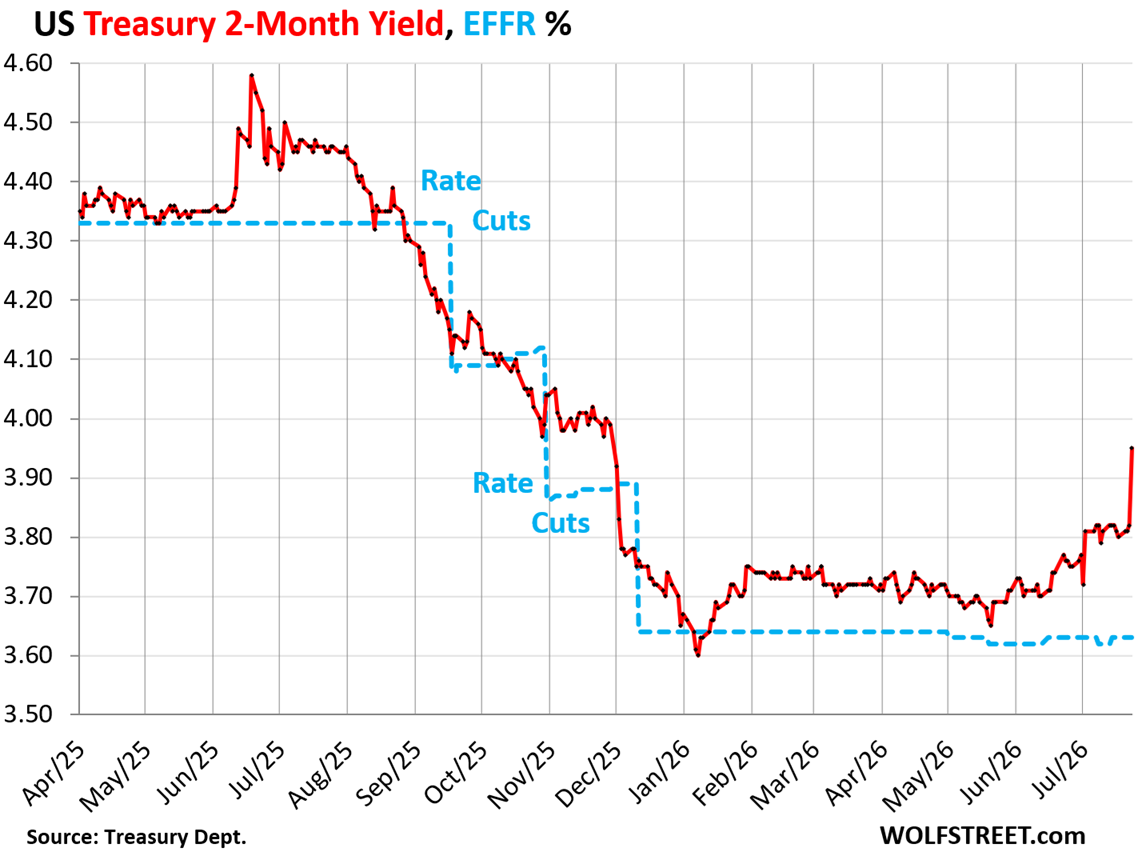
- •The 2-month Treasury yield jumped 13 basis points in a single day to close at 3.95%, a level consistent with the upper bound of the Fed's target range following a 25-basis-point rate increase.
- •Long-term yields also rose sharply, with the 10-year reaching 4.71%, the 20-year hitting 5.20%, and the 30-year climbing to 5.17%, as investors weighed inflation risks and anticipated heavy government borrowing.
- •Fed Chair Warsh has dismantled the practice of forward guidance, declining to signal upcoming rate decisions while emphasizing that inflation remains too high and further work is needed.
- •The 3-month Treasury yield, which also reached 3.95%, reflects expectations for a rate hike at either the July or September FOMC meeting but does not imply two separate increases.
- •The Fed has not executed a genuine surprise rate hike since 1994 under Alan Greenspan, and Warsh has reportedly adopted Greenspan's approach of reduced communication and prioritization of price stability.
Treasury Yields Surge Across the Curve
Treasury yields rose across the board on Wednesday. At the long end of the curve, concerns about inflation and fears of a flood of new government debt drove yields higher: the 10-year Treasury yield climbed to 4.71%, the 20-year yield to 5.20%, and the 30-year yield to 5.17%, with the latter two approaching multi-year highs.
But the most striking move came at the short end, specifically in the yield that most directly reflects expectations for the upcoming FOMC meeting on July 28–29: the 2-month Treasury yield. Short-dated Treasury bills are closely tied to expected policy rates over their brief life, so abrupt moves in this part of the curve can reveal changes in how investors are positioning for near-term Federal Reserve decisions.
2-Month Yield Signals a July Hike
The 2-month Treasury yield spiked by 13 basis points in a single day and by 15 basis points over the week, closing at 3.95%, according to the Treasury Department's yield calculation. That level sits at the upper end of the Fed's target range following a 25-basis-point hike, which would bring the range to 3.75%–4.0%. The yield also stands 32 basis points above the Effective Federal Funds Rate (EFFR), which the Fed targets through its policy rates.
This is a notable shift, effectively pricing in a rate increase at the FOMC meeting next week. Investors purchasing securities maturing in approximately two months demanded compensation for the portion of a potential July rate hike that had not previously been reflected in prices. A mid-September rate hike is irrelevant to these buyers, since their securities will have matured by then.
The 2-month yield last experienced a comparable surge in June 2025 during the Debt Ceiling standoff, when the bond market was uncertain whether securities maturing in July and August 2025 would be redeemed on schedule. At that time, the government's checking account—the Treasury General Account—was projected to run dry, preventing the issuance of new debt and raising the specter of a default. Investors demanded additional yield to compensate for that risk.
After the Debt Ceiling was resolved on July 4, 2025, and the Treasury Department resumed large-scale issuance of Treasury bills to fund operations and replenish its account, the 2-month yield settled back down.
3-Month Yield Also Reflects Tightening Expectations
The 3-month Treasury yield, which rose by 6 basis points on the day and by 10 basis points over the week—also reaching 3.95%, according to Treasury Department data—similarly prices in a rate hike. However, because the 3-month window extends to the September FOMC meeting, it reflects expectations for a hike at either the July or September meeting, but not two separate increases.
That distinction matters because the 2-month and 3-month maturities cover different FOMC windows. The 2-month yield is more narrowly focused on the July decision, while the 3-month yield can absorb expectations for policy action later in the summer.
A New Era Under Warsh
The current environment marks a shift in Federal Reserve communication. Fed Chair Warsh has dismantled the practice of forward guidance. He has refrained from commenting directly on prospective rate hikes while remaining firm in his stance that inflation is too high and that the Fed still has work to do. Other FOMC members have publicly supported further rate increases.
Market participants in the Treasury market are now effectively on their own. They can no longer rely on the Fed for explicit guidance and must independently analyze economic data to determine the yields they require. Warsh has stated that the bond market is highly adept at this process and has indicated that the Fed will use the bond market's signals as a key input in its monetary policy decisions. On Wednesday, the bond market delivered such a signal.
The Fed has not executed a genuine "surprise" rate hike in decades—perhaps not since 1994 under Alan Greenspan, when an intermeeting rate hike initiated a tightening cycle. Warsh has reportedly adopted Greenspan as a model, favoring reduced communications, allowing markets to function without forward guidance, and prioritizing the price stability mandate over the employment mandate.
Uncertainty Ahead
Several outcomes remain possible. The bond market could be mispricing the situation. The Fed could choose to disregard the market's signals and hold rates steady in July. The market itself could reverse course and scale back its rate hike expectations as early as the next trading session.
For now, the key data point is whether short-term Treasury yields remain near levels consistent with a July hike as the FOMC meeting approaches, or whether they retreat before policymakers announce their decision.
Source: Wolf Street