Google AI ATLAS 报告:AI 已覆盖 68% 的职业,但未造成大规模岗位替代
要点速览
- •Google 的 ATLAS 报告发现,AI 使用覆盖超过 68% 的职业,约占美国总就业的 88%,但在任何采用 AI 的职业中,中位数职业仅将其用于 21% 的任务。
- •与非常规认知工作相关的 AI 对话中,涉及端到端任务自动化尝试的比例不到 10%,绝大多数使用场景具有协作和辅助性质。
- •AI 使用集中在收入较高的职业中,某一职业的收入中位数每增加 1%,AI 使用强度就会增加逾 2.5%。
- •该研究仅涵盖 Google 自身 AI 服务的数据,并未包括 ChatGPT、Claude 或 Microsoft Copilot 等竞争平台,因此职场 AI 的整体覆盖范围可能更大。
- •研究人员正在关注,AI 对入门级任务的自动化是否会缩窄法律、咨询和软件开发等领域近期大学毕业生的职业入口。
AI 目前已出现在 68% 的职业中,这些职业代表了 88% 的美国就业岗位,涵盖从软件开发人员到农民、工业工程师和林务员等角色。根据 Google 最新发布的一项分析,AI 并不是把这些岗位自动化到消失,而是主要帮助员工更有效地完成任务。研究结果反映的是 Google 自身 AI 服务的使用情况,并未涵盖 OpenAI 的 ChatGPT、Anthropic 的 Claude 或 Microsoft Copilot 等竞争平台上的活动,这意味着 AI 工具在职场中的实际覆盖范围可能还要更大。
一段时间以来,一些 AI 公司创始人、内部人士和推广者助长了即将到来的“全面岗位毁灭末日”叙事,认为 AI 很快会取代几乎所有办公室工作。然而,近几个月来,其中许多声音已不再坚持这类悲观预测。美国就业数据也支持一种更为温和的判断:实际裁员规模一直相对较小。
许多被裁员工在仍领取遣散费期间就找到了新工作——有些人在遣散期剩余时间内同时领取两份薪水——因此从未符合领取失业保险的条件。一些全球公司的裁员公告包括其他国家的裁员,并未影响美国就业市场。有些所谓“裁员”实际上是取消空缺、尚未填补的岗位。另一些公告来自仍在其他部门招聘的公司,被裁员工有机会在公司内部申请这些岗位。
不过,AI 无疑已经推动了劳动力市场的变化。其中一个值得关注的问题是,近期大学毕业生进入职场时,AI 使经验丰富的专业人士能够自动化常规或入门级任务——也就是过去通常帮助年轻员工站稳脚跟的“基础杂活”。劳动力研究人员正在观察,这种动态是否会缩窄法律、咨询和软件开发等行业的职业入口;在这些领域,早期职业阶段员工过去通常通过结构化的分析任务积累专业能力。这些变化仍然较新,尚未得到全面追踪。
Google 发布了其分析(100页 PDF),研究其 AI 服务实际上如何被使用,涵盖人们在工作和家庭场景中与 AI 的互动。报告包括浏览器中的 Google AI 模式、Google 的 Gemini 应用,以及 Google 的 Gemini API;后者允许企业将 Google 的 AI 模型集成到自身网站和服务中,用于内容生成、对话代理、长文档摘要和定制 AI 代理。
核心发现是:AI 正在从编码到汽车维修等广泛职业中被采用,但主要由员工用于完成任务并提升质量,而不是完全取代这些岗位。
Google 通过多种渠道将 Gemini 应用和 Gemini API 商业化:将 Gemini 与现有软件捆绑并提高订阅费用(例如,将 Gemini 集成进 Workspace,并将月度订阅费提高 16.7%);按使用量计费的输入和输出 token、缓存、存储和附加功能;Cloud 工具;以及其他机制。Google 对广泛采用 AI 的商业利益,为解读该报告的表述提供了相关背景,不过其底层使用数据本身仍提供了一个重要的实证观察窗口。
该报告是名为 AI & Economy ATLAS(Activity, Task, Landscape, and Adoption Study)系列论文的第一篇,分析 Google AI 使用数据。该分析涵盖工作场景、非工作场景以及国际范围内的 AI 使用情况。
以下六点摘要直接引用自 Google 的分析:
1. AI has diffused very broadly in both work and life. Adoption in the workplace spans all major sectors (e.g., from Professional and Business Services, to Construction, Leisure and Hospitality, and more). It also spans over 68% of all occupations that collectively represent just above 88% of total US employment, including both much-discussed occupations such as software developers and market researchers, and those less-discussed such as farmers, industrial engineers, and foresters.
2. Though broadly used at work, the overall depth of AI's use is shallow. AI is used for only 21% of total tasks in the median occupation with any AI use. Only 3% of occupations showed AI usage for over 75% of their tasks; these occupations include software quality assurance analysts and testers, human resources specialists, and document management specialists.
3. While there is some task automation, the vast majority of use so far is collaborative and assistive to tasks and work. Non-routine cognitive tasks (e.g. hypothesis testing and creative design) make up only about 35% of the professional tasks in the economy as a whole, yet they make up almost 65% of work-related AI interactions in our data. In our initial attempt to taxonomize intent, only a small amount of this usage appears to be focused on automation based on our classification. Instead, usage of AI for non-routine cognitive work is centered on Partial Drafting and Generation, Review and Refinement, Ideation and Strategy, and Information Retrieval and Learning. Attempts to automate tasks end-to-end represent less than 10% of AI conversations in non-routine cognitive work appearing in our data.
4. AI use is not only a white-collar phenomenon; it is also assisting in physical and manual work. While nearly a third of heavily physical occupations show no observed AI usage, workers in many manual and technical trades are using AI on the job. In these roles, AI frequently acts as a hands-on collaborator for diagnostics, troubleshooting, and real-time learning. We also observe disproportionate multimodal use of AI (i.e., uses that involve images and video) in these contexts: for example, automotive technicians and industrial mechanics using AI to interpret complex test results, debug electrical wiring, and inspect machinery for wear, where the usage rate of multimodal AI is more than 2 times higher than the overall work baseline.
5. Work-related AI usage correlates strongly with higher wages and education. In the US workforce, a 1% increase in an occupation's median earnings is associated with a more than 2.5% increase in AI usage intensity. Weighted by Gemini conversations, the median salary across observed occupations is around $83,000, roughly $20,000 higher than the true employment-weighted national median. This relationship persists even after controlling for the occupation's educational attainment (which itself is positively correlated with AI usage). This correlation means current AI usage is concentrated among higher-earning occupations, a pattern labor researchers are monitoring for potential divergence in productivity and earnings across the workforce.
6. While wages and expertise are typically correlated in the economy, ATLAS points to a complex relationship between AI usage and expertise. When classified according to expertise levels, tasks requiring lower-to-middle levels of expertise tend to see relatively higher AI usage than the highest expertise level tasks, despite ATLAS data also suggesting high-earning workers—and therefore those with more scarce skills and expertise—adopt AI at the highest rates.
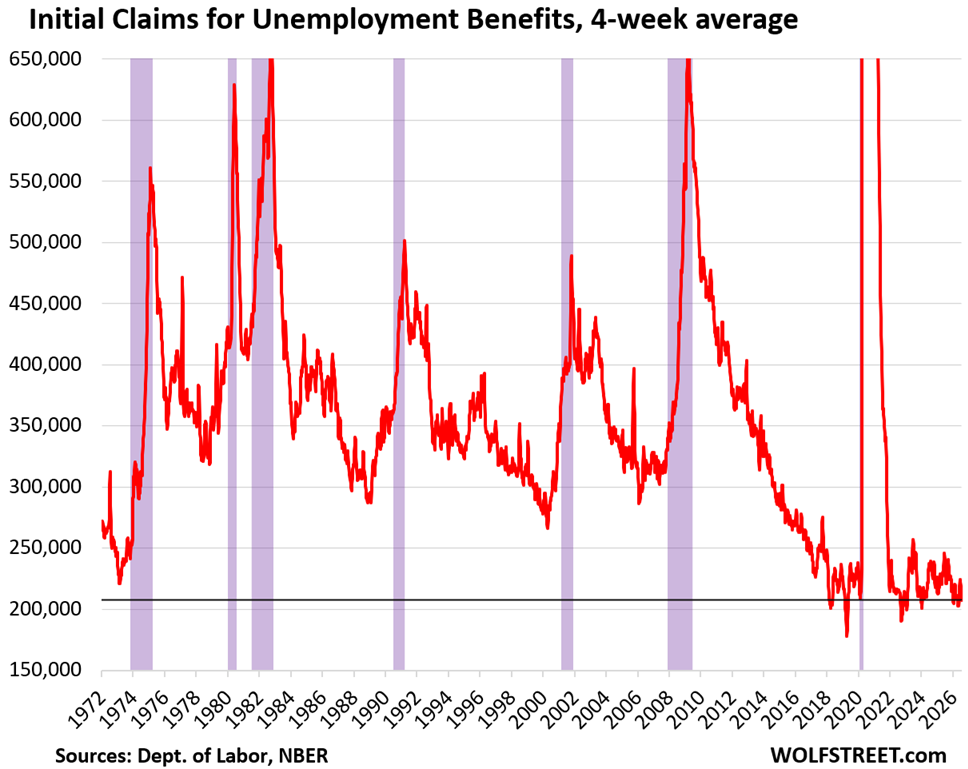
劳动力市场数据总体上支持这样一种观点:AI 并未造成广泛的岗位毁灭,尽管它可能正在推动一些变化。首次失业保险申请人数——用于追踪近期被裁并提交失业补偿申请的个人——一直处于历史低位,并在近几周进一步下降,包括美国劳工部发布的最新报告期数据;尽管当前劳动力规模远高于过去几年和几十年前。
来源:Wolf Street
