Begroting 2027 en de macro-economische en fiscale parameters
Belangrijkste punten
- •Het DBM heeft het National Expenditure Program en de Budget of Expenditures and Sources of Financing voor de voorgestelde nationale begroting van 2027 vrijgegeven; de eerste tabellen bevatten de macro-economische aannames achter de ramingen voor inkomsten en uitgaven.
- •De groeiverwachtingen lopen sterk uiteen: de DBCC voorziet bbp-groei van 3.5–4.5% in 2026 en 5–6% in 2027, terwijl het CPBRD slechts 1.9–3.2% voor 2026 raamt en zijn 2027-raming heeft achtergehouden wegens verwachte hoge volatiliteit na Q4 2026.
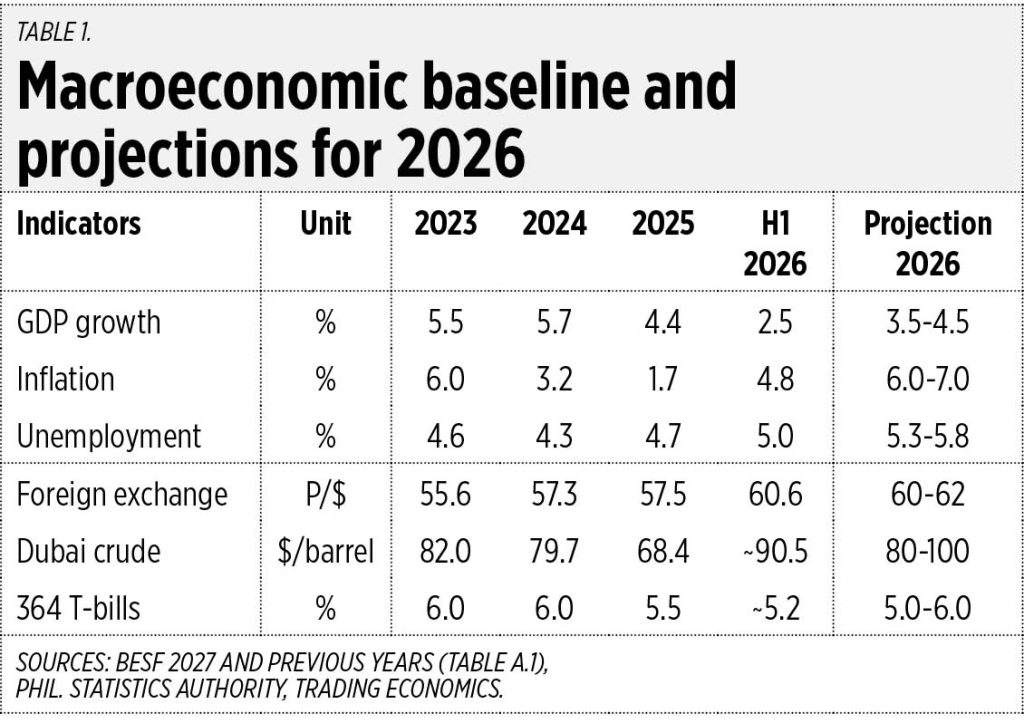
- •De feitelijke cijfers van 2023 tot en met de eerste helft van 2026 tonen een vertraging van de bbp-groei van 5.5% naar 2.5%, een werkloosheid van 5% en een verzwakking van de peso tot boven P60 per dollar.
- •Het begrotingstekort bedroeg de afgelopen drie jaar gemiddeld P1.5 trillion per jaar en wordt voor 2026-2029 geraamd op circa P1.7 trillion per jaar, terwijl de rentebetalingen naar verwachting bijna verdubbelen van P628 billion in 2023 tot P1.237 trillion in 2028.
- •Oplas bepleit een expliciet programma om het tekort onder P1.5 trillion per jaar te brengen en grootschalige privatisering, waaronder hydro-elektrische centrales in Mindanao en de 636 hectare grond van NAIA, die volgens hem op termijn ten minste P6 trillion kan opleveren; volgens hem kan de uitstaande overheidsschuld van P19.1-trillion niet alleen via belastingen worden afgebouwd.
Last week, the Department of Budget and Management (DBM) released the various 2027 budget documents like the National Expenditure Program (NEP) and Budget of Expenditures and Sources of Financing (BESF).
The BESF is a thick document — print copy is nearly two inches thick because it gives three years of data on previous year (actual), current year (programmed) and next year (proposed) of so many agencies, national and local, including government corporations, state universities, PPP projects, etc.
The first table of BESF is macroeconomic parameters of the budget — assumptions and projections before the projected revenues and proposed expenditures are made. In private business, entrepreneurs decide whether to expand, by how much, or not expand, based on the projected macroeconomic environment plus the foreseen industry situation. Business expansion means more job creation, more taxes to the government and so on.
For the government, bad or unrealistic growth projections mean it may assume high revenues from high growth, so it prepared and submitted high expenditures to Congress. If growth is much lower than projected, then revenues will be lower and the budget deficit will be higher than projected because the expenditures and appropriations are somehow fixed and legislated already.
Here is a review of actual numbers from 2023 to the first half of 2026. GDP growth has been slowing from 5.5% to 2.5%, inflation is fluctuating, unemployment has marginally increased to 5%, the peso has depreciated to “senior citizen” level of P60+, Dubai oil price of course has increased, while the 364-day Treasury bill has mildly decreased ( see Table 1 ).
This week, the House of Representatives’ economic think tank Congressional Policy and Budget Research Department (CPBRD) published a series of papers, one of which is “Philippine Economy Macroeconomic Perspectives: Inputs to the Analysis of the President’s Budget for FY 2027,” Budget Briefer No. 1, 2026. CPBRD’s old name was Congressional Planning and Budget Office (CPBO) where I worked from 1991-1999.
The paper summarized GDP growth and inflation projections for 2026 and 2027 by four multilaterals — ADB, WB, IMF and AMRO — then their own projections. I added in the table the projections and assumptions of the Development Budget Coordination Committee (DBCC) composed of the DBM, DoF, DEPDev and the Office of the President via the Office of the Executive Secretary.
I also asked the chief economists of several banks — BPI’s Jun Neri, China Banking Corp.’s Domini Velasquez and Sunlife’s Patrick Ella, for their GDP and inflation projections.
The DBCC naturally has the highest and most optimistic projections — growth of 3.5-4.5% for a median of 4% in 2026, and 5-6% for a median of 5.5% in 2027. CPBRD has the least optimistic projection of 1.9-3.2% for a median of 2.6% in 2026. I asked CPBRD Director-General Jun Miral for their 2027 predictions, and he said they see high volatility after Q4 2026 and decided to withhold releasing their projection next year.
I am also surprised at BPI’s low growth projections in both years. Jun Neri said they have both upside and downside scenarios but I did not ask for these anymore. Chinabank’s Domini and Sunlife’s Patrick have a more balanced view I think, and I go along with their projections ( see Table 2 ).
Now the fiscal situation. The budget deficit average in the last three years was P1.5 trillion/year, projected to rise to around P1.7 trillion/year from 2026-2029.
The more notable item is the consistent high rise of interest payments — from P628 billion in 2023 doubling to P1.237 trillion in 2028 or just five years. The projected interest payment this year of P996 billion implies an average of P2.7 billion/day (see Table 3).
There should be a drastic spending cut somewhere, a deliberate and explicit program to reduce the deficit below P1.5 trillion/year. Plus privatization of some government assets and corporations, like the big hydropower plants in Mindanao.
There is no way that the P19.1-trillion outstanding public debt can be repaid or even be significantly reduced by taxation alone. There should be large-scale privatization. I wish to see that the current land of NAIA, some 636 hectares, will be privatized someday to generate at least P6 trillion 15 years from now.
In the coming weeks I will analyze the budget of big agencies and projects, whether they are successful in improving the productivity of our people and businesses or not.
Bienvenido S. Oplas, Jr. is the president of Bienvenido S. Oplas, Jr. Research Consultancy Services, and Minimal Government Thinkers. He is an international fellow of the Tholos Foundation.
minimalgovernment @gmail.com

