La fracture entre le pôle semi-conducteurs et le pôle grand public de Samsung s’accentue, du conflit salarial aux négociations syndicales
Points clés
- •Le syndicat Samsung Electronics Company Union, centré sur DX, réclame une compensation équivalente à 1 000 actions Samsung par salarié DX.
- •Le syndicat estime que cette demande coûterait à Samsung plus de 12 000 milliards de wons, soit 8,68 milliards de dollars.
- •Samsung juge l’écart de rémunération justifié par la performance, en soulignant que DS a enregistré un bénéfice opérationnel record au premier semestre alors que celui de DX a fortement reculé.
- •Samsung Electronics Labor Union, dominé par les salariés de DS, prévoit de négocier séparément pour les discussions salariales de 2027 au lieu de former un groupe de négociation commun.
- •Un professeur de Séoul a averti qu’un ressentiment prolongé face à des salaires inégaux pourrait accroître le risque de grève et le turnover.
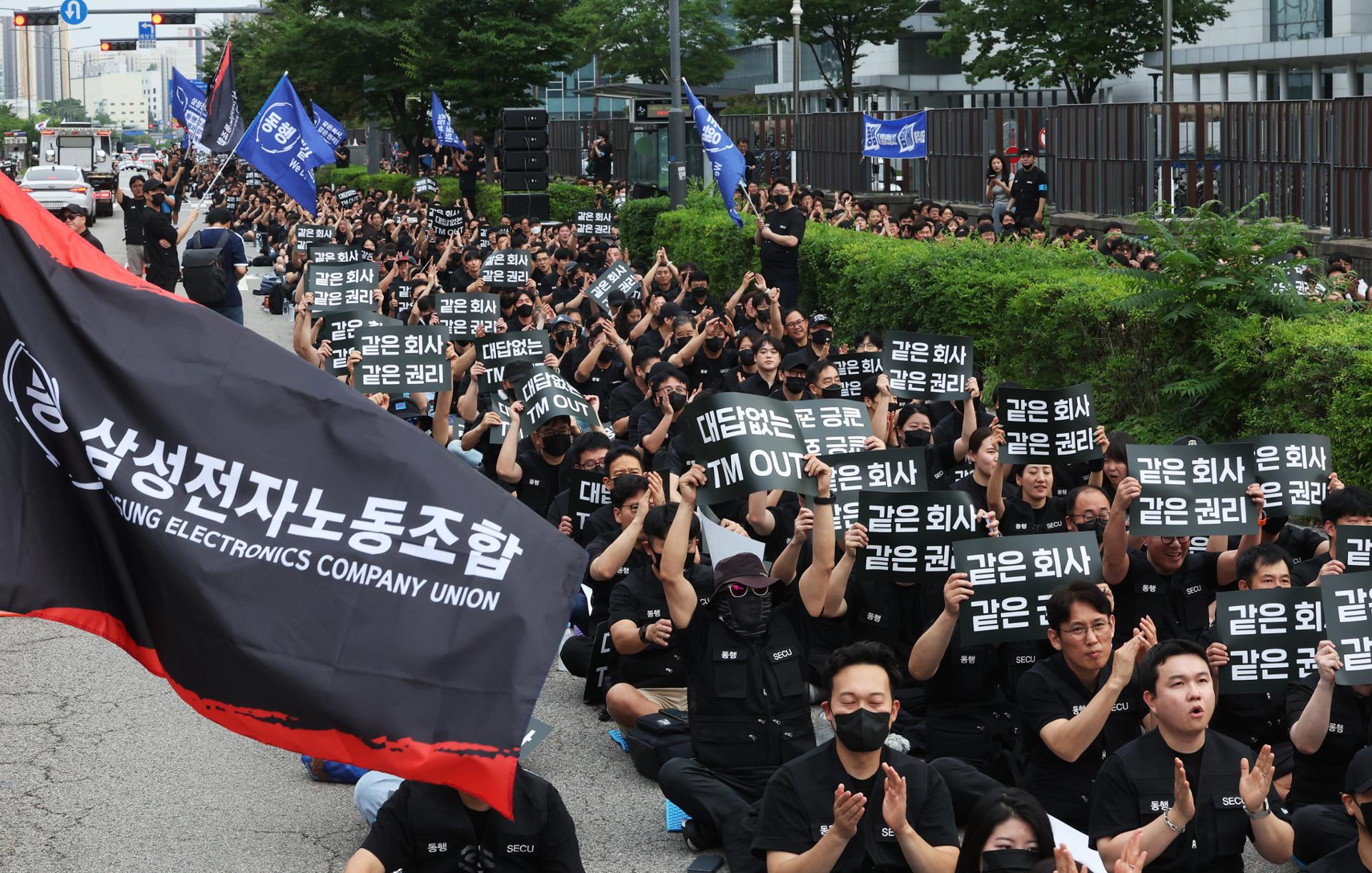
Samsung Electronics’ widening divide between its semiconductor-focused Device Solutions (DS) division and its finished-products-focused Device eXperience (DX) division is spilling over into next year's labor negotiations, following a dispute over performance pay that is testing the company's model of operating the two units as largely separate businesses.
The company's DS unit, which makes memory chips and other semiconductors, has benefited from a surge in memory prices — an industry-wide rally driven largely by demand from data centers built to run artificial intelligence — while the DX unit, which sells smartphones, televisions and appliances, has faced higher component costs and weakening profitability. Samsung is one of only three dominant global memory suppliers, alongside SK hynix of South Korea and Micron of the United States, and its chips business has long been a major driver of the company's earnings.
Unions take to the streets
Members of the National Samsung Electronics Union held a rally at the company's plant in Suwon, Gyeonggi Province, on July 16, protesting a wage agreement that mostly benefits employees of the chipmaking DS division. Labor activism is relatively new at the company: Samsung maintained a decades-old "no-union" policy until formally abandoning it in 2020, and the National Samsung Electronics Union went on to stage the first strike in the company's more than 50-year history in July 2024, during an earlier round of wage negotiations.
On Friday, the Samsung Electronics Company Union, which is mostly comprised of employees in the DX division, is holding a rally near the company's office in Gangnam District, Seoul, with about 3,000 participants expected.
The union is seeking additional compensation equivalent to 1,000 Samsung Electronics shares per DX employee, saying the pay gap with DS workers has become excessive. Meeting the demand is estimated to cost the company more than 12 trillion won ($8.68 billion).
The dispute follows a wage agreement reached in May that granted DX employees about 6 million won each in treasury shares, while industry reports have estimated that DS employees could receive bonuses of up to about 600 million won each.
The union argues that DX workers were sidelined in the latest wage negotiations, saying they are being penalized for a business structure over which they have little control. DS earns more when memory prices rise, but DX’s costs rise because it buys those components for Samsung’s consumer devices.
Samsung defends performance-based pay
Samsung, however, has defended the pay gap on the grounds that the two divisions have delivered sharply different financial results. DX posted an operating profit of 2.1 trillion won in the first half, down from 8 trillion won a year earlier, while the DS division saw a record operating profit of 142.9 trillion won. Against that backdrop, the union’s compensation demand of more than 12 trillion won is equivalent to less than one-tenth of the DS division’s first-half operating profit.
Roh Tae-moon, head of the DX division, reiterated the company’s performance-based compensation principle at an employee briefing on Wednesday, saying rewards should be based on business performance. His remarks effectively rejected calls for additional compensation for DX employees.
Samsung Electronics headquarters in Suwon, Gyeonggi Province / Korea Times photo by Park Ji-yeon
Rift extends to 2027 wage talks
The dispute is now spilling into next year's labor negotiations. Samsung Electronics Labor Union, the company's largest union, which is dominated by DS employees, said it would not form a joint bargaining group with other unions for the 2027 wage talks and plans to negotiate separately with the company.
The move could further institutionalize the divide between the two businesses, which have operated under separate financial and performance systems since Samsung Electronics introduced its division structure in 2009.
Kim Dae-jong, a business professor at Sejong University, said Samsung should ultimately integrate compensation systems across the two divisions. He noted that pay differences based solely on business assignments could undermine perceptions of fairness, as employees can be assigned to different divisions regardless of their academic or technical backgrounds.
“In the long term, I believe pay across the two divisions should be integrated,” Kim said. “The most important thing for a company is fairness … The employees may find unequal treatment more frustrating than simply earning less.”
Kim also noted that the two divisions have supported each other through different stages of the semiconductor cycle, with DX helping sustain the semiconductor business during periods of losses in the past years. He pointed out that the semiconductor industry’s cyclical nature could eventually reverse the current earnings gap.
“The semiconductor business is cyclical, so that it could enter a downturn after about five years,” he said. “I don't think the company should allow conflicts between the unions to deepen further.”
Kim warned that prolonged grievances could lead to large-scale strikes and higher employee turnover.
“If this discontent continues to build, it will naturally explode into something like a large-scale strike,” he said. “Employee turnover can also increase, with DX union members moving to competing companies such as SK hynix.”

