Le PDG de Delio, Jeong Sang-ho, condamné à 15 ans de prison dans une affaire de fraude crypto en Corée du Sud
Points clés
- •Le tribunal du district sud de Séoul a reconnu Jeong Sang-ho coupable d’avoir détourné des actifs de clients et utilisé de faux documents d’enregistrement pour obtenir une licence de négociation d’actifs virtuels.
- •Le tribunal l’a condamné à 15 ans de prison, en deçà des 20 ans demandés par les procureurs au titre de la loi sud-coréenne sur les sanctions aggravées.
- •Le juge a acquitté Jeong d’une accusation plus large portant sur 250 milliards de won après avoir estimé que les preuves obtenues auprès de l’hébergeur de serveurs Gabia avaient été recueillies illégalement.
- •Delio avait suspendu les retraits des clients en juin 2023 après des pertes liées à l’effondrement de FTX, puis est entré dans des procédures d’insolvabilité et de faillite.
- •La Corée du Sud a récemment renforcé sa surveillance des cryptoactifs, notamment avec de nouvelles règles sur les transferts vers l’étranger et des pouvoirs de contrôle élargis dans le cadre de la Virtual Asset User Protection Act.
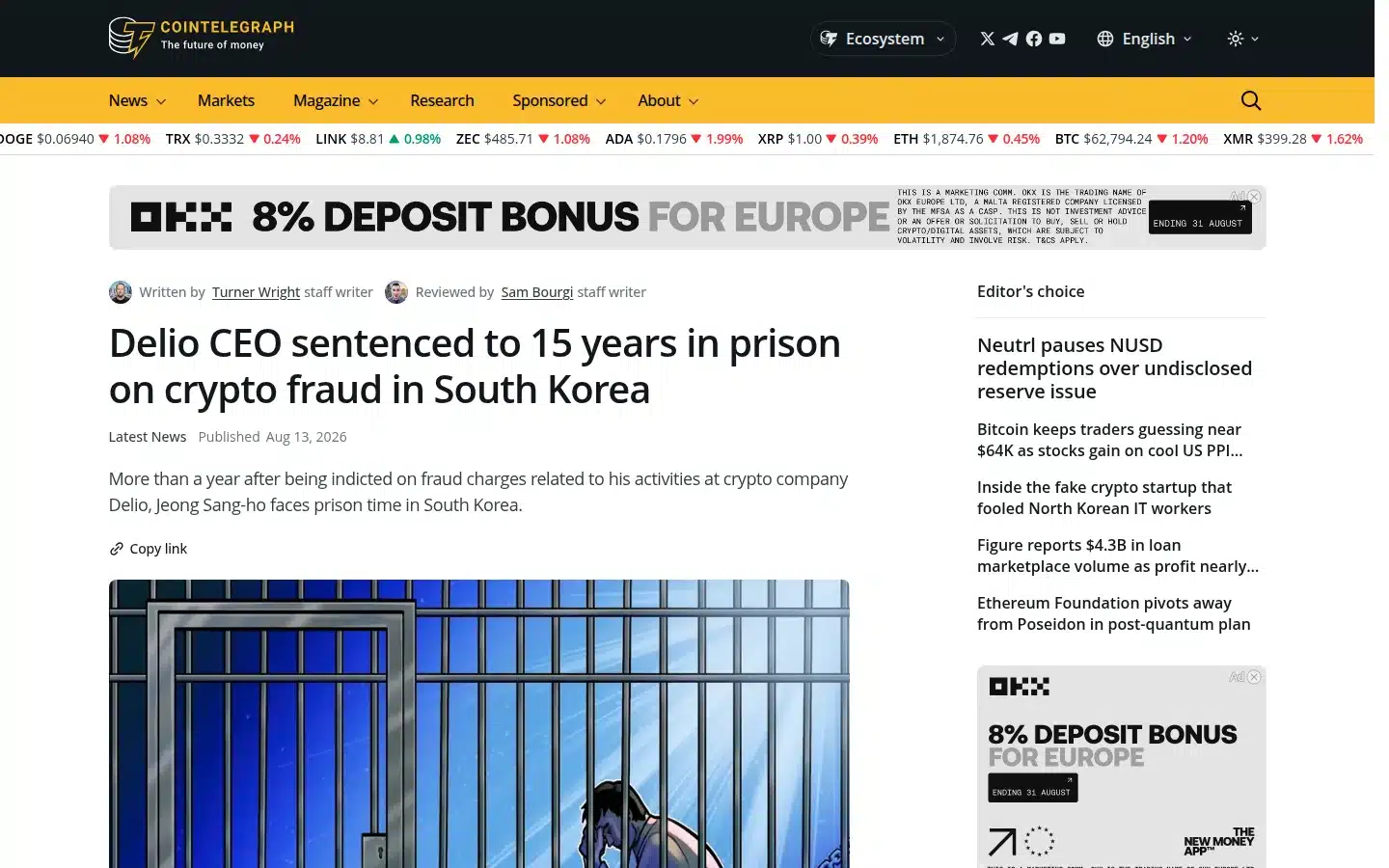
South Korea’s crypto enforcement drive has led to another major prison sentence. On Aug. 13, the Seoul Southern District Court sentenced Delio CEO Jeong Sang-ho to 15 years in prison for defrauding customers of roughly 70 billion won, or about $49.2 million, in virtual assets, according to News.Bitcoin.com and The Block.
Delio operated as a digital asset bank that offered high interest on customer deposits and was among the country’s largest crypto lenders before its collapse. The company froze customer withdrawals in June 2023 after suffering losses tied to the 2022 FTX collapse, according to Cointelegraph. Its failure echoed the 2022 downfalls of offshore lenders such as Celsius and BlockFi, which had similarly offered yield on deposited crypto before freezing withdrawals. News.Bitcoin.com reported that Delio was declared insolvent in November 2024, triggering liquidation proceedings for creditors. Cointelegraph later reported that the company officially declared bankruptcy, which led to Jeong’s indictment in April 2025.
The Block reported that Delio had promoted high returns on crypto deposits before its collapse.
The verdict
Prosecutors initially sought a 20-year prison sentence under South Korea’s Act on Aggravated Punishment, a statute that prescribes heavier penalties for specific economic crimes such as large-scale fraud, according to crypto.news. The court instead imposed a 15-year sentence after convicting Jeong of embezzling customer assets and submitting false registration documents. Cointelegraph reported that the judge found Jeong had falsely obtained a virtual asset trading license and defrauded victims of about 70 billion won, or $49.3 million, in virtual assets. As with all South Korean criminal verdicts, the ruling can be appealed.
What the court said
“The defendant committed the crime of defrauding a large sum from numerous victims, and given the methods and means employed, and the scale of the damage, the crime is extremely grave.”
“The defendant committed the crime of defrauding a large sum from numerous victims, and given the methods and means employed, and the scale of the damage, the crime is extremely grave.”
The court also said: “Numerous victims have suffered significant economic damage due to this case, which is difficult to recover.”
Acquittal on the larger charge
The 15-year sentence covered a narrower set of charges than prosecutors originally pursued. The judge acquitted Jeong on a primary charge involving 250 billion won, or $175.6 million, from about 2,800 people, according to The Block. Decrypt reported that the larger charge was voided because evidence obtained from server host Gabia was ruled unlawful. Jeong was instead convicted on fallback charges involving roughly 1,100 victims and 70 billion won.
Decrypt also reported that Jeong was convicted of registering as a virtual asset service provider using a falsified accounting report.
The acquittal was a technical ruling rather than a finding that the larger allegation was false. Police had obtained server data from Gabia, and the court concluded that the search and seizure were unlawful. That left the fallback charges that supported the 15-year sentence.
Wider South Korean regulatory pressure
The case comes amid wider scrutiny of South Korea’s crypto sector and follows other high-profile legal troubles, including those involving Terraform Labs co-founder Do Kwon, whose project’s May 2022 Terra-Luna collapse erased tens of billions of dollars in market value, according to Cointelegraph.
South Korea has since built out a dedicated legal framework for the sector. Since March 2021, virtual asset service providers have been required to register with the Korea Financial Intelligence Unit under the country’s anti-money-laundering law, and the Virtual Asset User Protection Act, the country’s first comprehensive crypto statute, took effect in July 2024 with expanded powers to police unfair trading and protect customer assets.
It also comes as South Korea tightens controls on crypto transfers abroad. On Aug. 11, the country’s Cabinet approved amendments requiring stricter anti-money-laundering monitoring for crypto transfers to overseas platforms and private wallets, according to CoinCentral. Transfers of 10 million won or more will require mandatory reporting to the Korea Financial Intelligence Unit. The 1 million won threshold for the crypto Travel Rule is being removed, which means sender and recipient data will be required for transfers of all sizes. The new overseas-transfer rules will take effect six months after promulgation.
The changes follow restrictions on foreign exchange apps including Bybit and OKX from new installations on South Korea’s Google Play Store. Those app-store restrictions mean certain offshore exchange apps can no longer be newly installed by local users. Together with the transfer-reporting rules, the measures are intended to make it harder for South Korean investors to move crypto to platforms outside the country’s regulatory perimeter.
Bottom line
For Delio customers, the sentence may do little to recover lost assets. As the court noted, “Numerous victims have suffered significant economic damage due to this case, which is difficult to recover.” Even so, the ruling signals that South Korean courts are prepared to impose lengthy prison terms on executives whose platforms are tied to large-scale investor losses.

