Las acciones de Nvidia forman un doble techo mientras se profundiza la venta masiva de chips
Puntos clave
- •Las acciones de Nvidia parecen haber formado un pequeño doble techo en el gráfico de cuatro horas después de caer por debajo de la línea de cuello cerca de $198.
- •Las acciones de semiconductores y los ETFs relacionados se han vendido ampliamente, con fabricantes de chips de Corea del Sur y Japón cayendo con fuerza desde sus máximos de este año.
- •Los reportes indicaron que Nvidia respalda el proyecto de centro de datos de OpenAI en Ohio, lo que suma preocupaciones sobre financiamiento circular en el sector de IA.
- •Los principales clientes de Nvidia planean gastar más de $720 mil millones este año, y sus próximas actualizaciones de resultados serán observadas por sus guías de gasto de capital.
- •Los indicadores técnicos muestran un debilitamiento del impulso, con la acción por debajo de su media móvil de 50 períodos y un primer objetivo bajista cerca de $190.
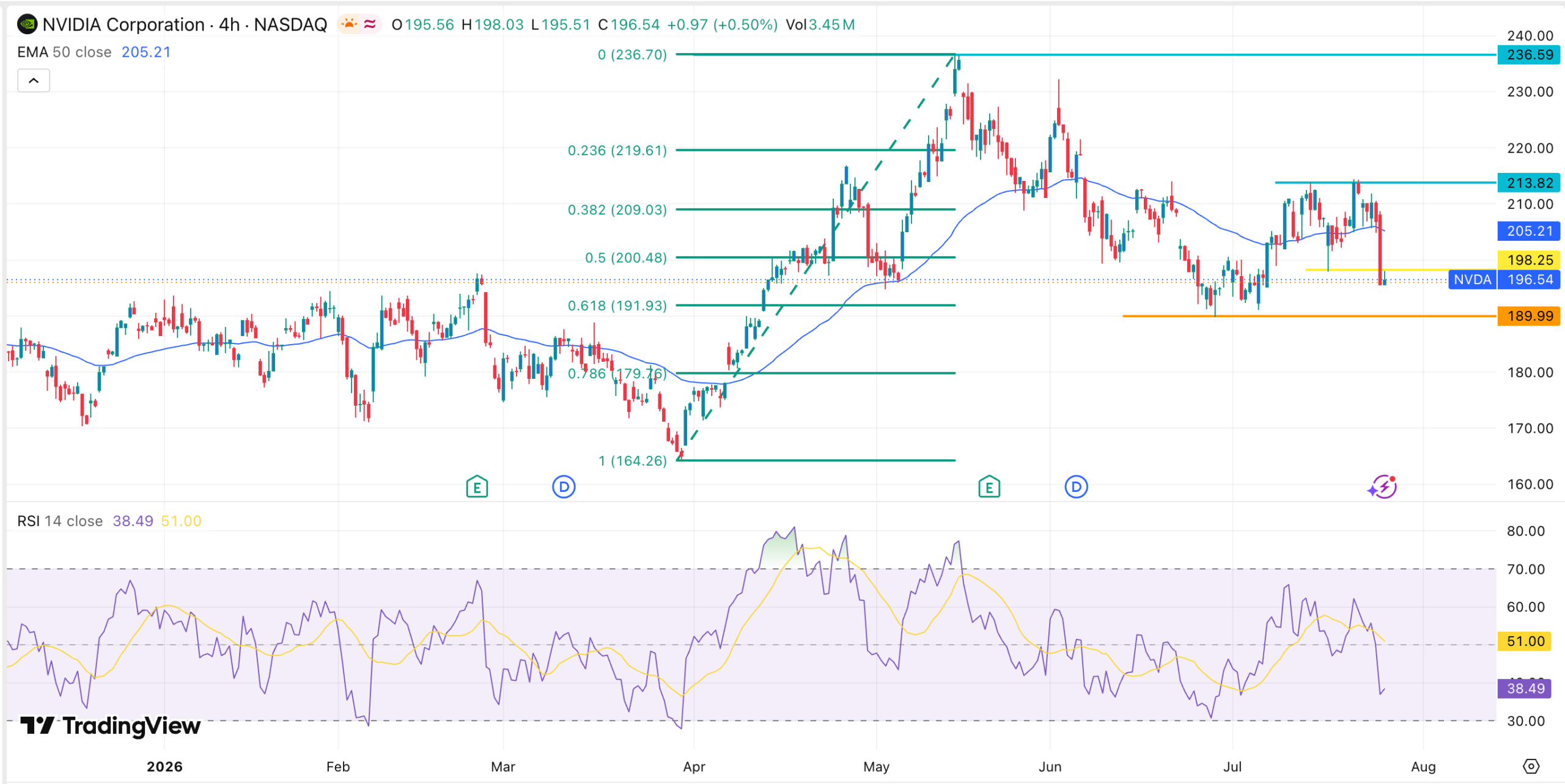
Nvidia stock formed a possible double-top pattern on the four-hour chart as semiconductor shares continued to slide and investors cut exposure to artificial intelligence-related trades.
The pullback accelerated after Nvidia fell sharply from its record high of $236.60 toward $196. The move came as traders reduced positions in semiconductor and AI infrastructure companies, while reports about Nvidia’s possible role in financing a large OpenAI data center added to concerns about circular funding across the chip sector.
That shift matters because Nvidia has been one of the clearest beneficiaries of the AI spending boom, and weakness in its stock has spilled into chipmakers, ETFs, and some of the companies tied to its ecosystem. Focus is now shifting to earnings from Nvidia’s largest customers, whose capital expenditure guidance could shape the next move in NVDA stock.
Nvidia Stock Drops as Chip Rout Continues
NVDA stock is in a steep decline as investors sell semiconductor and memory companies that helped drive US, South Korean, and Japanese markets higher earlier this year.
In South Korea, companies such as Samsung and SK Hynix have fallen more than 40% from their highest levels this year. In Japan, companies including Kioxia and Advantest have also dropped sharply over the same period.
Exchange-traded funds tied to semiconductors have also weakened. The iShares PHLX SOX Semiconductor Sector Index Fund (SOXX) has fallen to $494 from an all-time high of $655. The VanEck Semiconductor ETF (SMH) has declined from $672 to $540.
Several factors are behind the sell-off. One concern is the ongoing circular financing cycle, in which Nvidia invests in companies that later become its customers. Nvidia has invested in companies including OpenAI, CoreWeave, Nebius, and IREN.
This week, reports said Nvidia is backing OpenAI’s Ohio data center in a project worth more than $250 billion. Nvidia has also invested $30 billion in OpenAI and committed $10 billion to Anthropic, the creator of Claude.
At the same time, investors are watching the growing market share of Chinese AI models such as Qwen and Kimi. Moonshot recently released Kimi K3, which has become the biggest AI model. The concern is that some companies, including in the United States, could begin using Chinese models that are equally competitive.
Nvidia stock also came under pressure as some of its major investments weakened. Corning, in which Nvidia invested $3.2 billion, has fallen 56% from its all-time high. Other holdings such as IREN, CoreWeave, and Nebius have also dropped.
Big Tech Earnings in Focus
Nvidia stock has fallen sharply over the past few weeks as investors remain concerned about the profitability of its customers.
Its largest clients, including Microsoft, Amazon, Alphabet, and Meta Platforms, plan to spend more than $720 billion this year. By 2030, they are expected to spend more than $5.3 trillion on capital expenditures. Much of that spending will be financed through debt and equity.
That has raised the risk that these companies may eventually slow capital spending. Google stock fell last week after the company increased its capital expenditure forecast to $205 billion.
As a result, Nvidia stock is likely to remain in focus as major customers report earnings. Microsoft, Meta, Amazon, and Apple are set to release results this week, and their guidance will provide more detail on capital expenditure plans. Those updates will be closely watched because Nvidia’s revenue outlook remains tied to how aggressively cloud and platform companies keep buying AI chips and related infrastructure.
NVDA Stock Price Technical Analysis
On the four-hour chart, Nvidia stock fell from $236.60 toward $196. NVDA appears to have formed a small double-top pattern around its July 15 and July 22 highs.
A double top consists of two peaks near the same level. Traders generally view the formation as bearish after price closes below the neckline.
Nvidia stock moved below the neckline near $198, reinforcing the short-term bearish setup. The stock also dropped below the 50% Fibonacci retracement level and traded under its 50-period exponential moving average.
The Relative Strength Index fell below the neutral 50 level, indicating weakening momentum, though not yet confirming oversold conditions.
The first downside target is near $190, which marked a previous June support area and aligns with the 61.8% Fibonacci retracement. A sustained break below $190 could expose deeper support, with traders then watching the previous recovery base.
The pattern could still be invalidated. A move back above $198 would reduce immediate selling pressure, while a sustained close above $213 would invalidate the double-top setup.
Big Tech earnings remain the next major catalyst. Stronger cloud growth and continued capital spending could support NVDA, while weaker spending guidance could reinforce the bearish technical structure.

