Las acciones de Microsoft suben tras superar las estimaciones de ingresos en la nube y de IA
Puntos clave
- •Los ingresos del cuarto trimestre fiscal de Microsoft crecieron 18% hasta $90 billion, con utilidad operativa de $40.6 billion, apoyados por la fortaleza de la nube y una ganancia de valuación a mercado de $3.2 billion sobre su inversión en Anthropic.
- •Varios analistas de Wall Street elevaron sus objetivos de precio para Microsoft tras los resultados, con metas que van de $515 en BMO a $586 en Guggenheim, lo que refleja un sesgo alcista sobre la valuación de la acción.
- •Los asientos pagos de Microsoft 365 Copilot se duplicaron respecto al trimestre anterior hasta 30 million, lo que indica una mayor disposición empresarial a adoptar funciones de productividad con IA generativa, aunque persisten dudas sobre la monetización por asiento.
- •Microsoft planea gastar aproximadamente $175 billion en gastos de capital este año, ampliando los plazos de arrendamiento y la capacidad de centros de datos para entrenamiento e inferencia de IA junto con compañías como Tesla y Google.
- •Los ingresos de personal computing cayeron 4% hasta $12.9 billion, mientras las divisiones Windows OEM y Xbox enfrentaron presión por el alza de los precios de los chips de memoria, marcando el principal punto débil de un trimestre sólido.
Microsoft stock rose in premarket trading after the company reported stronger fiscal fourth-quarter earnings, with shares of MSFT gaining about 8% to $423 and some premarket quotes approaching $425. The move left the stock about 22% above its year-to-date low.
The advance followed stronger revenue, earnings and cloud growth. Investors now face the question of whether the move will develop into a sustained recovery or remain a post-earnings relief rally.
Analysts Keep Bullish Targets on Microsoft
Top Wall Street analysts remain constructive on MSFT, saying the stock looks highly undervalued after its sharp decline over the past few months. In a note dated July 30, Keith Bachman of BMO maintained an outperform rating and raised his target from $500 to $515.
Other analysts also lifted their targets. Piper Sandler's Billy Fitzsimmons increased his target from $540 to $550. Citizens and Guggenheim analysts have targets of $550 and $586, respectively.
The revisions came as Microsoft reported strong financial results. Revenue rose 18% in the fiscal fourth quarter to $90 billion, while operating income increased 18% to $40.6 billion.
Profitability also remained strong, reaching $35.8 billion. One factor behind the increase was the value of Microsoft's Anthropic investment, which rose by $3.2 billion in the quarter as the company's valuation reached $900 billion. Microsoft is one of several hyperscalers that have taken equity stakes in leading AI model developers, and the mark-to-market gain on that position flowed through to reported earnings.
By segment, Microsoft Cloud revenue increased 27% to $59.3 billion, while productivity and business processes rose 14% to $37.8 billion. Intelligent cloud revenue increased 32% to $39.3 billion, and remaining performance obligations climbed to $678 billion. That backlog represents contracted revenue not yet recognized, giving investors multi-quarter visibility into Azure and other enterprise commitments.
The main weak spot was personal computing, where revenue fell 4% to $12.9 billion. That decline was driven mainly by the Windows OEM and Xbox segments, which are facing pressure as memory chip prices rise.
Microsoft Copilot Adoption Continues to Expand
Microsoft stock also gained as the company reported further growth in its Copilot business. Management said paid Microsoft 365 Copilot seats increased to 30 million from 15 million in the previous quarter. The year-over-year doubling provides an early data point on enterprise willingness to pay a per-seat premium for generative-AI productivity features, though monetization depth per seat remains an open question for investors.
Even so, Copilot's market share remains small compared with other products, despite the company's ongoing investment in the service.
The stock also reacted to changes in Microsoft's capital expenditure plans. The company said capex reached $41 billion in the fourth quarter and that it plans to adjust spending by changing lease terms from 15 years to 25 years. Microsoft now expects to spend about $175 billion this year. Other companies, including Tesla and Google, have also increased capex. The industry-wide buildout is aimed at expanding data-center capacity for AI training and inference workloads.
Microsoft's valuation remains below historical levels. Its forward price-to-earnings ratio is 20, compared with a five-year average of 30 and a sector median of 22.
The Rule of 40 also suggests the stock remains inexpensive relative to its growth and profitability. With revenue growth of 18% and an operating margin of 45%, the measure stands at 63%. Using net income margin of 38%, it comes to 56%.
Those valuation measures help explain why Microsoft has continued to increase share buybacks. The company spent $10 billion on buybacks and dividends in the fourth quarter and $43 billion in the last fiscal year.
MSFT Stock Price Technical Analysis
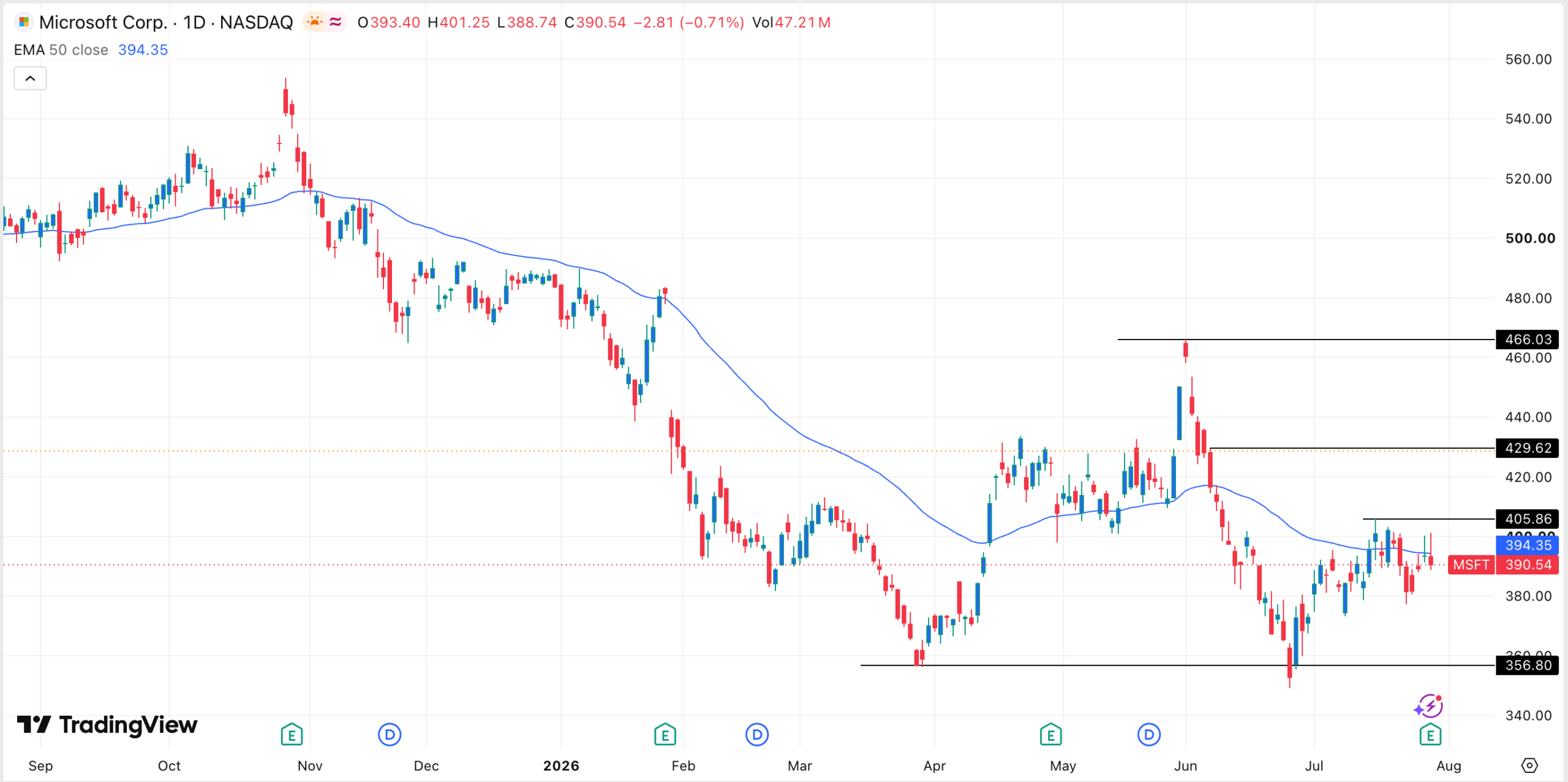
The daily chart showed Microsoft stock finding support near $356 in March and June. Those lows formed a possible double-bottom pattern.
However, the pattern's neckline sits near $466 on the supplied chart, which means the double bottom remains unconfirmed while MSFT trades near $425.
Microsoft stock has moved above its 50-day exponential moving average and short-term resistance near $405. The breakout improved momentum and shifted attention toward $425 and $466.
A sustained close above $466 would confirm the larger double-bottom structure and could open the way to higher resistance from the previous trading range.
The sharp post-earnings gap also increases the chance of short-term profit-taking.
A move below $405 would weaken the immediate breakout. A drop below $388 would invalidate the short-term bullish setup and bring the $356 support zone back into focus.
Microsoft's earnings support a stronger fundamental outlook. Further gains will depend on whether the stock can hold its post-earnings breakout and move toward $466.

