USD/JPY Suffers Major Bearish Reversal Below 200-Day Moving Average as Yen Strength Accelerates
Key Takeaways
- •USD/JPY fell 0.91% on 2 September 2026 and a further 1.35% on 3 September, with the pattern resembling FX intervention but no official confirmation from Japan or the US.
- •US Treasury Secretary Scott Bessent expressed support on 1 September 2026 for decisive Japanese action to address yen weakness in talks with BoJ Governor Ueda at the G-20 meeting.
- •BoJ board member Hajime Takata said on 2 September 2026 that policymakers should consider rate hikes larger than or in addition to the conventional 25-basis-point increase.
- •The yen's decline to the 164 handle on 23 July 2026 was its weakest in about 40 years, prompting Japan's solo intervention on 30 July and a joint US-Japan intervention on 31 July, their first in roughly 28 years.
- •The drop sent USD/JPY below its 200-day moving average; failure to reclaim the 158.04/50 resistance zone could open intermediate supports at 155.03 and 153.84, while an hourly close above 158.50 would invalidate the bearish scenario.
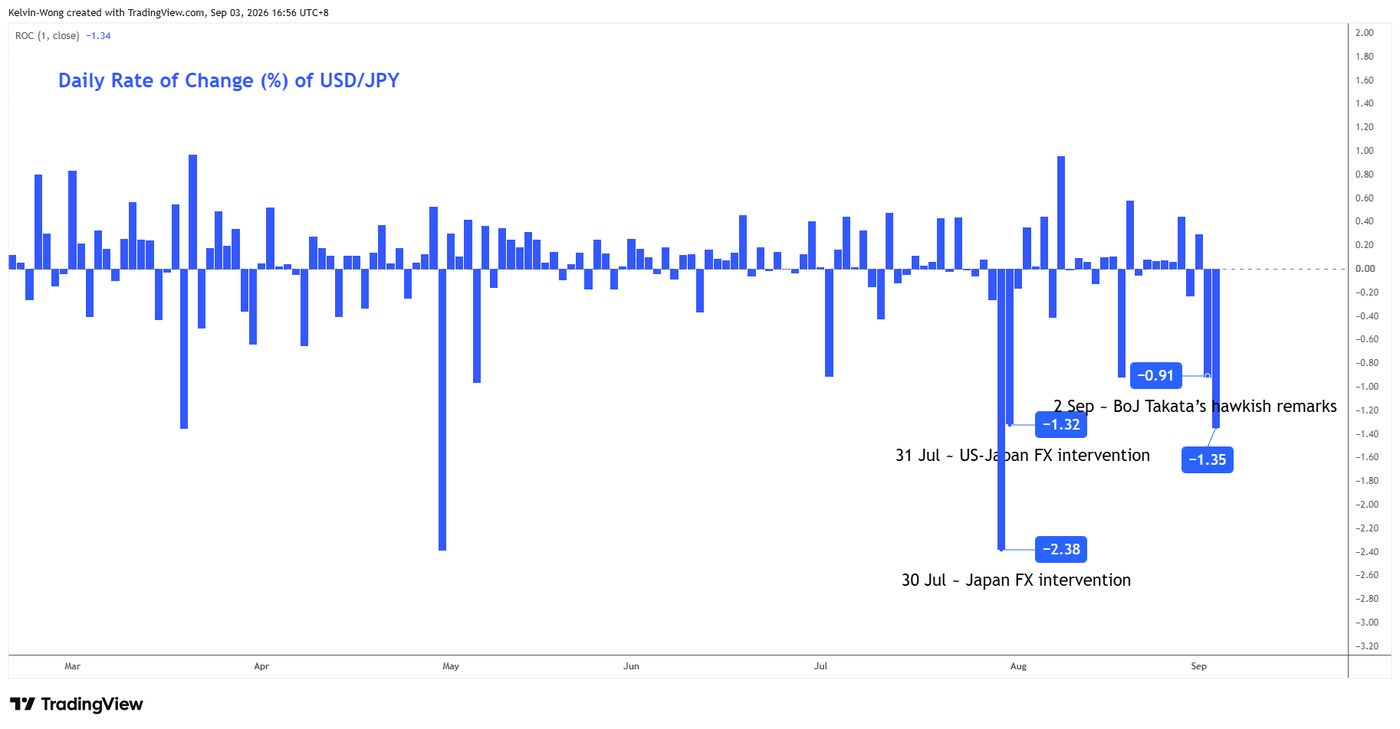
In the past 40 hours, the Japanese yen has strengthened dramatically against the US dollar. The move began on Wednesday, 2 September 2026, when USD/JPY declined 0.91%, and extended further on Wednesday, 3 September 2026, with an additional loss of 1.35% at the time of writing.
The current decline is almost on par with the 1.32% daily drop recorded on 31 July 2026, when Japan and the US confirmed their first joint foreign exchange intervention in roughly 28 years — a scale of coordinated action not seen since the late 1990s. That joint action followed the Japanese government's sole intervention a day earlier, on 30 July 2026, aimed at halting the steep pace of yen weakening, during which USD/JPY had soared to the 164 handle on 23 July 2026 — its highest level in about 40 years, surpassing even the levels that preceded Japan's intervention episodes of 2022.
The yen's prolonged weakness in recent years has been rooted in the wide interest-rate gap between the Bank of Japan's ultra-loose monetary policy stance and the much higher policy rates maintained by the Federal Reserve, a differential that also fueled large carry-trade positioning in which investors borrowed cheaply in yen to fund higher-yielding assets elsewhere. Sharp yen rallies, such as the current one, tend to squeeze those positions, which can amplify the speed of the move.
Today's swift decline in USD/JPY has the characteristics of FX intervention, with no clear catalyst in relevant economic data releases. However, as of yet there have been no official press releases from Japan or the US confirming any form of intervention, and no "according to sources" reporting from media outlets.
What we know so far
Three fundamental developments have reinforced the current bout of yen strength:
US Treasury Secretary Scott Bessent's support for Japanese action. According to a readout released by the US Treasury Department on Tuesday, 1 September 2026, Bessent expressed support for decisive Japanese action to address yen weakness in a discussion with Bank of Japan (BoJ) Governor Ueda during the G-20 finance and central bank leaders meeting the previous weekend. This reduces the political constraint on further BoJ tightening and suggests Washington is increasingly comfortable with a stronger yen — a notable shift, as US administrations have historically pressed Tokyo on currency matters in trade discussions.
Hawkish comments from BoJ board member Hajime Takata. Speaking at a news conference on Wednesday, 2 September 2026, Takata said policymakers should consider options beyond the conventional 25-basis-point rate increase, including larger or consecutive hikes. While Takata remains one of the BoJ's most hawkish members, his comments increase the risk that the central bank accelerates its tightening cycle.
Renewed intervention risk. The speed of the yen's appreciation has placed traders on high alert for another round of intervention. Although there was no immediate confirmation of official yen buying, the threat of action creates increasingly asymmetric risk around the psychologically important 160.00 region.
Technical outlook: major uptrend damaged, bounce before a new drop
Today's swift bearish reaction in USD/JPY came immediately after a retest of key pullback resistance at around 160.30, a former major ascending trendline support dating from the 22 April 2025 low.
The decline has sent the pair below its key 200-day moving average — a widely watched long-term trend gauge — and erased all of its gains from the past month, since the 3 August 2026 low of 155.23.
The steep intraday decline has pushed the hourly RSI momentum indicator into oversold territory, though there is no clear bullish divergence at this juncture. USD/JPY may therefore form a potential minor dead cat bounce at near-term support of 156.32 toward near-term resistance of 157.30.
The key short-term pivotal resistance to watch is the 158.04/50 zone, which also coincides with the 200-day moving average. If this zone is not surpassed to the upside, the odds skew toward a new potential bearish impulsive down-move sequence, which could expose intermediate supports at 155.03 and 153.84 in the first step.
On the other hand, a clearance and an hourly close above 158.50 would invalidate the bearish scenario, triggering a squeeze up to retest the next intermediate resistance at 159.18/54, the 20-day moving average.
For markets, the near-term focus now falls on any official confirmation or denial of intervention from Tokyo or Washington, as well as upcoming BoJ communication for signals on the pace of further rate increases.
Opinions are the authors' and not necessarily those of OANDA Business Information & Services, Inc. or any of its affiliates, subsidiaries, officers, or directors. The provided publication is for informational and educational purposes only.
