WTI Oil Price Polymarket Odds Put $95 Threshold at 67.5%
Key Takeaways
- •A Polymarket snapshot at 00:50 UTC on September 28 priced the "↑$95" outcome for WTI crude at 67.5%, making the $95 threshold the market's leading result.
- •November WTI futures rose 1.87% to $94.14 a barrel and Brent crude gained 2.89% to $107.34 after Trump rejected an Iranian proposal linked to reopening the Strait of Hormuz.
- •Iranian Foreign Minister Abbas Araghchi had offered to reopen the strait and resume nuclear negotiations if US aggression ended and Iranian assets were released.
- •The Polymarket market on WTI's September price ceiling had recorded $8.43 million in total trading volume and carries an October 1, 2026 settlement date.
- •Reports indicated Trump expected US strikes on Iran to resume after the midterm elections, a scenario that could cause the market odds to shift in the opposite direction.
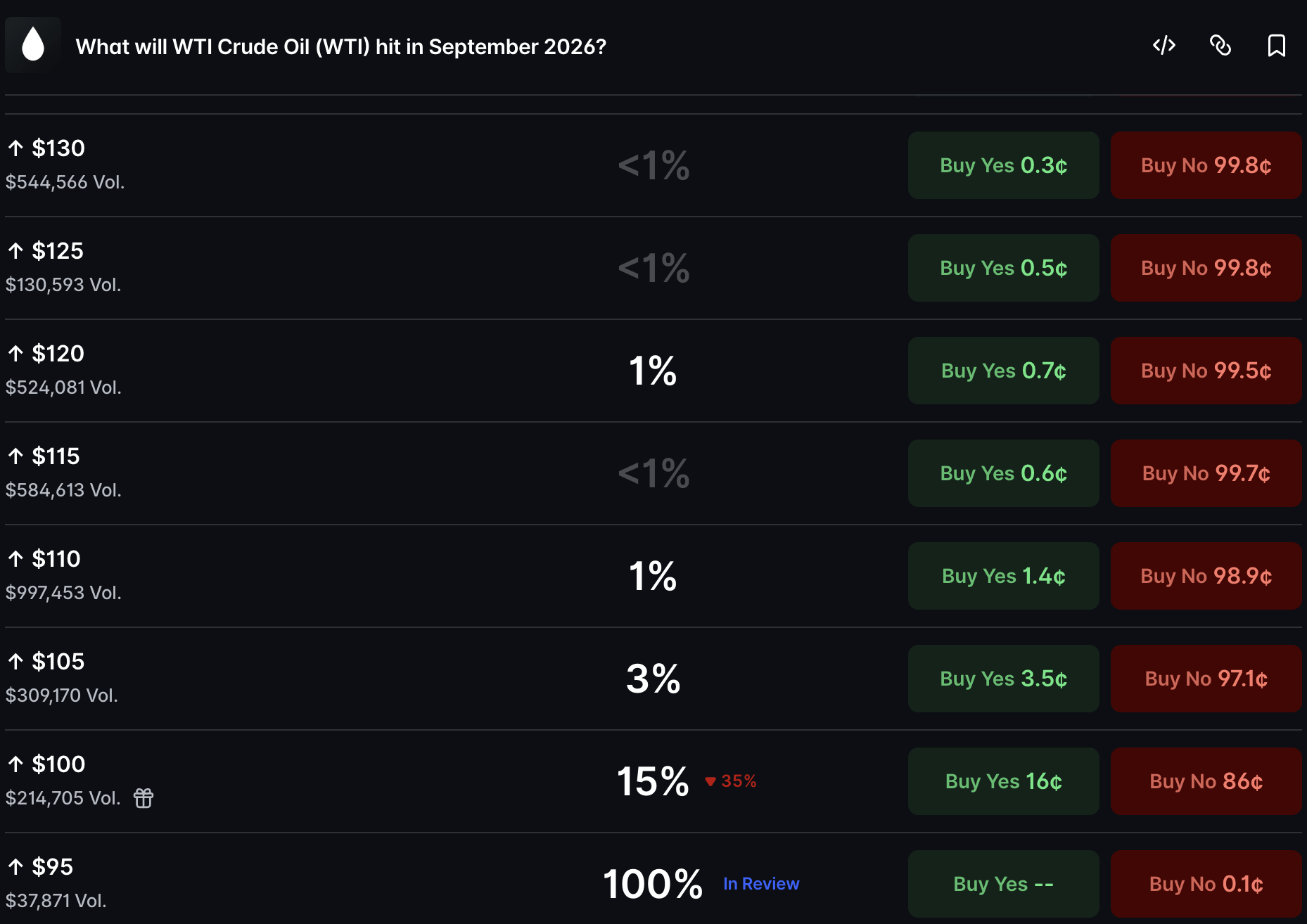
WTI crude futures moved toward $95 a barrel heading into Monday, September 28, after President Donald Trump rejected an Iranian proposal linked to reopening the Strait of Hormuz. Against that backdrop, Polymarket odds for WTI's September price ceiling showed the $95 threshold as the leading outcome.
At 00:50 UTC on September 28, the “↑$95” outcome was priced at 67.5% on Polymarket. The figure indicated that traders were assigning a relatively high probability to another move above the threshold, although it was not a guarantee or official forecast. The implied probability also fluctuated during trading hours before and after the recorded snapshot.
The market was attempting to quantify the impact of a live geopolitical development in real time, before the physical situation in the Gulf had been resolved. Polymarket was the source of the market data.
What the Polymarket snapshot shows
The market, titled “What will WTI Crude Oil (WTI) hit in September 2026?”, lists a series of price-threshold outcomes and has a settlement date of October 1, 2026 — three days after the snapshot. According to data compiled by Polymarket View, three outcomes were leading the market in the September 28 snapshot taken at 00:50 UTC.
By that point, the market had recorded $8.43 million in total trading volume. Trading during the preceding 24 hours amounted to $95,000, while available liquidity for additional positions stood at $1.39 million.
Polymarket prices represent the cost of a “YES” share. A share trading at 67.5 cents therefore implies that market participants collectively assign an approximately 67.5% probability to the relevant outcome. It is a market-implied probability rather than a certified prediction, and the price can change as traders buy or sell shares.
Polymarket is not buying this mornings Bloomberg claim that the Saudi East West Pipeline is working pic.twitter.com/s3UvzaQStf — Nicholas James (@avionsunantiqu1) September 28, 2026
— Nicholas James (@avionsunantiqu1) September 28, 2026
The post was published by Nicholas James on September 28, 2026. The associated X links are and https://x.com/avionsunantiqu1/status/2104557887268044820?ref_src=twsrc%5Etfw.
The Saudi East West Pipeline referenced in the post runs from Saudi Arabia's Persian Gulf coast to Red Sea terminals, providing a crude export route that bypasses the Strait of Hormuz.
The Iran-related catalyst
The latest market shift followed Trump's rejection of an Iranian proposal to reopen the Strait of Hormuz, a major shipping route amid the ongoing US-Iran conflict. The strait connects the Persian Gulf to the Gulf of Oman and is one of the world's most important transit points for oil exports.
November WTI futures rose 1.87% to $94.14 a barrel, while Brent crude gained 2.89% to $107.34. At $94.14, the contract traded just below the $95 mark that anchors the market's leading outcome. Reports said Trump anticipated that US strikes on Iran would resume after the midterm elections.
Iranian Foreign Minister Abbas Araghchi had offered to reopen the strait and resume nuclear negotiations if US aggression ended and Iranian assets were released. The increase in oil prices reflected market risk and expectations surrounding the geopolitical situation, rather than confirmed physical disruption at the strait.
Why the oil move matters beyond energy markets
The development also formed part of the broader macroeconomic backdrop for risk assets. Sharp changes in crude prices can affect market conditions during periods of geopolitical stress, including the conditions discussed in Bitcoin price analysis and BTC-USD analysis.
When oil prices rise amid war-related concerns, the immediate focus is on potential supply risks and increased price volatility. The Strait of Hormuz is central to the current oil-market narrative, while disruptions affecting Gulf shipping can also influence pricing across other risk assets. As a result, traders monitoring WTI near $95 are also watching for signs of broader macro-driven volatility in cryptocurrency markets.
Factors that could change the market price
The Polymarket price will continue to reflect developments before the October 1 settlement window closes. Diplomatic movement involving the Strait of Hormuz and developments in the physical conflict were identified as two factors that could affect the market's assessment.
Trump on Iran: We're going to win this war very soon, and as soon as we win it, the oil will go down, way down to what it was before the war. pic.twitter.com/5Mk51SzPp4 — Clash Report (@clashreport) September 27, 2026
The statement was shared by Clash Report on September 27, 2026. Its associated X links are and https://x.com/clashreport/status/2104320964293190115?ref_src=twsrc%5Etfw.
If Tehran and Washington returned to discussions based on the conditional proposal Araghchi presented at the UN, the article said the war-risk premium in oil could unwind quickly, potentially affecting the Polymarket price as well. If strikes resumed, as Trump reportedly told aides he expected after the midterm elections, the market could reprice in the opposite direction.
Neither scenario was incorporated into the 67.5% figure as a certainty. That number represented the market's real-time assessment at a specific moment. Because traders continuously update their positions, the odds can differ substantially from the archived September 28 snapshot. The original report was published by 99Bitcoins.

