New Paper Finds Sovereign Credit Risk Explains Long-Horizon UIP Failure in Emerging Markets
Key Takeaways
- •A new NBER working paper by Rebucci, Toraman, Valente, and Capirone finds that uncovered interest parity holds at long horizons for G10 currencies but fails for emerging market currencies.
- •The study relies on monthly zero-coupon local-currency yield curves covering every emerging market currency for which such data exist, spanning 2000 to 2025.
- •At the five-year maturity, the UIP regression slope for emerging market currencies is well below one, meaning exchange rate movements fall short of what interest differentials alone would predict.
- •When sovereign CDS spreads are added to the regressions, the slope rises to values statistically indistinguishable from one for floating emerging market currencies, and the correction is strongest where credit risk is most variable, pointing to sovereign default risk as the cause of the failure.
- •The Econbrowser author, who highlighted the paper on November 24, 2026, described the results as quite interesting, linking them to short-horizon findings by Kalemli-Ozcan et al. (2026) and partly validating earlier results for G3 currencies over 1983–2022.
A newly released paper finds that uncovered interest parity (UIP), a standard no-arbitrage benchmark in international finance, tends to hold at long horizons for advanced-economy currencies but does not hold for emerging market currencies — and that sovereign credit risk can explain the failure. The paper, by Rebucci, Toraman, Valente, and Capirone, is available as NBER Working Paper No. 36052 from the National Bureau of Economic Research (NBER), whose working-paper series circulates research for discussion ahead of journal publication, and was highlighted in a November 24, 2026 Econbrowser post.
Under UIP, the interest rate differential between two currencies should be offset by expected movements in the exchange rate, so that expected returns are equalized across currencies; when that offset breaks down, the residual is what the literature commonly labels the uncovered interest parity premium. Using monthly zero-coupon local-currency yield curves for all emerging market currencies for which such curves are available, covering 2000 to 2025, the authors find that the slope of long-horizon UIP regressions is well below one at the five-year maturity for emerging market currencies, while unity cannot be rejected for G10 currencies. In practical terms, a slope below one indicates that exchange rate movements fall short of what the interest differential alone would predict.
However, when the regressions are augmented with sovereign CDS spreads — the market price of protection against a government default, and a standard barometer of sovereign credit risk — the slope rises to values statistically indistinguishable from one for floating emerging market currencies. The correction works best for currencies whose credit risk is most variable. A no-arbitrage asset pricing framework guides the specification of the regressions and the interpretation of the results.
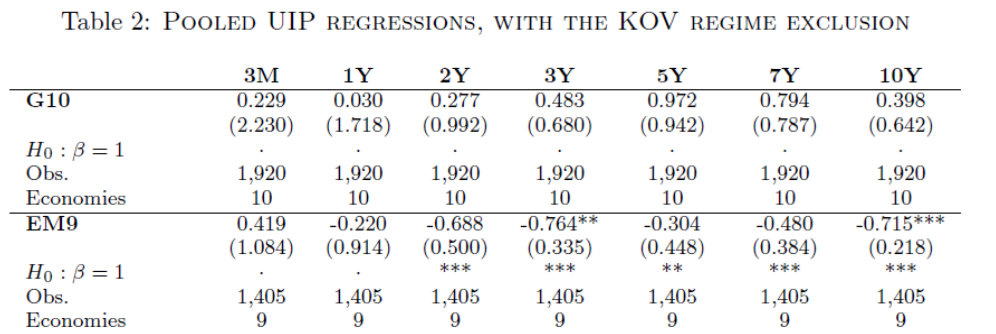
A key table in the paper reports panel estimation results of Equation (1) for each currency group at different maturities, estimated on a common sample across maturities from January 2000 (2000m1) to December 2015 (2015m12) — the last year-month observation allowing a 10-year forward exchange rate difference to be computed with a data sample ending in December 2025 (2025m12). All regressions include currency fixed effects. Standard errors are of the Driscoll and Kraay (1998) heteroskedasticity- and autocorrelation-consistent (HAC) type, with the Lazarus, Lewis, Stock, and Watson (2018) bandwidth and Vogelsang (2012) fixed-b p-values. Stars apply to the coefficient test of H0: β = 0; the third row of each block tests H0: β = 1, where a dot means not rejected. "Obs." is the number of economy-month observations, and "economies" is the number of economies in the regression. *, **, and *** indicate significance at the 10%, 5%, and 1% levels, respectively.
The paper's Table 3 results are described as consistent with the importance of default risk, particularly where the real exchange rate is highly persistent. The table reports estimation results for Equation (3). The dependent variable is the cumulative five-year log change in the bilateral nominal exchange rate against the U.S. dollar, ln(St+60) − ln(St). The interest differential is the cumulative five-year continuously compounded differential, 5[ln(1 + i*5y) − ln(1 + iUSD,5y)]. The CDS spread enters as cds5y = 5 ln(1 + CDS5y/10,000). The bilateral real exchange rate is qt = ln(St) + ln(CPIUSD,t) − ln(CPI,t); a rise in qt denotes a real depreciation against the U.S. dollar. All four specifications are estimated on the CDS-available sample from January 2000 to December 2015, with a common sample imposed only within each panel and allowed to vary across panels. As in the first set of estimates, all regressions include currency fixed effects, and inference uses Driscoll–Kraay HAC standard errors with the Lazarus et al. (2018) bandwidth and fixed-b critical values. Stars denote significance against zero; in the unit-slope null rows, stars denote rejection and a dot denotes non-rejection, at the 10%, 5%, and 1% significance levels.
In commentary accompanying the post, the Econbrowser author calls the results "quite interesting," noting that they link up with short-horizon results in Kalemli-Ozcan et al. (2026). The author also writes that the findings validate, to some degree, results obtained for G3 currencies over the 1983–2022 period, described in an earlier Econbrowser post.
Source: Econbrowser — "Long Horizon UIP in Emerging Markets", November 24, 2026.

