Week 36 Commodities Market Watch: Oil Reclaimed Geopolitics, Gold Hit a Jobs Shock, and Copper Stayed Tight
Key Takeaways
- •Brent and WTI posted strong weekly gains as geopolitical risk and shipping concerns restored an oil premium.
- •U.S. crude inventories fell by 4.5 million barrels, while gasoline and distillate stocks remained below five-year averages.
- •Gold dropped more than 2% on Friday after stronger-than-expected U.S. jobs data lifted rate-hike expectations.
- •Henry Hub natural gas strengthened toward two-month highs, but production and storage kept prices capped.
- •Corn, soybeans, and wheat all closed lower on Friday, showing grains remained driven by weather and export factors rather than oil.
- •Copper stayed near late-August highs because of supply and logistics tightness, even as payroll data added rate pressure.
Quick Answer
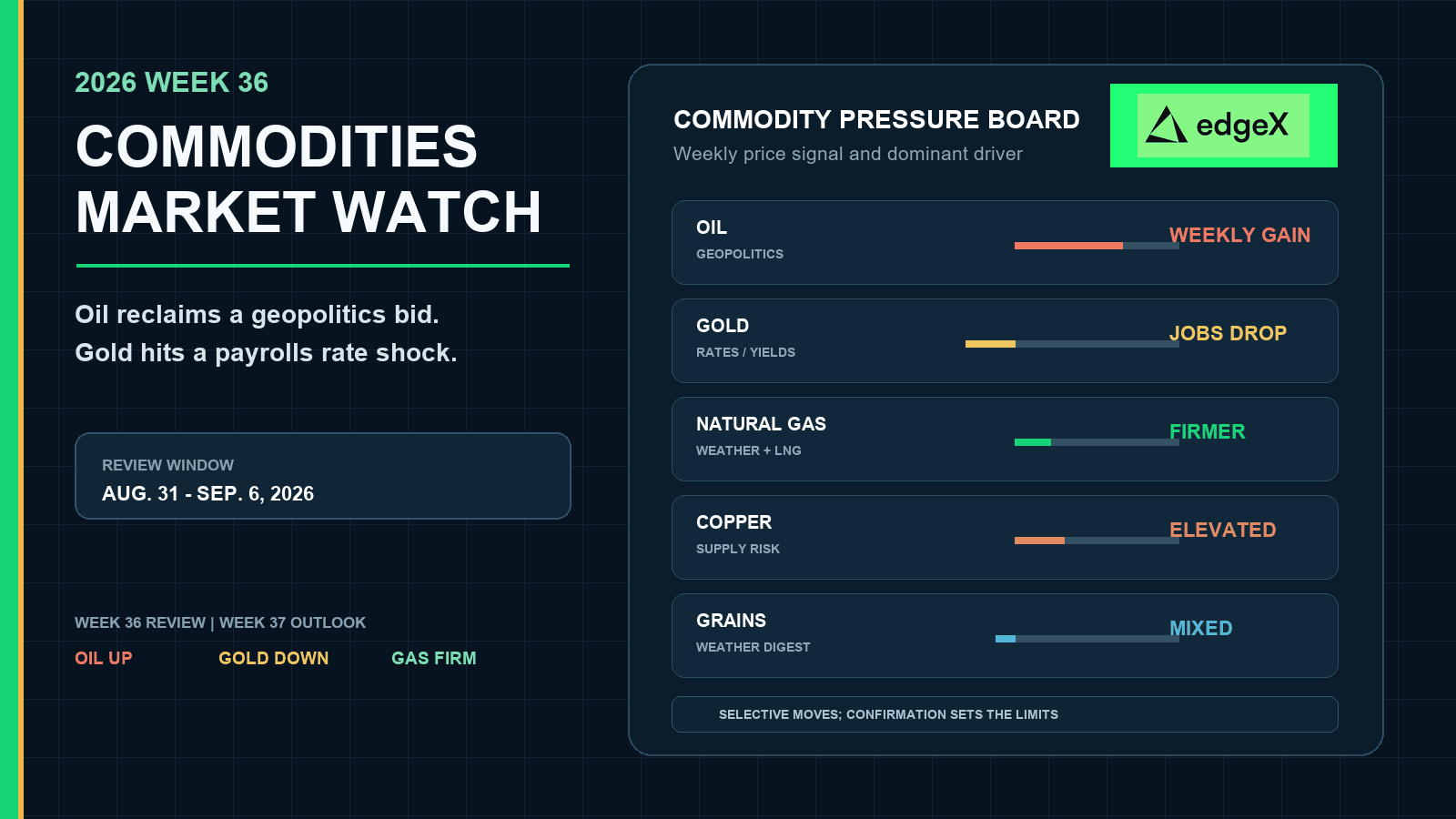
Week 36 flipped the Week 35 map without restoring a single commodity cycle. Oil reclaimed a geopolitical and product-supported bid after the prior week’s partial premium unwind, with Brent and WTI posting sharp weekly gains as U.S.–Iran strike risk and Hormuz logistics worries returned. Gold moved the other way: a hot U.S. payrolls print revived rate-hike odds and overpowered residual safe-haven support into Friday. Natural gas improved on weather and LNG feedgas but remained supply-capped. Copper stayed elevated on physical and logistics risk while still feeling the rate channel. Grains cooled into the Friday close after Week 35’s firmer finishes. Week 37 therefore starts with a split setup: energy risk is again one of the loudest inflation channels, gold is more sensitive to yields and the dollar, copper needs demand confirmation after the supply signal, and grains remain a weather-and-export market.
Week 36 Put Geopolitics Back in Front of Energy
After Week 35 reduced the most aggressive oil premium and left gold more sensitive to rate communication, Week 36 had to decide whether energy risk would stay mean-reverting or reassert itself. Oil reasserted through logistics and risk premium, reinforced by a larger-than-expected U.S. crude draw and still-tight product inventories. Gold’s Friday drop showed the opposite constraint: metals that can benefit from geopolitical stress can reverse quickly when labor data lifts real-rate expectations. Copper and grains again moved on their own supply, weather, and rate calendars.
Oil rebuilt the premium that Week 35 had partially unwound
Friday market summaries put Brent near $94.86 a barrel and WTI near $90.40, with weekly gains of about 6.6% and 8.8%. Barron’s live coverage and related energy wires framed the move as a sharp weekly oil advance driven by renewed U.S.–Iran hostilities and fear that Persian Gulf flows could stay constrained. Brownfield Ag News listed October crude at $91.48 into the Friday close, well above the levels left by Week 35's partial premium unwind.
Week 35 had reduced the most aggressive disruption bid while sanctions and diplomatic friction remained unresolved. Week 36 showed the same unresolved file can be re-bid quickly when strike risk and shipping uncertainty return. Oil can fall one week because the panic premium overshoots, then rise the next because the logistics risk never left.
Policy and physical markets still diverged inside the complex
Gold’s Friday decline was driven by labor data and rate expectations rather than commodity-specific supply. Natural gas improved on cooling demand and stronger LNG feedgas while domestic production and storage still limited upside. Copper stayed elevated on supply and logistics risk, then felt the same rate impulse that hit gold. Grains softened into Friday after the prior week’s weather-and-risk bid. Energy returned to the center of the inflation debate, while metals and agriculture still needed their own confirmation paths.
Week 36 Commodities Dashboard
| Market | Completed Week 36 evidence | What the result means |
|---|---|---|
| Brent crude | About +6.6% weekly; Friday trade near $94.86 | Geopolitical premium rebuilt after Week 35’s partial unwind |
| WTI crude | About +8.8% weekly; Friday trade near $90.40 | U.S. crude joined the global logistics bid rather than a pure domestic demand story |
| U.S. petroleum stocks | Crude −4.5 mb to 424.5 mb; gasoline −1.2 mb; distillates +0.8 mb | Physical balance stayed firm; products remained below five-year norms |
| Gold | Friday drop of more than 2%; weekly-loss direction after payrolls | Rate-hike bets reclaimed control of the bullion tape |
| U.S. natural gas | Held near high-$2s to low-$3/mmBtu | Weather and LNG helped, but production and storage still capped scarcity |
| Copper | Near $6.55–$6.60/lb, close to late-August highs | Supply risk supported levels; jobs data added rate pressure |
| Corn, soybeans, wheat | Softer Friday closes after prior firmness | Weather and export calendars still dominate over oil’s weekly rebound |
Oil and Products Rejoined the Geopolitical Bid
Oil’s weekly gain was large enough to change the inflation tape, and inventories blocked a pure headline reading. The EIA Weekly Petroleum Status Report summary for the week ending August 28 showed commercial crude down 4.5 million barrels to 424.5 million barrels, about 1% above the five-year average. WSJ coverage dated September 2 called the draw larger than expected. Gasoline stocks fell another 1.2 million barrels and stood 6% below the five-year average. Distillates rose 0.8 million barrels but remained about 14% below the five-year average. Refineries ran at 98% of operable capacity.
The weekly oil rebound was a risk-and-balance story, not a demand boom
Week 35 showed an overextended geopolitical premium can reverse while the underlying file stays open. Week 36 showed the mirror: the same file can reprice higher as soon as strike risk and shipping uncertainty return. Contemporaneous coverage emphasized strike risk, logistics constraints, and product tightness rather than a broad demand boom. The thinner product cushion and crude draw were large enough to support the logistics premium.
If Hormuz traffic stays impaired, alternative barrels stay expensive, or product tightness persists in the next EIA prints, oil can hold or extend the rebound. If diplomatic signals improve and product stocks rebuild, the weekly gain can reverse quickly. Watch whether the market is still paying for delivery risk or only chasing the latest strike headline.
Products remained the closer link to consumer inflation
Gasoline and distillate balances sit closer to retail fuel, freight, and food-distribution costs than crude in storage. Draws below the five-year average support refining margins and limit how far crude can fall before the physical market pushes back. Even the modest distillate build left stocks far below the seasonal norm, helping oil reverse Week 35’s setback without a synchronized global growth upturn.
Gold Ran Into a Payrolls Rate Shock
Gold exited Week 36 under a payrolls-driven rate shock. CNBC and Reuters-linked coverage dated September 4 reported gold fell more than 2% Friday and was headed for a weekly loss after stronger-than-expected U.S. jobs data. USAGOLD put physical spot near $4,420, while Brownfield listed December gold at $4,480.30, down $59.60 on the day.
Hot labor data reclaimed control of the gold tape
August nonfarm payrolls rose 162,000, unemployment held at 4.1%, and average hourly earnings rose 0.3%, according to the BLS Employment Situation. Money-market pricing swung back toward a nearer-term rate hike, lifting yields and the dollar and lowering the appeal of non-yielding metal. Week 36 extended the Week 35 point: residual geopolitical hedging is not automatic gold support while the rate channel is hostile. Oil can rise on Hormuz risk in the same week gold falls on payrolls, so gold is trading the policy path more than the oil path.
Natural Gas Firming Stayed Capped by Supply
U.S. natural gas remained a regional physical market rather than a pure satellite of crude. Trading Economics notes around the Week 36 close left Henry Hub above roughly $2.90 and near $2.97/mmBtu at points, close to two-month highs. The same coverage emphasized elevated cooling demand, average feedgas flows to nine major LNG export plants rising to about 18.3 billion cubic feet per day in early September from 17.2 bcfd in August, and inventories still 5.2% above the five-year seasonal average as of August 28.
Weather and LNG helped; production protected the ceiling
That combination improved near-term demand without validating scarcity. Hotter forecasts and stronger LNG feedgas can stabilize nearby contracts, but near-record Lower-48 output and comfortable storage still require weaker production, bullish storage prints, or a deeper international shock for a sustained breakout. Persian Gulf LNG disruptions can support U.S. export demand, yet Henry Hub remains anchored by domestic balance. Week 36 left firmer support without a clean breakout: a weather-plus-LNG market with a production ceiling.
Copper Stayed Elevated on Supply Risk While Rates Pressed
Copper remained a tight-supply, contested-demand market. Trading Economics copper notes placed U.S. futures around $6.55–$6.60 a pound into the Week 36 close, still close to the late-August record area near $6.70. Commentary stressed Hormuz-linked shipping and sulfuric-acid frictions, weaker production signals from major miners, Congo export restrictions in market notes, and tariff-related positioning that tightened availability outside the United States even as COMEX inventories rose.
Inventory and logistics tightness still need demand confirmation
Nearby availability, acid and shipping bottlenecks, and tariff front-loading supported copper through Week 36. The hot payrolls print then added rate-sensitive pressure on industrial demand expectations even while physical tightness remained real. China is still the key verification market: official manufacturing PMI stayed below 50 in August, so logistics tightness is running ahead of broad end-demand confirmation. Elevated prices are constructive but conditional evidence of tightness, not yet a synchronized industrial upturn.
Grains Cooled Into Friday Without Becoming an Oil Trade
Agriculture did not copy the energy complex. Brownfield Ag News closing futures for September 4 put December corn at $5.36 3/4, November soybeans at $13.09 3/4, and December Chicago wheat at $7.34, all lower on the day into the holiday weekend. That softer Friday tape followed Week 35’s firmer closes and again showed grains can decouple from oil’s weekly direction.
Crop, export, and demand calendars still dominate
Late-summer weather can still change corn and soybean yield assumptions, while wheat remains sensitive to global supply headlines and export competition. Higher energy costs can lift the longer-run floor through diesel, fertilizer, drying, and freight, but nearby direction still depends on production and export balances. Week 36 showed traders less willing to extend the prior week’s weather-and-risk premium into Friday, especially in wheat. That is selective digestion, not a food-price collapse, and not an oil-led grain trade for Week 37.
Cross-Market Impact Map
| Commodity signal | Economic transmission | What would confirm it |
|---|---|---|
| Oil’s weekly rebound with risk open | Renewed logistics premium and firmer energy inflation channel | Hormuz traffic, sanctions/strike headlines, and the next product inventory path |
| Crude draw plus tight gasoline/distillates | Supportive refining and freight cost floor | Continued product tightness in the next EIA reports |
| Gold’s Friday jobs drop | Higher rate-hike odds and less support from real yields | Softer CPI, weaker dollar, or renewed safe-haven demand |
| Gas near $3 on weather and LNG | Demand support capped by production and storage | Bullish storage or weaker Lower-48 output |
| Copper near record-area levels | Tight visible/logistics supply | Chinese premiums, factory demand, and further stock confirmation |
| Softer Friday grains | Weather/export premium digestion | Crop-condition deterioration or stronger export sales |
What Week 36 Changed
Week 36 replaced Week 35’s premium-reset map with a harder split. Energy risk returned through oil geopolitics and still-tight U.S. products. Gold again showed hot labor data can overpower residual hedge demand. Natural gas improved on weather and LNG without escaping its production ceiling. Copper stayed expensive on supply risk while feeling the rate channel. Grains cooled after the prior week’s firmer finishes. Commodity inflation can intensify in energy while monetary-policy hedges weaken in the same week, so Week 37 still requires market-specific confirmation rather than one complex trade.
Week 37 Outlook: Selective Volatility Needs Fresh Confirmation
Week 37 covers September 7–13. The base case is continued selective volatility rather than a uniform rebound. Oil starts higher with geopolitical and product-inventory support still intact. Gold starts from a second rate-damaged finish and needs softer real yields or cooler inflation data. Copper enters elevated on supply risk and must prove demand. Grains enter after Friday softness and need crop or export follow-through.
Oil and gas will be decided by logistics and storage
Energy’s first tests are physical. Watch Hormuz traffic and U.S.–Iran headlines for whether the geopolitical premium holds, and use the next EIA Weekly Petroleum Status Report to test whether gasoline and distillate tightness persists after the August 28 crude draw. If products keep drawing while logistics stay impaired, oil can hold the higher range; if products rebuild and diplomacy improves, the advance can reverse quickly.
For U.S. gas, the next storage print, production trend, and LNG feedgas path remain decisive. Weather and export demand can support the high-$2s/low-$3 area, but record-area output and above-average inventories still cap conviction unless storage turns clearly bullish or production softens.
Gold needs the rate channel to stop working against it
Gold’s Week 37 path depends less on oil and more on yields, the dollar, and the September inflation sequence into FOMC pricing. Cooler CPI or softer real yields would help repair Friday’s damage; another firm inflation impulse would keep bullion defensive. Residual geopolitical risk is not automatic gold support while the rate channel is hostile.
Copper and grains must convert their Week 36 signals
Copper already has elevated prices and a supply-risk narrative. Week 37 confirmation requires Chinese physical premiums, broader industrial data, and no quick restocking that would mark tightness as positioning alone. Without that, rate pressure can dominate even if mine and logistics constraints remain real.
Grains need weather and export follow-through after Friday’s softer closes. Further crop-condition deterioration or stronger export sales would rebuild premium; comfortable production assumptions and weaker overseas demand would not. Higher energy costs can support the longer-run floor, but they are not enough alone.
A single shipping or strike headline can reprice oil faster than weekly inventories, while a single CPI print can reprice gold faster than commodity-specific flows. Favor oil only while logistics and product stocks stay tight, gold only if yields cooperate, copper if Chinese demand joins the supply signal, and grains if weather or exports tighten the balance sheet.
Trade Commodities Perpetuals On-Chain with edgeX
Commodity markets move fast. Your trading infrastructure should too.
edgeX is a decentralized exchange built on EDGE chain, settling on Ethereum via Arbitrum, that lets traders access tokenized RWA commodities perpetuals with institutional-grade execution and true self-custody. No KYC. No centralized custodian. Just full control of your assets, your private keys, and your positions.
Why traders choose edgeX for commodities:
- Ultra-deep liquidity: $10 million of depth within a one-basis-point spread, with sub-0.1-basis-point slippage on trades over $100,000, even during peak volatility.
- High-performance engine: Up to 200,000 orders per second with sub-10 millisecond matching latency.
- True self-custody: Withdrawals require only your wallet authorization; no platform approval needed.
- No KYC required: Start trading commodities, tokenized stocks, and crypto perpetuals without identity verification.
- 100% trading fee rewards: edgeX’s Trade to Own program returns 100% of trading fees back to users in $EDGE tokens.
- USDC-backed settlement: USDC is designed by Circle to be redeemable 1:1 for U.S. dollars, giving traders a familiar settlement base.
Whether you're trading gold, oil, or other RWA commodities, edgeX gives you the liquidity depth of a centralized exchange with the security of on-chain settlement.
The platform is available on desktop and as a native mobile app on iOS and Android, so you can manage positions and react to commodity market moves from anywhere.
Ready to trade commodities perpetuals without the constraints of a centralized exchange? Start trading on edgeX with no KYC and no compromises.
Frequently Asked Questions
What dates did 2026 Week 36 cover?
This review covers August 31 through September 6, 2026. The principal futures-market close was Friday, September 4, ahead of the U.S. Labor Day weekend.
Why did oil rebound in Week 36 after falling in Week 35?
Oil reclaimed a geopolitical and product-supported premium as U.S.–Iran strike risk and Hormuz logistics worries returned. Friday coverage put weekly gains near 6.6% for Brent and 8.8% for WTI. The move reversed Week 35’s partial premium unwind rather than proving a clean global demand boom.
What did inventories say about the oil balance?
For the week ended August 28, crude stocks fell 4.5 million barrels to 424.5 million barrels. Gasoline inventories fell again and remained 6% below the five-year average, while distillates stayed about 14% below the five-year average even after a 0.8 million barrel build.
Why did gold drop on Friday?
Gold fell more than 2% after August nonfarm payrolls rose 162,000, lifting rate-hike bets, yields, and the dollar. That revived real-yield pressure and overpowered residual hedge-driven support.
What is the Week 37 commodities outlook?
The base case is selective volatility. Oil needs logistics and product-inventory confirmation, gold needs softer yield pressure after CPI and FOMC pricing, copper needs Chinese demand to validate elevated supply-risk prices, and grains need weather or export follow-through. A uniform commodity rally is not the base case.
