Week 35 Commodities Market Watch: Oil Retraced, Gold Hit a Policy Shock, and Copper Tightened
Key Takeaways
- •Brent and WTI posted weekly losses in Week 35 even though Iran-related sanctions pressure and geopolitical risk remained unresolved.
- •U.S. crude inventories rose only slightly, while gasoline and distillate stocks fell below their five-year averages.
- •Gold dropped about 3% after Fed Chair Kevin Warsh’s Jackson Hole remarks increased bets on a more restrictive rate path.
- •U.S. natural gas remained near the high-$2 to low-$3 per mmBtu range as strong production capped further gains.
- •Copper inventories on the LME declined sharply, but the market still needs demand confirmation from China and broader industrial data.
Quick Answer
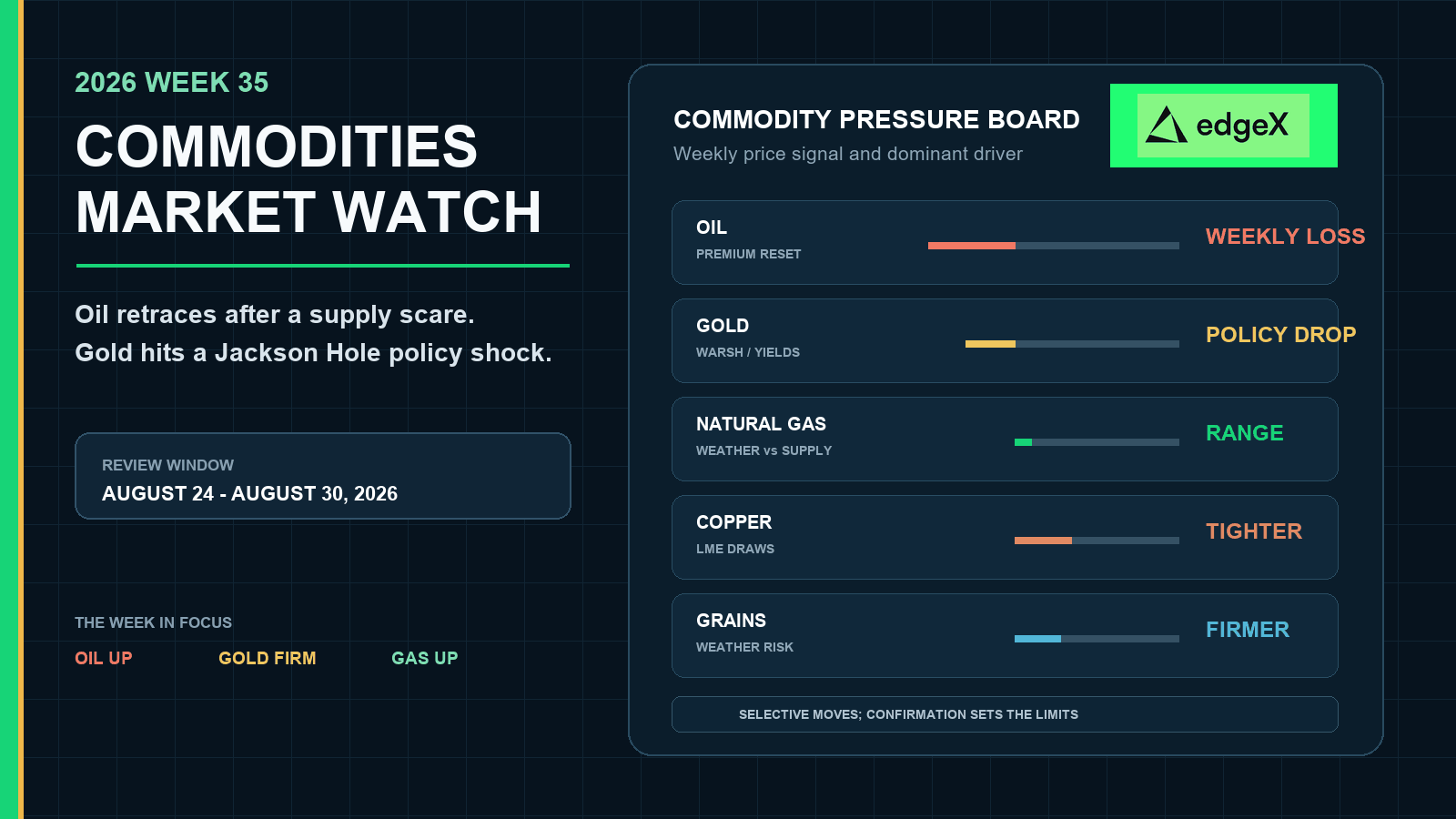
Week 35 reversed the simple narrative left by Week 34. Oil did not extend its supply-shock rally; instead, Brent and WTI gave back a large share of the prior two-week advance while still trading with a geopolitical premium. Gold, which had looked technically strong into the prior week, ran into a Jackson Hole policy shock and fell sharply as rate-hike bets returned. Natural gas stayed range-bound under record U.S. production even as cooling demand remained elevated. Copper was the clearest physical improvement, with LME inventories drawing down through the week ended August 28. Grains finished firmer on weather and risk buying rather than on energy pass-through alone. Week 36 therefore starts with a split setup: energy risk is still present but no longer one-directional, gold is more sensitive to yields and the dollar, copper needs demand confirmation after the inventory signal, and grains remain a weather-and-export market.
Week 35 Turned a Supply Rally Into a Confirmation Test
The completed Week 35 record mattered more than the forecasts that framed the week. After Week 34’s oil-led supply shock, the market’s next job was to decide whether the premium would persist, broaden, or mean-revert. The answer was selective mean reversion.
Oil lost the prior two-week winning streak even though Iran-related sanctions and diplomatic friction remained unresolved. That combination is important. A weekly decline does not automatically equal a clean risk-off signal when the geopolitical file is still open; it can also mean that traders reduced the most aggressive disruption premium after a large prior move. Gold’s late-week drop showed a different constraint: even metals that benefit from uncertainty can reverse quickly when policy communication lifts real-rate expectations. Copper and grains, by contrast, moved more on their own physical and weather calendars than on oil’s daily headlines.
Oil lost momentum without erasing the risk premium
Reuters-syndicated coverage dated August 28 reported Brent near $89.45 a barrel and WTI near $83.31, with both benchmarks on track for weekly losses of about 5.3% and 4.3%. The same reporting stream still emphasized U.S. sanctions pressure on Iran and little appetite in Washington for a quick return to prior deal terms. The market therefore priced two ideas at once: the immediate panic bid cooled, but the medium-term supply-risk file stayed open.
That is a different setup from a demand-led collapse. When oil falls because global growth is deteriorating, copper and cyclical industrial markets usually confirm the move. Week 35 did not deliver that clean confirmation. Copper inventories tightened, grains firmed, and product stocks remained relatively tight in the United States. The better reading is that oil’s Week 35 setback was mainly a reset of an overextended geopolitical premium after Week 34’s surge.
Policy and physical markets diverged inside the complex
Gold’s late-week decline was driven by policy communication rather than by commodity-specific supply. Warsh’s Jackson Hole remarks lifted rate-hike bets and challenged the weaker-dollar, lower-yield support that had helped bullion earlier in August. Natural gas remained capped by strong U.S. production even while weather supported cooling demand. Copper’s inventory draw suggested that visible metal availability was tightening. Grains responded to weather and risk appetite into the Friday close.
The net result was not a synchronized commodity cycle. It was a multi-speed complex in which energy, monetary-policy hedges, industrial metals, and agriculture each required a separate confirmation path.
Week 35 Commodities Dashboard
| Market | Completed Week 35 evidence | What the result means |
| Brent crude | About -5.3% weekly; Friday trade near $89.45 | Prior supply premium partially unwound, but geopolitical risk remained active |
| WTI crude | About -4.3% weekly; Friday trade near $83.31 | U.S. crude followed the global reset rather than a pure domestic demand shock |
| U.S. petroleum stocks | Crude +0.1 mb to 428.9 mb; gasoline -2.5 mb; distillates -2.2 mb | Product-side inventories stayed tight even as crude only built modestly |
| Gold | Late-week drop of about 3% after Warsh comments | Policy and real-yield risk overrode the prior hedge bid |
| U.S. natural gas | Held near the high-$2s to low-$3/mmBtu area | Weather support met a still-heavy production cushion |
| Copper | Major LME inventory draw in week ended August 28 | Visible supply tightened; demand confirmation still needed |
| Corn, soybeans, wheat | Firmer Friday closes; soybeans and wheat led the day | Weather and risk buying mattered more than oil’s weekly reverse |
The table separates price direction from economic meaning. Oil signaled a partial premium reset. Gold signaled policy sensitivity. Petroleum products and copper pointed to firmer physical conditions in selected markets. Grains remained a weather-and-balance-sheet story.
Oil and Products Sent Mixed Physical Messages
Oil’s weekly loss was large enough to change the tape, but the inventory detail prevented a simple bearish conclusion. The EIA summary for the week ending August 21 showed commercial crude inventories up only 0.1 million barrels to 428.9 million barrels, about 1% above the five-year average. That was not a flooding of surplus crude. More important for the near-term balance, gasoline stocks fell 2.5 million barrels and stood 6% below the five-year average, while distillate inventories fell 2.2 million barrels and stood about 14% below the five-year average. Refineries ran hard at 97.4% of operable capacity.
The weekly oil decline was a premium reset, not a demand collapse
The Week 34 advance had been built on sanctions threats, constrained shipping, and fear that future barrels would become harder to move. Week 35 reduced the most aggressive form of that premium after prices had already jumped. Friday trade still showed Brent and WTI well above the midsummer lows that preceded the Hormuz and sanctions scare. The market was therefore discriminating between “risk is unresolved” and “risk must be re-bid every session.”
Investors should treat that distinction carefully. If Hormuz logistics remain impaired, alternative barrels stay expensive, or product inventories keep tightening, oil can stabilize or rebound even after a 4% to 5% weekly decline. If diplomatic signals improve and product draws reverse, the Week 35 setback can extend into a broader correction. The practical rule is to watch whether the market is still paying for delivery risk or only reacting to the memory of last week’s scare.
Products stayed tighter than crude
The product-side data mattered because gasoline and distillate stocks are closer to the consumer and freight complex than crude sitting in storage. Draws below the five-year average support refining margins and limit how far crude can fall before the physical market pushes back. Four-week product supplied remained softer than a year earlier, so demand was not booming. But the inventory cushion on the product side was thinner than the crude-side reading alone would suggest.
That mix explains why oil could fall on the week without looking like a fully normalized market. The geopolitical premium cooled. The product balance did not suddenly become comfortable.
Gold Ran Into a Jackson Hole Policy Shock
Gold entered Week 35 with residual momentum from the prior week’s breakout and weaker-dollar narrative. It exited the week under a clear policy overhang. Market coverage around August 28 reported an approximate 3% drop after Fed Chair Kevin Warsh’s Jackson Hole comments lifted bets on a more restrictive rate path. Spot readings in secondary market summaries clustered in the mid-$4,500s after the late-week reverse, well below the prior week’s three-month high area near the mid-$4,600s.
Rate expectations reclaimed control of the gold tape
The transmission channel was straightforward. When policy communication raises the odds of firmer rates, real yields and the dollar tend to firm, lowering the relative appeal of a non-yielding metal. Week 35 showed that this channel can overpower residual geopolitical hedging demand, at least in the short run. Gold can still benefit from fiscal concern, currency hedging, or fresh geopolitical escalation, but those supports need the interest-rate backdrop to stop working against them.
The practical implication is that gold is no longer a pure shadow of the oil-risk premium. In Week 34, oil and gold could rise together for different reasons. In Week 35, oil fell on a premium reset while gold fell on a policy shock. The common theme was not synchronized commodity strength; it was the return of market-specific constraints. For portfolio construction, that means gold now has to clear a rates test before it can again function as a clean hedge against energy or geopolitical noise.
Natural Gas Stayed Capped by Supply Even as Weather Helped
U.S. natural gas remained a regional physical market rather than a pure satellite of crude. Price summaries around the Week 35 close left Henry Hub in the high-$2s to low-$3 per mmBtu area, with market notes still emphasizing elevated cooling demand and strong Lower-48 production. Production running near record rates continued to limit how far weather alone could push the benchmark.
Weather supported demand; production protected the ceiling
That combination kept gas from validating a scarcity narrative. Hotter forecasts can lift power-burn demand and stabilize nearby contracts, but a market already carrying strong production and a comfortable storage path needs either weaker output, stronger LNG feedgas, or a sequence of bullish storage prints before it can break higher with conviction. International LNG buyers may still face shipping and replacement-cargo risk tied to the broader energy complex, yet Henry Hub remains anchored by domestic balance.
For Week 35, the right conclusion is modest support without a clean breakout. Gas was not collapsing with oil, and it was not leading a new energy inflation wave either.
Copper Tightened on Inventories While Demand Still Needed Proof
Copper provided the week’s strongest physical signal. Investing News Network coverage dated August 31 reported major LME copper inventory drawdowns in the week ended August 28, with open tonnage falling as warehouse movements and tariff-related positioning reduced visible availability. After Week 34’s more hesitant inventory message, that draw changed the near-term supply picture.
Inventory tightness is not yet full demand confirmation
A visible-stock draw can come from tighter nearby availability, metal moving off-warrant, or precautionary positioning. It becomes a durable bullish confirmation only when Chinese physical premiums, fabrication demand, and broader industrial activity agree. China remains the key verification market because property weakness can still offset strength in power equipment, grids, and manufacturing linked to electrification.
Even so, Week 35 improved copper’s evidence set. The metal no longer looked like a pure long-term scarcity story fighting rising exchange stocks. It looked like a market in which nearby availability was tightening faster than the demand debate was being resolved. That is constructive, but still conditional. Traders should therefore treat the inventory draw as necessary but not sufficient evidence for a broader industrial upturn.
Grains Firming Was About Weather and Risk, Not Oil Alone
Agriculture did not simply copy the energy complex. Brownfield Ag News closing futures for August 28 put September corn at $5.12, soybeans at $12.76 1/4, and Chicago wheat at $7.67, with soybeans and wheat posting strong day gains. Earlier in the week, AP-syndicated coverage already showed corn rebuilding toward the $5 area. The grain complex therefore finished Week 35 with a firmer tone even while oil retraced.
Crop risk reasserted itself late in August
Late-summer weather can still change yield assumptions for corn and soybeans, while wheat remains sensitive to global supply headlines and export competition. Higher energy costs can lift the cost floor through diesel, fertilizer, drying, and freight, but nearby grain direction still depends on whether production and export balances tighten. Week 35 suggested that traders were again willing to pay for weather and risk premia, especially in soybeans and wheat.
The correct reading is selective strength, not a full food-inflation breakout. Grains improved on their own catalysts. They did not need oil’s weekly direction to move, and they should not be forced into an oil-led narrative in Week 36 either.
Cross-Market Impact Map
| Commodity signal | Economic transmission | What would confirm it |
| Oil’s weekly loss with risk still open | Partial premium reset, not full geopolitical normalization | Hormuz logistics, sanctions headlines, and product inventory path |
| Gasoline and distillate draws | Firmer refining and freight cost floor | Continued product tightness in the next EIA reports |
| Gold’s ~3% policy drop | Higher rate-hike odds and less support from real yields | Softer yields, weaker dollar, or renewed safe-haven demand |
| Gas stuck near $3 | Weather support capped by production | Bullish storage or weaker Lower-48 output |
| Copper inventory draw | Tighter visible supply | Chinese premiums, factory demand, and further stock declines |
| Firmer soybeans and wheat | Weather and export-risk premium | Crop-condition deterioration or stronger export sales |
What Week 35 Changed
Week 35 replaced the “oil leads everything” story with a harder confirmation standard. Energy risk remained real, but the market stopped paying the same panic premium every day, and natural gas stayed capped by strong U.S. supply even as weather supported demand. Gold proved highly sensitive to policy communication. Copper improved on inventories. Grains answered weather and risk signals more than crude’s weekly reverse.
The lasting lesson is that commodity inflation can stay selective even after a major geopolitical scare. Traders who separated oil logistics, product inventories, monetary-policy hedges, industrial stock draws, and crop weather received a clearer map than those who treated the complex as one trade. Week 35 therefore raised the bar for confirmation heading into Week 36: each market now has to re-prove its own driver rather than borrow conviction from oil alone.
Week 36 Outlook: Selective Volatility Needs Fresh Confirmation
Week 36 covers August 31–September 6. The base case is continued selective volatility rather than a uniform commodity rebound. Oil starts from a lower weekly base but still carries geopolitical and product-inventory support. Gold starts from a policy-damaged technical position and needs softer real yields or a weaker dollar to stabilize. Copper enters with a better inventory signal and must now prove demand. Grains enter with weather premium and need follow-through from crop conditions and exports.
Oil and gas will be decided by logistics and storage
The first decision criteria for energy are physical. Watch Hormuz traffic and sanctions headlines for whether the geopolitical premium rebuilds, and use the next EIA Weekly Petroleum Status Report to test whether gasoline and distillate tightness persists after Week 35’s crude-only modest build. If products keep drawing while logistics stay impaired, oil can stabilize quickly despite the weekly loss. If products rebuild and diplomatic signals improve, the Week 35 reverse can extend.
For U.S. gas, the next storage print and production trend remain decisive. Weather can support demand into early September, but record-area output still caps conviction. A bullish storage surprise or clear production softening would be needed to turn the high-$2s/low-$3 area into a sustained breakout. Otherwise gas remains a range market with weather noise.
Gold needs the rate channel to stop working against it
Gold’s Week 36 path depends less on oil and more on yields, the dollar, and whether Warsh’s Jackson Hole message keeps lifting rate-hike odds. A stabilization in real yields or a softer dollar would help repair the late-week damage. Another firm policy impulse or stronger U.S. data would keep bullion defensive. The investor rule is simple: do not treat residual geopolitical risk as automatic gold support while the rate channel is hostile.
Copper and grains must convert their Week 35 signals
Copper already has the inventory draw. Week 36 confirmation requires Chinese physical premiums, broader industrial data, and no quick restocking on the LME or Shanghai systems. Without that, the draw risks being read as positioning or warehouse logistics rather than end-demand strength.
Grains need weather and export follow-through. Soybeans and wheat already showed that traders will reprice crop risk quickly. The constructive case is further deterioration in crop conditions or stronger export sales. The downside case is a return of comfortable production assumptions and weaker overseas demand. Higher energy costs can support the longer-run floor, but they are not enough alone.
The principal uncertainty remains geopolitical and policy-driven at the same time. A single shipping or sanctions headline can reprice oil faster than weekly inventories, while a single rates impulse can reprice gold faster than commodity-specific flows. The reader-facing implication is to require market-specific confirmation: favor oil only while logistics and product stocks stay tight, gold only if yields cooperate, copper if Chinese demand joins the inventory signal, and grains if weather or exports tighten the balance sheet.
Trade Commodities Perpetuals On-Chain with edgeX
Commodity markets move fast. Your trading infrastructure should too.
edgeX is a decentralized exchange built on EDGE chain, settling on Ethereum via Arbitrum, that lets traders access tokenized RWA commodities perpetuals with institutional-grade execution and true self-custody. No KYC. No centralized custodian. Just full control of your assets, your private keys, and your positions.
Why traders choose edgeX for commodities:
- Ultra-deep liquidity: $10 million of depth within a one-basis-point spread, with sub-0.1-basis-point slippage on trades over $100,000, even during peak volatility.
- High-performance engine: Up to 200,000 orders per second with sub-10 millisecond matching latency.
- True self-custody: Withdrawals require only your wallet authorization; no platform approval needed.
- No KYC required: Start trading commodities, tokenized stocks, and crypto perpetuals without identity verification.
- 100% trading fee rewards: edgeX’s Trade to Own program returns 100% of trading fees back to users in $EDGE tokens.
- USDC-backed settlement: USDC is designed by Circle to be redeemable 1:1 for U.S. dollars, giving traders a familiar settlement base.
Whether you're trading gold, oil, or other RWA commodities, edgeX gives you the liquidity depth of a centralized exchange with the security of on-chain settlement.
The platform is available on desktop and as a native mobile app on iOS and Android, so you can manage positions and react to commodity market moves from anywhere.
Ready to trade commodities perpetuals without the constraints of a centralized exchange? Start trading on edgeX with no KYC and no compromises.
Frequently Asked Questions
What dates did 2026 Week 35 cover?
This review covers August 24 through August 30, 2026. The principal futures-market close was Friday, August 28.
Why did oil fall in Week 35 after rising so sharply in Week 34?
Oil snapped a two-week winning streak as part of the Week 34 supply premium was unwound. Reuters-linked coverage put weekly losses near 5.3% for Brent and 4.3% for WTI. Geopolitical risk did not disappear; the market simply stopped paying the same panic premium every session.
What did inventories say about the oil balance?
For the week ended August 21, crude stocks rose only 0.1 million barrels to 428.9 million barrels. Gasoline and distillate inventories fell and remained below five-year averages, leaving the product side tighter than the crude headline alone suggested.
Why did gold drop late in the week?
Gold fell about 3% after Fed Chair Kevin Warsh’s Jackson Hole comments lifted rate-hike bets. That revived real-yield and dollar pressure and overpowered the prior hedge-driven support.
What is the Week 36 commodities outlook?
The base case is selective volatility. Oil needs logistics and product-inventory confirmation, gold needs softer yield pressure, copper needs Chinese demand to validate the LME draw, and grains need weather or export follow-through. A uniform commodity rally is not the base case.
