2026 Week 32 Commodities Market Watch: Gold Leads as Oil Risk, Copper Scarcity, and Gas Weakness Split the Tape
Key Takeaways
- •Gold and silver gained leadership during Week 32 as softer U.S. labor-market signals lowered yield expectations and reduced the opportunity cost of holding non-yielding assets.
- •Oil's geopolitical risk premium was partially offset by OPEC+ supply policy considerations and an EIA crude inventory draw complicated by mixed product-stock data.
- •Copper held firm as supply constraints and demand from power-grid and AI-infrastructure projects outweighed concerns about uneven Chinese consumption.
- •Natural gas remained the weakest energy commodity because storage levels stayed comfortable enough relative to seasonal norms to discourage shortage pricing.
- •The FAO's July Food Price Index stayed elevated with pressure across meat, vegetable oils, and sugar, keeping food inflation relevant even as energy signals were mixed.
Quick Answer
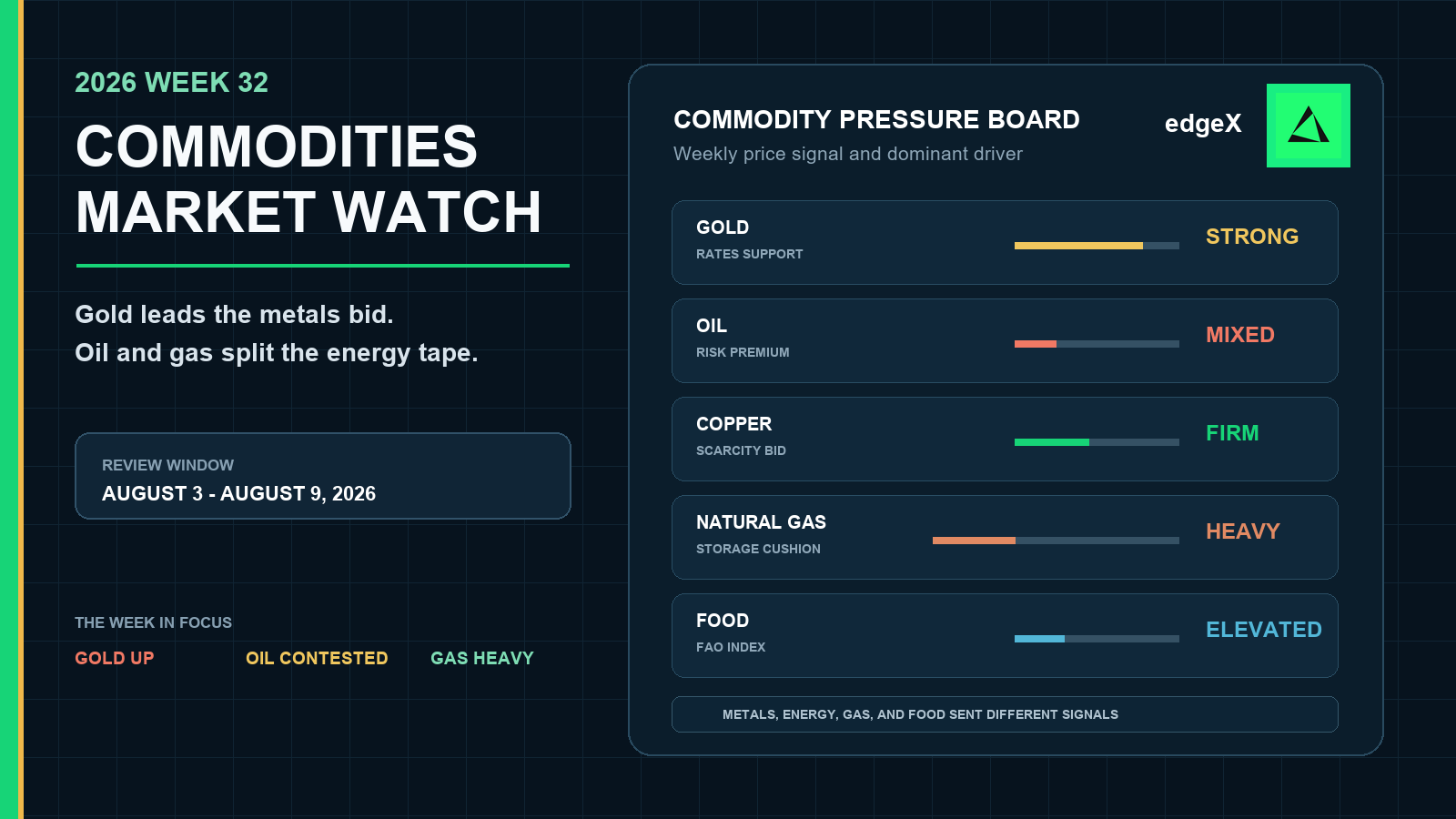
Week 32 was a split commodities market. Precious metals led because rates, the dollar, and policy expectations became more supportive after weaker U.S. labor signals. Oil remained a geopolitical market, but it could not trade only on risk premium because OPEC+ supply plans and EIA inventory details complicated the bull case. Copper held a scarcity bid tied to power, grid, AI-infrastructure, and supply constraints, even as China demand stayed uneven. Natural gas lagged because storage remained too comfortable for traders to price a shortage. Food prices added a separate inflation channel, with FAO's July index showing that agricultural and soft-commodity pressure had not disappeared.
Week 32 Was Not One Commodity Trade
Commodities entered Week 32 with traders looking for a clean macro instruction. They did not get one. The same week that gave precious metals a rate-sensitive lift also kept oil tied to shipping risk, copper tied to scarcity, natural gas tied to storage, and food commodities tied to supply stress. That is why the week should be read as a dashboard, not as a single inflation trade.
The review window ran from August 3 through August 9, 2026, while the main futures read ended on Friday, August 7. Within that window, the cross-market signal was unusually fragmented. Gold and silver responded to softer growth and lower-yield expectations. Oil still reflected Middle East risk, but the price story was less explosive than a pure Strait of Hormuz shock because supply-policy news also mattered. Copper remained a structural scarcity trade. Natural gas stayed heavy. Food prices added another layer through global agricultural data.
That mix matters for crypto, equities, currencies, and macro portfolios. A gold rally can support the idea that traders are preparing for easier policy. An oil spike can threaten inflation expectations. A copper breakout can look like a growth signal, but only if end demand confirms it. A weak natural gas market can lower energy-cost pressure in one region while doing little to solve global oil risk. Week 32 forced traders to separate those signals instead of blending them into one headline.
The week belonged to interpretation
Direction alone was not enough. A rising gold price did not automatically mean panic. Firm copper did not automatically mean a clean China recovery. Oil strength did not automatically mean demand was strong. Gas weakness did not automatically mean energy inflation was dead.
Commodities often lead inflation expectations, but they do so through different channels. Week 32 showed monetary hedging in precious metals, geopolitical insurance in crude, physical scarcity in copper, storage pressure in gas, and food-cost risk in agriculture. Those drivers can move together during a broad inflation scare. In Week 32, they moved with their own logic.
Week 32 Commodities Dashboard
| Market | Week 32 Signal | Why It Mattered |
|---|---|---|
| Gold | Stronger precious-metals bid | Lower-yield expectations and softer labor data supported non-yielding assets. |
| Silver | Followed gold with industrial nuance | Silver benefited from the metals bid but still needed clearer industrial confirmation. |
| Oil | Risk premium remained but was contested | Middle East tension supported crude, while OPEC+ supply plans and inventory details limited a one-way story. |
| U.S. crude inventories | Weekly draw in EIA report | The draw showed physical support, but product inventories complicated the demand read. |
| Copper | Firm scarcity trade | Supply constraints and power-grid demand outweighed uneven China signals. |
| Natural gas | Weakest energy signal | Storage remained comfortable enough to restrain shortage pricing. |
| Food prices | FAO index stayed elevated | Meat, vegetable oils, and sugar kept food inflation on the macro watchlist. |
The dashboard shows why the commodity complex gave mixed signals to other asset classes. Gold pointed toward rate relief. Oil warned about inflation risk. Copper argued for scarcity and infrastructure demand. Gas argued against a synchronized energy squeeze. Food prices warned that inflation pressure can reappear outside crude.
Gold Led Because Rates Became More Supportive
Gold's Week 32 strength came from a familiar but important mechanism: when traders expect lower yields or a softer dollar, the opportunity cost of holding gold falls. The setup improved after weaker U.S. labor-market signals pushed investors to think more seriously about future rate cuts. That helped precious metals regain leadership after earlier weeks in which inflation concern and higher-rate risk had pulled in opposite directions.
Gold was not just trading fear. It was trading policy probability. If the economy slows enough to bring rate cuts closer but not enough to trigger a disorderly earnings shock, gold can benefit from lower real-yield expectations. If the slowdown becomes more severe, gold can also attract defensive demand. Week 32 sat between those two readings.
Silver confirmed the bid, but not the whole story
Silver's participation helped confirm that the precious-metals move was broader than a gold-only hedge. Still, silver carries more industrial sensitivity than gold, so its signal was more complicated. A strong silver move can reflect monetary easing expectations, but it can also reflect demand for electrification, solar, electronics, and industrial production.
That dual identity is why silver did not settle the macro debate. It supported the metals bid, but it did not prove that global manufacturing demand was accelerating. Traders still needed copper, China trade data, manufacturing surveys, and physical premiums to confirm the industrial side of the story.
Oil Held a Risk Premium, but Supply News Capped the Message
Oil remained the market most exposed to geopolitics. Reuters reported during the week that crude climbed as Iran-related tension offset OPEC+ output plans. That sentence captures the Week 32 problem neatly: the bullish impulse came from disruption risk, but the market also had to price the possibility of more supply.
The Middle East premium was not imaginary. Any renewed stress around major shipping lanes can reprice crude quickly because the oil market has little tolerance for uncertainty around export routes, insurance costs, and tanker flows. When traders are forced to pay for tail risk, crude can rise even if demand data are mixed.
But Week 32 was not the same as a clean supply-shock week. OPEC+ production plans gave traders a reason to question how much risk premium should remain embedded in prices. If additional supply reaches the market while shipping flows remain intact, oil's upside becomes harder to sustain. If geopolitical stress intensifies, that additional supply may matter less than the probability of disruption.
EIA data showed support, not certainty
The EIA's weekly petroleum report added another layer. Commercial crude inventories fell in the report released during Week 32, which pointed to some underlying physical support. A draw can indicate refiner demand, exports, or tighter domestic balances. On its own, that would usually help crude.
The product side made the read less simple. Gasoline and distillate inventories are important because they show whether crude draws are translating into tight end-user fuel markets. If crude falls while product stocks build, the market may question whether the draw reflects durable demand or timing, exports, refinery behavior, and regional logistics. That is why the EIA report supported oil without giving bulls a clean victory.
The gap between price risk and physical confirmation left crude vulnerable to sharp repricing in either direction. Oil can keep a premium if geopolitical risk stays high. It can also lose that premium quickly if diplomacy improves, OPEC+ supply arrives, and product demand looks less urgent.
Natural Gas Stayed Heavy Because Storage Still Mattered
Natural gas told a different energy story. While crude traded shipping risk and global supply policy, gas remained anchored by storage. The EIA's weekly natural gas report kept the market focused on inventories, seasonal demand, and whether summer power burn was enough to tighten balances.
Comfortable storage does not eliminate volatility. A severe heat wave can lift power demand, LNG flows can change regional balances, and hurricane risk can affect production or infrastructure. But the starting point matters. When storage is adequate versus seasonal norms, traders need a stronger weather or demand catalyst before paying aggressively for scarcity.
That is why gas weakness was important. It prevented the energy story from becoming a single inflation alarm. Oil could still threaten transport, shipping, and headline inflation. Natural gas, at least in the U.S. context, was sending a more restrained signal.
Copper Stayed Firm Because Scarcity Beat Demand Doubt
Copper remained one of the most important signals in the commodity complex because it sits at the intersection of old and new demand. It is tied to construction, manufacturing, power grids, electrification, data centers, and AI infrastructure. In Week 32, the market continued to treat supply tightness as more important than the uncertainty around China demand.
The bullish case is straightforward. Grid expansion, AI data-center construction, renewable-energy integration, electric transport, and industrial equipment all require copper. At the same time, mine supply, concentrate availability, smelter economics, and scrap flows can tighten quickly. When supply is difficult to expand, even moderate demand growth can support prices.
China still decides whether copper becomes a macro signal
The caution is China. Copper can rise because supply is tight, but it becomes a broader global-growth signal only when demand confirmation follows. China's trade and manufacturing data remained important in Week 32 because China is central to refined copper demand, industrial metals sentiment, and commodity imports.
If China demand improves, copper's scarcity story becomes more powerful. If China remains uneven, copper can still trade firm, but the message becomes narrower: less "global cycle is accelerating" and more "specific metal supply is constrained." Week 32 leaned toward the second reading.
That distinction matters for equities and crypto. A copper rally driven by AI infrastructure and grid investment can support parts of the industrial and technology supply chain. A copper rally without broad demand confirmation may be less useful as a signal for global risk appetite.
Food Prices Kept the Inflation Watch Alive
Food commodities added a quieter but important macro signal. FAO's July Food Price Index, released during Week 32, showed food costs remained an issue, with pressure across several categories including meat, vegetable oils, and sugar. Food inflation does not move financial markets as dramatically as oil, but it matters for households, emerging-market policy, and central-bank communication.
Food is also politically sensitive. Rising food costs can affect consumer sentiment faster than some financial indicators because households feel the change directly. For emerging markets, food and energy prices can influence currencies, subsidies, trade balances, and rate policy. For developed markets, they can complicate the disinflation story if headline inflation stops improving.
Inflation risk was not only an oil story in Week 32. Even if natural gas stays soft and crude fails to break higher, food prices can keep pressure alive in a different part of the consumer basket.
Cross-Market Impact Map
| Commodity Signal | Risk-On Interpretation | Risk-Off Interpretation |
|---|---|---|
| Gold strength | Lower yields can support growth assets and crypto liquidity | Defensive demand may be warning that growth risk is rising |
| Oil risk premium | Energy equities and producers may benefit from geopolitical premium | Higher crude can pressure inflation expectations and consumers |
| Copper firmness | AI infrastructure and grid demand remain durable | Supply-driven strength may not confirm broad global growth |
| Gas weakness | Softer energy costs can ease inflation pressure | Weak gas may reflect oversupply rather than healthy demand |
| Food-price pressure | Agricultural producers may gain pricing support | Household inflation and emerging-market stress can rise |
What Traders Should Watch Next
The next test for commodities is whether Week 32's split signals converge or keep diverging. Gold needs the rates market to confirm that lower-yield expectations are durable. If yields fall further, precious metals can extend leadership. If stronger data returns, gold may lose part of the policy bid.
Oil needs three confirmations: geopolitical risk, OPEC+ supply execution, and product demand. If all three turn bullish at once, crude can move quickly. If only the risk premium remains, rallies may struggle to hold. Natural gas needs storage to tighten enough for weather to matter more than inventory comfort.
Copper needs China and physical-market confirmation. AI infrastructure is a real demand story, but copper's broader macro message depends on whether industrial demand catches up with scarcity. Food prices need monitoring because they can complicate central-bank messaging even when energy is mixed.
Week 32 did not send one commodity message. It sent five. Gold argued for easier-policy sensitivity. Oil argued for geopolitical caution. Copper argued for structural scarcity. Gas argued for inventory restraint. Food argued that inflation pressure can survive outside the energy complex.
Trade Commodities Perpetuals On-Chain with edgeX
Commodity markets move fast. Your trading infrastructure should too.
edgeX is a decentralized exchange built on EDGE chain, settling on Ethereum via Arbitrum, that lets traders access tokenized RWA commodities perpetuals with institutional-grade execution and true self-custody. No KYC. No centralized custodian. Just full control of your assets, your private keys, and your positions.
Why traders choose edgeX for commodities:
- Ultra-deep liquidity: $10 million of depth within a one-basis-point spread, with sub-0.1-basis-point slippage on trades over $100,000, even during peak volatility.
- High-performance engine: Up to 200,000 orders per second with sub-10 millisecond matching latency.
- True self-custody: Withdrawals require only your wallet authorization; no platform approval needed.
- No KYC required: Start trading commodities, tokenized stocks, and crypto perpetuals without identity verification.
- 100% trading fee rewards: edgeX's Trade to Own program returns 100% of trading fees back to users in $EDGE tokens.
- USDC-backed settlement: USDC is designed by Circle to be redeemable 1:1 for U.S. dollars, giving traders a familiar settlement base.
Whether you're trading gold, oil, or other RWA commodities, edgeX gives you the liquidity depth of a centralized exchange with the security of on-chain settlement.
The platform is available on desktop and as a native mobile app on iOS and Android, so you can manage positions and react to commodity market moves from anywhere.
Ready to trade commodities perpetuals without the constraints of a centralized exchange? Start trading on edgeX with no KYC and no compromises.
Frequently Asked Questions
What was the main commodities story in Week 32 of 2026?
The main story was fragmentation. Gold and silver strengthened with a more supportive rate backdrop, oil kept a geopolitical premium, copper held a scarcity bid, natural gas stayed weak because storage remained comfortable, and food prices kept inflation risk on the watchlist.
Why did gold perform better during Week 32?
Gold benefited from softer U.S. labor-market expectations and lower-yield pressure. When traders expect easier policy or lower real yields, the opportunity cost of holding gold declines.
Why was oil not a simple bullish story?
Oil still reflected geopolitical risk, especially around the Middle East, but OPEC+ supply plans and mixed U.S. inventory details limited the message. The market had to price both disruption risk and potential supply relief.
Why did copper matter for broader markets?
Copper matters because it is tied to manufacturing, electrification, power grids, and AI infrastructure. Week 32's firmness supported the scarcity narrative, but China demand still needed confirmation before copper could be treated as a broad global-growth signal.
Why should traders watch food prices?
Food prices affect households, emerging markets, inflation expectations, and central-bank communication. FAO's July index showed that food inflation risk remained relevant even when energy signals were mixed.

