Fall Natural Gas Storage Builds Seen Lagging Norms Despite High Output
Key Takeaways
- •US natural gas storage injections are expected to accelerate as summer demand fades, thanks to near-record production increasingly driven by Permian Basin associated gas.
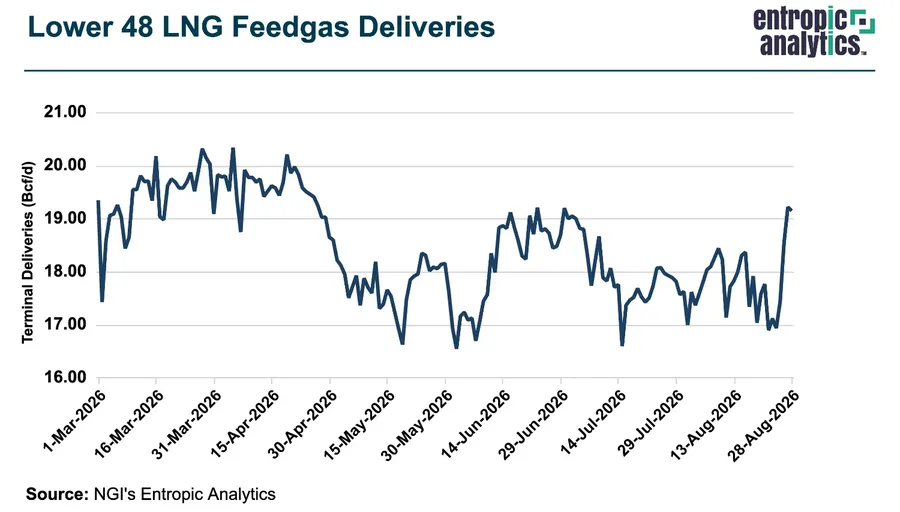
- •Rising LNG feedgas demand from terminals such as Corpus Christi and Golden Pass could hold fall storage builds below historical norms and leave inventories under 4 Tcf before winter.
- •Private forecasts of end-of-season inventories fall below EIA projections, reflecting differing assumptions about LNG feedgas ramp-up as new export capacity comes online.
- •The EIA reported just a 15 Bcf storage injection for the week ended August 21, well short of expectations, as heat and recovering LNG activity pressured demand.
- •Freeport LNG completed major maintenance, with feedgas nominations nearing 2 Bcf/d and returning roughly 0.8 Bcf/d of demand to the Gulf Coast.
Near-record natural gas production in the United States should allow storage injections to accelerate as summer demand fades, but growing LNG demand could keep fall builds below historical norms and leave inventories shy of 4 Tcf heading into winter.
At a Glance
- Fall storage builds are set to accelerate
- LNG demand is expected to strengthen
- Private forecasts fall below the EIA's
The outlook reflects the competing forces shaping the US natural gas market ahead of the heating season. On one hand, robust production — increasingly driven by associated gas from the Permian Basin — positions operators to push substantial volumes into storage during the shoulder season, when cooling demand recedes and heating demand has not yet begun. On the other hand, rising feedgas demand from LNG export terminals, including facilities such as Corpus Christi LNG and the ramp-up of Golden Pass LNG, is expected to absorb a growing share of supply, limiting the pace of injections.
The tension matters because the injection season, which typically runs from April through October, sets the inventory cushion available when winter heating demand arrives. A tighter starting point leaves the market more sensitive to cold-weather demand swings and to any supply or export disruptions during the heating season.
Private forecasts of end-of-season inventories fall below projections from the US Energy Information Administration (EIA), the federal agency that tracks weekly storage data. The divergence points to differing assumptions about how much LNG feedgas demand will ramp up as new export capacity comes online. Inventories below the 4 Tcf mark heading into winter would mark a tighter starting point than in some recent years.
The storage picture has been strained in recent weeks. For the week ended August 21, the EIA reported an injection of just 15 Bcf into storage — well short of expectations — as sweltering heat across much of the country and recovering LNG activity kept upward pressure on demand. Operators in the South Central region drew heavily on storage during that week.
LNG feedgas flows have also been recovering. Freeport LNG, the Gulf Coast export terminal in Texas, recently completed major maintenance, with feedgas nominations nearing 2 Bcf/d on Thursday — returning roughly 0.8 Bcf/d of demand to the Gulf Coast just as summer heat lingers into September.
With roughly two months left in the typical injection season, the weekly EIA storage reports and the pace of LNG feedgas nominations will be the key data points to watch in gauging whether fall builds can close the gap with historical norms.
Source: Natural Gas Intelligence

