Cooling Demand Slips, but Steady Heat Seen Keeping Natural Gas Storage Build Tight
Key Takeaways
- •NGI models a 31 Bcf storage injection for the week ended Aug. 28, nearly double the previous week's 16 Bcf build.
- •The projected injection trails both the 50 Bcf build from the same week a year ago and the 37 Bcf five-year average.
- •Henry Hub spot prices averaged $2.805/MMBtu during the week.
- •US natural gas inventories stood at 3,184 Bcf as of Aug. 28, 30 Bcf below year-earlier levels but 167 Bcf above the five-year average.
- •The EIA will publish its weekly storage report on Thursday, revealing whether the injection matches NGI's estimate.
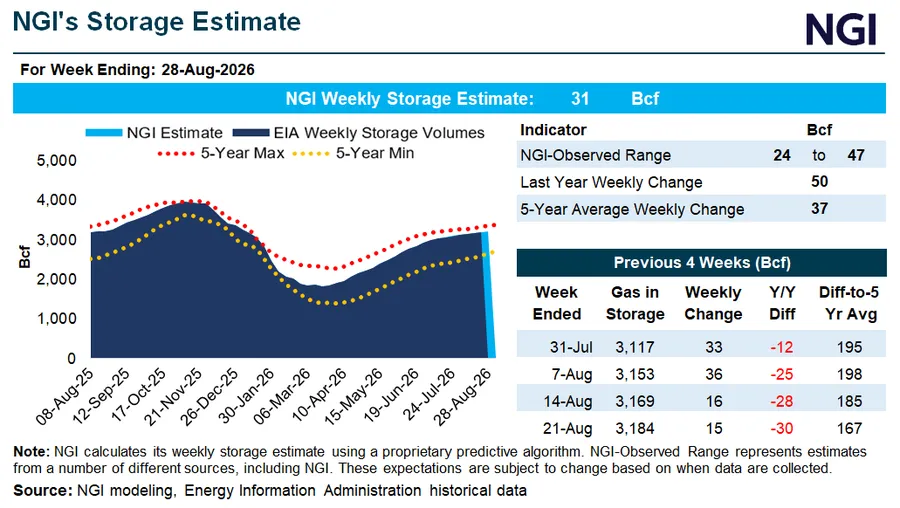
Natural gas storage inventories are on track for a larger injection this week, as a double-digit percentage decline in cooling demand could nearly double last week's build, according to analysis from NGI's price and data analysts.
NGI is modeling a 31 Bcf injection into US natural gas storage for the week ended Aug. 28. The estimate follows the 16 Bcf build reported by the US Energy Information Administration (EIA) last Thursday. The EIA publishes its Weekly Natural Gas Storage Report each Thursday, drawing on a survey of underground storage operators, and the figures are closely watched as a gauge of supply and demand balance because storage acts as the buffer between production and seasonal demand — injections in summer and withdrawals in winter.
The expected 31 Bcf build is consistent with the modest decline seen in weekly spot prices at Henry Hub, the benchmark pricing hub for US natural gas, which averaged $2.805/MMBtu. Henry Hub spot prices serve as a reference point for physical and financial natural gas contracts across North America, so weekly storage outcomes and weather-driven demand shifts there are widely tracked by producers, utilities and traders.
Even so, the projected injection would fall short of historical norms for the week. A 31 Bcf build compares with a 50 Bcf injection during the same week a year ago and the 37 Bcf five-year average. Smaller-than-normal injections during the late-summer refill season typically indicate that more gas is being consumed than in prior years, tightening the margin of surplus inventories heading into the heating season.
The EIA said inventories as of Aug. 28 stood at 3,184 Bcf — 30 Bcf below year-earlier levels but 167 Bcf above the five-year average. The surplus relative to the five-year average is the figure most market participants watch as the winter approaches, since it shapes expectations for how cushioned the market is against cold-weather demand. The next EIA storage report, due Thursday, will show whether the injection matches NGI's modeling or surprises to the upside or downside.
