LNG Feedgas Demand Retreats Ahead of Sabine-Neches Waterway Reopening
Key Takeaways
- •US LNG feedgas demand fell to about 17.37 Bcf/d on Wednesday, down roughly 892 MMcf/d from Tuesday.
- •The Sabine-Neches Waterway reopened to outbound traffic after closing because of Tropical Depression Edouard.
- •The Houston area was placed in the highest flood risk category as Edouard’s remnants moved across Texas.
- •Global LNG exports totaled 32.83 Mt in August, which was 1.73 Mt below the level a year earlier.
- •US LNG exports climbed to 10.19 Mt in August, up 15% year on year and about 31% of the global total.
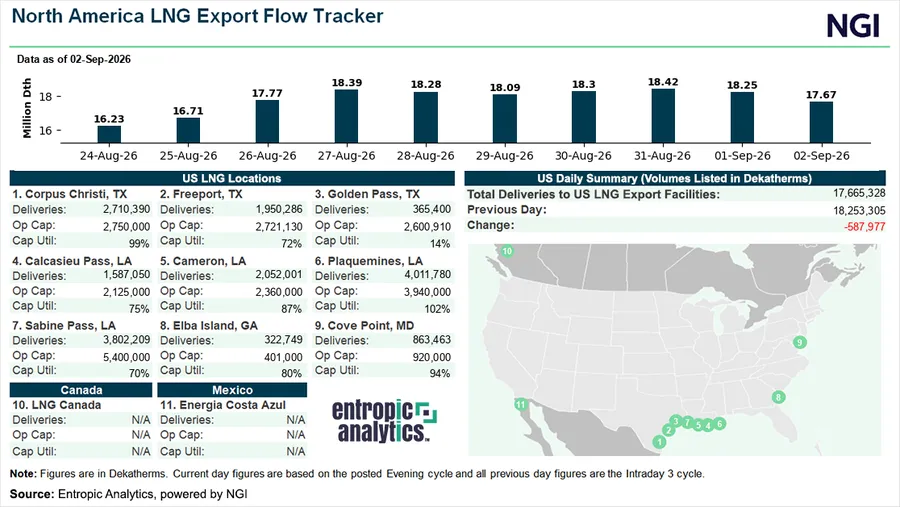
A look at the global natural gas and LNG markets by the numbers.
17.37 Bcf/d: US LNG feedgas demand slipped to roughly 17.37 Bcf/d in Wednesday’s nominations, down about 892 MMcf/d from Tuesday, according to NGI’s Entropic Analytics data. Lower nominations at all four of Sabine Pass’s feeder points accounted for roughly three-quarters of the decline, with smaller decreases at Calcasieu Pass and Cameron. Feedgas nominations have not topped 18.5 Bcf/d since April 26 and remain below the 19.50 Bcf/d high set March 28. The Sabine-Neches Waterway serving Beaumont and Port Arthur reopened to outbound traffic at 12 p.m. ET Wednesday after closing late Aug. 31 for Tropical Depression Edouard, which produced a peak gust of 91 mph about two miles south of Port Arthur, according to the US Coast Guard Marine Safety Unit Port Arthur. The reopening matters because the corridor handles LNG-related marine traffic for the Texas Gulf Coast, where any weather-driven closure can quickly affect vessel movements even when operators report no technical issues.
70%: The National Oceanic and Atmospheric Administration’s Weather Prediction Center (WPC) placed the Houston area under its highest risk category for flooding starting at 8 a.m. ET Thursday as the remnants of Tropical Depression Edouard continued tracking across Texas. Meteorologists estimated flood risks at 70% or higher across a swath northwest of Houston as the National Hurricane Center advised of 35-45 mph gusts near the depression’s center. A marginal flood risk extended east to near New Orleans. While feedgas nominations to Gulf Coast terminals were cut significantly by Wednesday afternoon, pipeline and export facility operators did not report any technical issues to customers or state regulators, leaving the focus on weather impacts to transport and scheduling rather than infrastructure damage.
1.73 Mt: Global LNG exports fell 1.73 Mt short of year-ago levels in August, totaling 32.83 Mt even as loadings rose 1.21 Mt from July, according to Kpler vessel tracking data. The shortfall was attributed almost entirely to the Middle East, where exports dropped by 4.98 Mt from the year-ago period in 2025 to 2.94 Mt as Qatari volumes collapsed 78% to 1.46 Mt. Growth elsewhere offset only part of the decline, adding a combined 3.25 Mt year/year. The Americas led at 12.30 Mt, up 1.97 Mt, followed by the Pacific at 12.24 Mt. Europe rose 0.66 Mt to 2.08 Mt, and Africa gained 0.15 Mt to 3.26 Mt. Global imports totaled 32.06 Mt, down 3.37 Mt year/year, with Asia accounting for most of the decline at 22.31 Mt, off 3.25 Mt. The regional split underscores how shifts in one major supplier can outweigh broader gains elsewhere, especially when Asia’s intake softens at the same time.
10.19 Mt: US LNG exporters loaded 10.19 Mt in August, up 15% from a year earlier. The United States recorded the largest year/year increase of any exporting country for August, according to Kpler vessel tracking data. US LNG exports were essentially flat compared with July. Europe took 5.47 Mt in US LNG during the month, up 1.47 Mt and 0.32 Mt year/year. Asia took 2.91 Mt, down 0.93 Mt from July but still 1.19 Mt above the same period last year. US volumes accounted for roughly 31% of the 32.83 Mt global total for the month, and the Americas as a region exported 12.30 Mt, up 1.97 Mt year/year.
