U.S. shale expertise helps drive Australia’s Beetaloo Basin toward a gas boom
Key Takeaways
- •Tamboran Resources and Daly Waters Energy announced the first commercial natural gas sales from Australia's Beetaloo Basin in September, delivering the partners' first revenue after years of losses.
- •The project succeeded after major U.S. oilfield-services companies—Helmerich & Payne, Baker Hughes, Liberty Energy, and Halliburton—brought American shale drilling and slickwater fracking equipment and expertise to Australia.
- •In 2022, Tamboran acquired Origin Energy's Beetaloo acreage for just over $40 million plus a share of future royalties, it the basin's largest player.
- •The company plans to expand output from roughly 40 million cubic feet per day to 100 million cubic feet per day in 2028, with additional drilling and a new pipeline targeted by 2030 to supply domestic markets and potentially support LNG exports.
- •Tamboran is not yet profitable, its auditor continues to flag financial viability as a going concern, and management is seeking a larger strategic partner to fund further expansion.
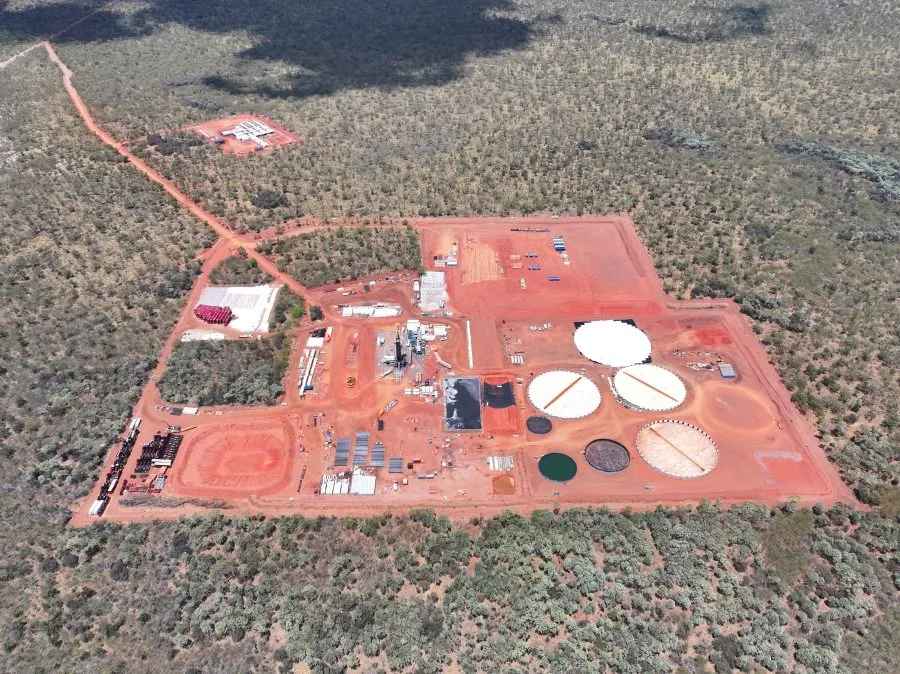
Australia spent two decades studying whether the U.S. shale oil and gas revolution could be replicated in its own largely undeveloped reserves. That effort began producing results in September, when the first commercial natural gas deliveries from the Beetaloo Basin started flowing to the energy-hungry Northern Territory.
The milestone followed years of setbacks and a major influx of American oilfield expertise and capital. Tamboran Resources, a Sydney startup, and Daly Waters Energy, an Australian subsidiary established by Texas investor Bryan Sheffield, still need to show that the basin can operate economically over the long term. But the first sales demonstrated that the Beetaloo can produce and deliver gas.
“This is a total gamechanger,” Sheffield told Fortune. Five wells are now ramping up, he said. “We created revenue. This whole time, the past five years, we have not had $1 coming back to us.”
The timing is significant for companies that have been losing money and for Australia, which could face natural gas shortages in the coming years. The United States, Australia and Qatar are the leading liquefied natural gas exporters. Qatar’s exports have been largely offline because of the Iran war, while more of Australia’s offshore gas fields are declining. The Beetaloo’s onshore shale resources could offer another source of supply.
Sheffield’s involvement began after the American shale industry had already established the techniques needed to unlock dense rock. Tamboran hired an American veteran of ExxonMobil and Chevron as its CEO in 2013. In 2014, Texas oil executive Scott Sheffield joined the board of Santos, an Australian natural gas company, and became interested in applying U.S. shale drilling and hydraulic-fracturing expertise to the sparsely populated Beetaloo Basin.
Scott Sheffield saw similarities between the Beetaloo and the Marcellus Shale in Appalachia and brought the opportunity to his son, Bryan, who was also a Texas oil executive. Bryan Sheffield was then focused on taking his company, Parsley Energy, public. A few months later, shale pioneer Aubrey McClendon acquired a small land position in the Beetaloo. Bryan Sheffield read about it and felt he had missed an opportunity.
“I just remember feeling deflated,” Bryan Sheffield told Fortune. “He got into the Beetaloo really early and cheap. I remember thinking to myself, ‘He’s just running circles around me.’”
McClendon died in a car accident a year later, and the basin faced further obstacles. Amid global opposition to fracking, the Northern Territory imposed a moratorium from 2016 to 2018. Santos and other companies drilled wells that produced limited results but failed to replicate the U.S. formula. The COVID-19 pandemic then reduced global exploration budgets and caused most companies to lose interest in the Beetaloo.
Parsley was also hurt by the pandemic and was sold to Scott Sheffield’s company, Pioneer Natural Resources, for $4.5 billion. Two years ago, ExxonMobil acquired Pioneer for $60 billion, the largest U.S. oil deal of the century.
After the pandemic, Bryan Sheffield’s former top geologist at Parsley again raised the subject of the Beetaloo. This time, Sheffield took the lead through his private-equity firm, Formentera Partners.
“This play keeps coming up. This is three times,” Sheffield said. He took that repetition as a sign. After investing heavily in Tamboran and Beetaloo Energy, he established Daly Waters Energy as his own Australian subsidiary.
Four years later, Daly Waters and Tamboran announced the first natural gas sales from the Beetaloo in September. The partners’ progress depended not only on capital but also on persuading major U.S. oilfield-services companies to bring shale expertise and equipment to Australia.
Helmerich & Payne (H&P), a drilling company; Baker Hughes, a tools and services provider; and Liberty Energy, a hydraulic-fracturing company cofounded by U.S. Energy Secretary Chris Wright, all took ownership stakes in Tamboran. Beetaloo Energy recently contracted with Halliburton.
“Applying the American [fracking] recipe to another country is the way forward,” Sheffield said.
A newly built pipeline and gas-processing plant now transport and process the gas. “The big problem was the lack of service companies and infrastructure. Talking the service companies into moving into this play was key to unlocking it,” Sheffield said.
“It’s kind of like in that movie, ‘Field of Dreams,’” he added. “‘If you build it, they will come.’”
A basin that long defied drillers
A 1979 minerals-drilling program caused an accidental gas blowout in the Beetaloo. The incident attracted the attention of Amoco, a major U.S. oil and gas company that was later acquired by BP. Amoco drilled a test well in 1984, but it was dry. Other companies also tried and failed, even though geological survey data indicated that the basin had significant gas potential.
Those attempts came roughly 20 years before U.S. shale operators developed the combination of horizontal drilling and slickwater fracking that unlocked shale production. Slickwater fracking uses water, sand and thin, friction-reducing chemicals rather than thicker gels to fracture dense shale rock deep underground and release gas.
In 2008, Texas geologist and Petrohawk Energy cofounder Dick Stoneburner helped advance drilling and fracking techniques and led the discovery of the Eagle Ford Shale oil boom in South Texas. Three years later, Australian mining company BHP acquired Petrohawk for $12 billion as its entry into U.S. shale. Stoneburner was contractually required to help with the transition, which brought him to Australia.
After completing his BHP obligation, Stoneburner joined Tamboran’s board in 2014. That same year, Santos drilled its first Beetaloo test well using modified shale techniques. The results were modest and did not impress investors, but they remained promising.
“I got intrigued,” Stoneburner told Fortune. “Santos had limited shale experience, really none. They had a big learning curve.”
Stoneburner and later Bryan Sheffield concluded that Santos’ wells needed wider diameters, or wider casing, and slickwater fracking rather than gelled fluids. Those changes were needed to sustain enough pressure to produce substantial gas flows, and the required equipment was available in the United States but not in Australia.
“This is when I knew the play was going to work. They just weren’t doing it right,” Sheffield said. The partners found that Australian rigs could accommodate only smaller diameters. “That’s when I knew I had to talk a rig company into moving horizontal rigs to Australia.”
The pitch was helped by conditions after the pandemic. Oilfield-services companies had surplus equipment and were looking for growth opportunities. H&P shipped a high-specification rig, Liberty brought a fracking fleet, and Baker Hughes supplied tools and services.
“It’s not off-the-shelf stuff. So it’s all worked out very, very well,” Stoneburner said.
Sheffield was initially impressed by a detailed report on the Beetaloo prepared by his former geologist, Tom Layman. After the pandemic, Layman connected Sheffield with Stoneburner. The two knew of each other but had not met in person. Sheffield later met Tamboran’s CEO at the time, Alabama native Joel Riddle.
Rather than invest only in Tamboran, Sheffield also acquired stakes in Beetaloo Energy and Falcon Oil & Gas, which Tamboran acquired earlier this year. He formed Daly Waters as well.
“He was ready to go,” Stoneburner said, describing himself as surprised by Sheffield’s speed and aggressiveness.
The Origin Energy deal
Origin Energy, an Australian utility, was the largest acreage holder in the Beetaloo. The company lacked shale expertise and had no clear development plan for the land. Facing investor pressure to decarbonize and avoid fracking, Origin considered selling its position.
In 2022, Tamboran, supported by Sheffield’s capital, acquired Origin’s Beetaloo interests for just over $40 million plus a share of future royalties. The transaction made Tamboran the basin’s largest player. Sheffield and Stoneburner credit Riddle with completing the deal.
“Origin was a really huge domino to fall,” Stoneburner said.
“We split the deal because it was too much for [Tamboran] to take on alone, and I kind of just paid out of my family office,” Sheffield said. Tamboran and Formentera-backed Daly Waters effectively divided the acreage, with Sheffield forming a joint venture on Tamboran’s operations. He now controls nearly 10% of Tamboran’s stock.
Formentera’s normal strategy is to pursue “singles and doubles” in mature U.S. shale basins, and Sheffield’s initial investments in Australian companies followed that model. The Origin transaction changed the scale of the opportunity.
“I knew my investors would not like the Beetaloo because there’s a lot of risk,” Sheffield said. “The pension funds and the endowments, they did not invest. It was just too risky for them. The Beetaloo is the home run product, and it’s more tailored toward family offices.”
Since the Origin deal closed, Tamboran and Daly Waters have brought their services partners to Australia, constructed a pipeline and processing facility, completed early permitting and developed the Shenandoah South pilot project. Shenandoah South is now online and expected to ramp up. Daly Waters plans to add a second H&P rig next year.
Japan’s INPEX became a major investor early this year. Its participation supports the eventual supply of gas to Australian LNG facilities serving Japan and the wider Asian market, particularly INPEX’s Ichthys LNG hub in northwestern Australia. Tamboran is also a joint-venture partner with Santos, which operates Darwin LNG and Gladstone LNG, two facilities that could receive Beetaloo gas.
Last year, Tamboran removed Riddle as CEO and appointed Stoneburner interim CEO. Scott Sheffield joined the board at the same time, after serving three years on Santos’ board. Riddle is credited with building Tamboran, but he also had conflicts with partners.
“I was there to help mend relationships,” Stoneburner said. His involvement helped lead to Tamboran’s acquisition of Falcon.
In January, Tamboran hired Houston-based Todd Abbott, a 15-year veteran of Scott Sheffield’s Pioneer and a friend of Stoneburner. Bryan Sheffield also supported the appointment.
“I was trained as an oilman underneath Scott Sheffield and his people, and Todd Abbott is the exact same,” Bryan Sheffield said. “We come from the same learning curves.”
Abbott had read about Stoneburner’s interim appointment the previous year and sent him a text. “He just replied back, ‘We should talk,’” Abbott told Fortune.
Production is only the starting point
Abbott said his most enjoyable years were Pioneer’s early Permian Basin shale-oil expansion, when the focus was “grow, grow, grow.” U.S. shale is now focused on extracting another penny from existing operations each day, he said. Tamboran offers the opportunity to establish a pioneering position in a basin again, which he called a “once-in-a-lifetime opportunity.”
“First production is the really big milestone,” Abbott said of the Beetaloo. “But it’s certainly not the finish line. It’s more of the starting line.”
The Beetaloo’s rock is similar to the Marcellus Shale in Pennsylvania and West Virginia. The Beetaloo is approximately 1.3 billion years old, compared with nearly 400 million years for the Marcellus.
Abbott said initial well results are promising, but additional results will be needed in the coming weeks and months to attract new investors and partners. Tamboran acknowledges that it needs a larger partner to continue expanding. Its stock is up more than 25% this year, but a new auditor’s report continues to flag its financial viability as a “going concern.” The company is not profitable and is only now recording its first revenue.
“We’re out looking for the right strategic partner for the long term,” Abbott said.
Production is ramping up toward 40 million cubic feet of gas per day. The company plans to increase output to 100 million cubic feet per day in 2028 after completing an expansion of its gas-processing facilities. After that, the plan calls for additional drilling and another pipeline by 2030. The expansion would supply more domestic gas beyond the Northern Territory and could support LNG exports.
Until now, the territory has relied on emergency contracts with LNG exporters to supply gas-fired electricity.
“Once it’s fully connected, the Beetaloo is multiple times large enough to supply the Australian domestic market. It takes care of the expected shortage,” Abbott said. “But to really get this basin up to the scale, it needs LNG export access.”
Australian entrepreneur Patrick Elliott founded Tamboran in 2009 and remains on its board. The Beetaloo, however, quickly became an American-Australian venture.
“Seventeen years is a long time, but there was a lot of work to do, and it’s accelerating now,” Abbott said. “It’s an exponential curve, and you’re starting to see real traction.”
The Iran war has further highlighted the Beetaloo’s potential by leaving Qatar’s LNG exports largely offline. The disruption has increased the world’s dependence on U.S. and Australian LNG, particularly in the Asia-Pacific region, while Australia may need additional gas for export.
“It has focused everyone on the need for diversifying,” Abbott said. “Supply chains are critical, and energy security is national security.” He added that Australia can supply Asia at a lower cost than the United States because of shorter shipping distances.
About 75% of Australia’s natural gas production comes from offshore fields, limiting the scope for growth. The remainder comes from onshore coalbed methane, also known as coal seam gas, and those resources are not expanding either.
“There are really not a lot of other sources of this scale in the Asia-Pacific that can do it,” Abbott said. “I think it really put eyes on Australia and on the Beetaloo at a pretty critical moment for us.”
Originally published by Fortune: https://fortune.com/2026/10/10/us-fracking-australia-gas-boom-texas-trump-energy/

