U.S. opens vast Pacific seabed to mining near Northern Mariana Islands
Key Takeaways
- •The U.S. Bureau of Ocean Energy Management issued a Proposed Leasing Notice covering about 271,000 square kilometres of federal waters offshore the Commonwealth of the Northern Mariana Islands.
- •The seabed area may contain polymetallic nodules and ferromanganese crusts with commercially valuable concentrations of cobalt, nickel, copper, manganese, zinc and rare earth elements.
- •The lease sale is scheduled for Dec. 16, with leases carrying 20-year terms, and a Final Leasing Notice would be published at least 30 days before any sale.
- •Environmental groups sharply criticised the plan, and more than 30 countries, including France, Germany and New Zealand, have called for a moratorium or precautionary pause on deep-sea mining.
- •The IUCN reported that 125 of the 201 known hydrothermal-vent mollusc species are now listed as threatened because seabed mining would smother ecosystems with sediment and destroy habitats.
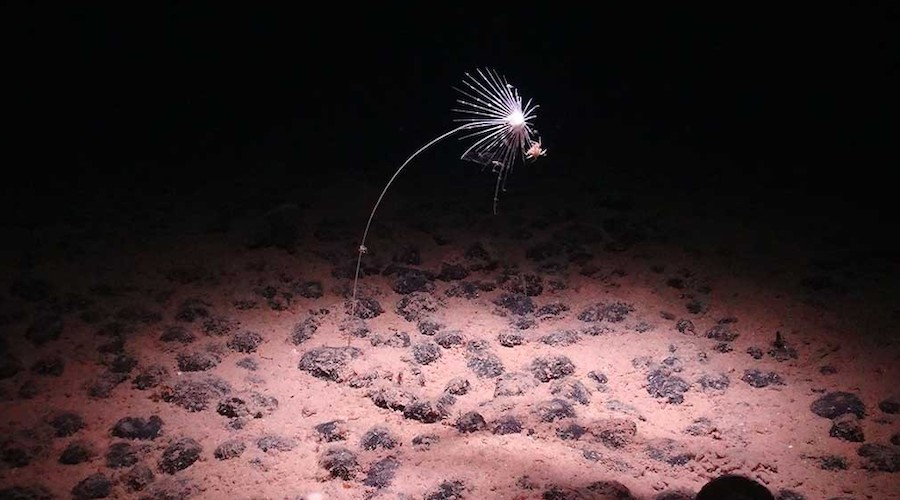
Washington is planning to auction deep-sea mining leases near the Northern Mariana Islands later this year, advancing the Trump administration’s push to develop domestic sources of critical minerals from the ocean floor.
The U.S. Bureau of Ocean Energy Management (BOEM) on Monday issued a Proposed Leasing Notice for a potential mineral lease sale in federal waters offshore the Commonwealth of the Northern Mariana Islands (CNMI).
The area covers about 271,000 sq. km of seabed east and west of the U.S. Pacific territory, which is about 2,400 km east of the Philippines. It includes abyssal plains, seamounts and underwater volcanic mountains, with water depths ranging from 1,130 to 7,650 metres. The islands sit near the Mariana Trench, the deepest oceanic trench on Earth, and the surrounding waters host hydrothermal vent ecosystems that scientists are still working to catalogue.
The proposed sale would mark a major step for an industry that has not yet begun commercial-scale deep-sea mining anywhere in the world. The U.S. Department of the Interior has identified the CNMI as one of several areas where offshore critical-mineral lease sales could be held as Washington seeks to reduce reliance on foreign mineral supplies.
In international waters, seabed mining is overseen by the International Seabed Authority, a U.N.-affiliated body that has spent more than a decade drafting commercial exploitation rules without finalizing them. The United States, which has not ratified the U.N. Convention on the Law of the Sea, regulates leasing on its own Outer Continental Shelf independently.
“Critical minerals are essential to America’s national security, economic strength and resource sovereignty,” Matt Giacona, acting director of the U.S. Marine Minerals Administration (MMA), a newly created office overseeing U.S. marine mineral development, said in a statement. “The United States cannot afford to depend on foreign nations for the resources that power our economy and support our defense industrial base. The Marine Minerals Administration is working to unlock the critical mineral potential of the U.S. Outer Continental Shelf responsibly, transparently and with the rigorous environmental review the American people expect.”
Polymetallic nodules
The area near the Mariana Islands contains several types of seabed mineral deposits. BOEM’s earlier work identified potential polymetallic nodules and ferromanganese crusts, with possible commercially valuable concentrations of cobalt, nickel, copper, manganese, zinc and rare earth elements, among other minerals.
Polymetallic nodules are rock-like mineral concentrations that form on the seafloor over millions of years, and they have attracted commercial interest because they contain battery metals such as nickel and cobalt used in electric vehicles, electronics and defence systems. Supply and processing of many of these minerals are currently concentrated in a small number of countries, a key driver of U.S. policy.
The MMA said issuing the proposed leasing notice does not necessarily mean a lease sale will be held. If the agency decides to proceed, it will publish a Final Leasing Notice in the U.S. Federal Register at least 30 days before the sale date.
The sale is scheduled for Dec. 16. Leases would carry a 20-year term.
Last month, the Trump administration proposed leasing more than 125,000 sq. km of seabed off American Samoa for deep-sea mining.
Swift criticism
Reaction from environmental organizations to Monday’s announcement was swift and sharp.
“It’s disgraceful that the Trump administration is bulldozing ahead with plans to allow deep-sea mining while the people who live closest to the proposed project are rightfully demanding that it be stopped,” Nick Katkevich, an oceans campaigner at the Tucson, Arizona-based Center for Biological Diversity, said in an e-mailed statement. “Deep-sea mining will be catastrophic for most of the mollusks on the ocean floor, along with all kinds of other creatures. These massive mining projects are just too experimental and dangerous for marine life to allow them to go forward.”
The U.S. push also runs alongside an international debate over the industry’s future: more than 30 countries, including France, Germany and New Zealand, have called for a moratorium or precautionary pause on deep-sea mining until more is known about its environmental effects.
Existential threat
Sixty-two percent of the rare mollusc species living around deep-sea hydrothermal vents face extinction from proposed seabed mining, the International Union for Conservation of Nature (IUCN) said last month.
Some 125 of the 201 known vent-dwelling mollusc species are now listed as threatened because mining for critical minerals such as copper, cobalt and zinc would blanket fragile ecosystems with sediment and destroy habitats, the IUCN, the global scientific authority on the status of species, said July 9.
More than 200 mollusc species are known to live exclusively around hydrothermal vents, where water heated by volcanic rock can reach 450°C before jetting through the seabed. Many have been discovered only within the past decade and exist nowhere else on Earth.

