US Crude Oil and Petroleum Product Exports Surge to Records in May as SPR Draws Continue
Key Takeaways
- •US crude oil exports reached an all-time high of 5.73 million barrels per day in May, representing a 58% increase from the same month a year earlier.
- •Ultra-low sulfur diesel exports set a record at 1.54 million barrels per day, driven partly by EU sanctions cutting off Russian supplies and increasing European reliance on American distillates.
- •Net petroleum exports climbed to a new record of 5.9 million barrels per day in May, according to US Energy Information Administration data.
- •The Strategic Petroleum Reserve has fallen to multi-decade lows of 307.7 million barrels, declining 107.8 million barrels since the start of the Iran war.
- •The Department of Energy has indicated plans to begin refilling the SPR, a process that could eventually absorb supply currently available for export.
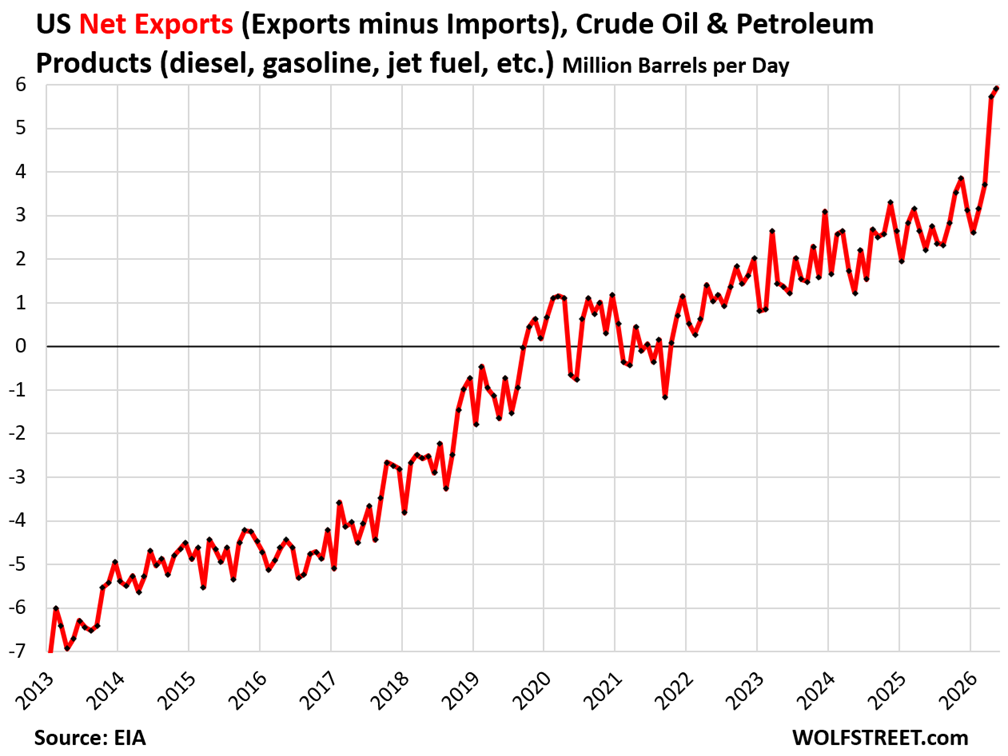
Crude oil exports from the United States reached an all-time high of 5.73 million barrels per day (MMb/d) in May, a 58% increase from a year earlier, driven in part by large releases from the Strategic Petroleum Reserve (SPR). Exports of ultra-low sulfur diesel also set a record at 1.54 MMb/d, up 36% year-over-year.
The global surge in crude oil and petroleum product prices—including diesel, gasoline, and jet fuel—has accelerated US production and export activity, supplemented by substantial SPR releases that were either exported directly as crude oil or refined into value-added products before being shipped overseas. Concurrently, imports of crude oil and petroleum products declined further.
Net exports (exports minus imports) climbed to a new record of 5.9 million barrels per day in May, according to data released by the US Energy Information Administration (EIA).
The United States became the world's largest crude oil and lease condensate producer in 2018. In 2025, US production exceeded Russia's output by 37% and Saudi Arabia's by 42% (Wolf Street analysis). On an annual basis, the US became a net exporter of petroleum in 2020, and the export-import gap has widened substantially since. The shift has been reinforced by European Union sanctions on seaborne Russian crude oil, effective December 2022, and refined products, effective February 2023, which redirected European buyers toward alternative suppliers including the United States.
Releases from the SPR were sent overseas, contributing to downward pressure on global crude oil prices. Both the Biden and Trump administrations have utilized the SPR as a tool to moderate global oil prices, effectively pursuing a strategy of buying low and selling high. With the US now abundant in domestic production, the SPR's traditional strategic role has diminished. The reserve now sits at multi-decade lows, and the Department of Energy has stated its intent to begin replenishing it, a process that could eventually absorb supply otherwise available for export.
Exports of petroleum products—including diesel, gasoline, and jet fuel—eased slightly in May from the elevated levels recorded in March and April, settling at 7.81 MMb/d, still an 18% increase year-over-year.
The United States has been the world's largest diesel producer for several years but consumes less than Europe. Nearly all passenger vehicles with internal combustion engines in the US run on gasoline, whereas in Europe, the majority of such vehicles run on diesel. With EU sanctions having cut off Russian diesel imports, European markets have increasingly relied on US-sourced distillates, supporting the record export volumes seen in recent months.
The breakdown of petroleum product exports in May was as follows:
- Distillate fuel oil: 1.65 MMb/d, including 1.54 MMb/d of ultra-low sulfur diesel
- Finished motor gasoline: 806,000 b/d
- Jet fuel: 336,000 b/d
- Propane: 2.02 MMb/d
- Butane: 893,000 b/d
- Ethane: 717,000 b/d
The SPR has continued to be drawn down to supply US crude oil and petroleum products to global markets. As of the week ending July 24, the SPR had declined by 107.8 million barrels since the start of the Iran war, ending the week at 307.7 million barrels. The use of the SPR as a mechanism to influence global oil prices was previously detailed by Wolf Street.

