US-Canada Oil and Gas Trade: Two-Way Flows Charted in Latest Data
Key Takeaways
- •Econbrowser's chart is built on official US trade statistics compiled by the Census Bureau and published through the Commerce Department's International Trade Administration.
- •Canada remains the single largest foreign supplier of crude oil to the United States, with most volumes moving by pipeline from Alberta's oil sands to refineries in the Midwest and along the Gulf Coast.
- •The United States, the world's largest producer of crude oil and natural gas, also exports crude, refined petroleum products, and natural gas to Canada, including pipeline gas serving eastern Canada.
- •The expanded Trans Mountain pipeline to the Pacific Coast, which entered service in 2024, added an additional route for Canadian crude to reach markets beyond the United States.
- •US-Canada energy trade is governed by the USMCA, which replaced NAFTA in July 2020 and provides for a joint review by the three governments in July 2026.
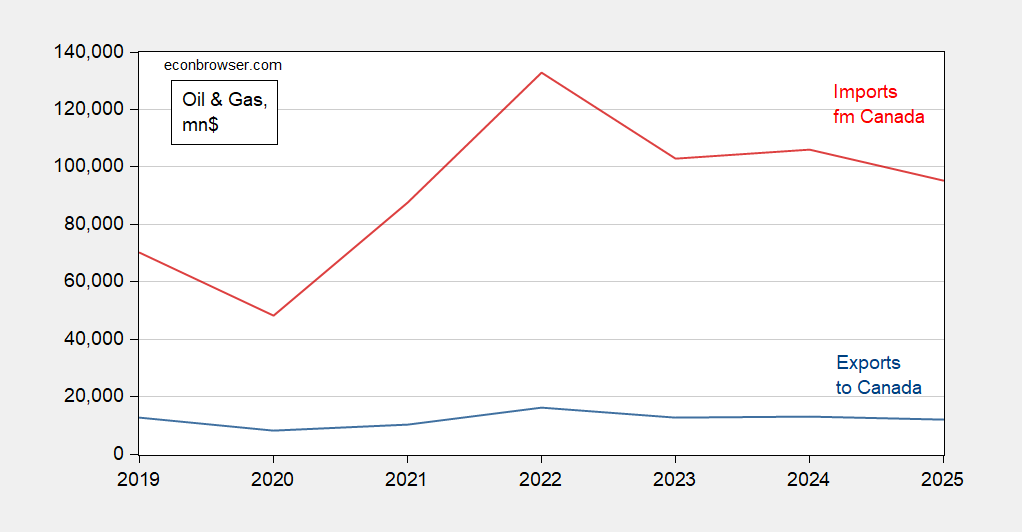
Econbrowser has published a data visualization tracking two-way oil and gas trade between the United States and Canada, drawing on official US trade statistics from the US Census Bureau distributed via the International Trade Administration (ITA).
Figure 1. US exports of oil and gas to Canada (blue) and US imports of oil and gas from Canada (red), in millions of dollars. Source: Census via ITA.
The chart plots both series in millions of dollars (mn.$), allowing a direct comparison between the value of American oil and gas shipments heading north to Canada and the value of Canadian oil and gas shipments entering the United States. Because the series are expressed in dollar terms, they reflect commodity prices as well as physical volumes; the US Energy Information Administration separately tracks petroleum and natural gas trade in volume terms.
The two countries maintain one of the world's largest bilateral energy trading relationships. Canada has long been the single largest foreign supplier of crude oil to the United States, with the bulk of those volumes moving by pipeline from Alberta - home to one of the largest proven crude oil reserves in the world, centered on the oil sands - to US refineries concentrated in the Midwest and along the Gulf Coast. Western Canadian heavy crude, benchmarked as Western Canadian Select (WCS), is a staple feedstock for US refineries configured to process heavy oil. Canada has retained that top-supplier position even as the United States itself ranks as the world's largest producer of both crude oil and natural gas, with much of the growth in US output coming in lighter crudes while many US refineries are configured to run heavier grades.
Flows run in the opposite direction as well. The United States exports crude oil, refined petroleum products, and natural gas to Canada, with American pipeline gas serving parts of eastern Canada in particular. Natural gas moves in both directions across the border, reflecting the integration of the North American gas grid. Canada's export infrastructure has also broadened in recent years: the expanded Trans Mountain pipeline to the Pacific Coast, which entered service in 2024, added an additional route for Canadian crude to reach markets beyond the United States.
Bilateral trade between the two economies is governed by the United States-Mexico-Canada Agreement (USMCA), which replaced the North American Free Trade Agreement (NAFTA) in July 2020. The agreement provides for a joint review by the three governments six years after entry into force, placing that milestone in July 2026, with the energy trade charted here among the cross-border commerce covered by the deal.
The underlying figures come from the US Census Bureau, the agency responsible for compiling the official trade statistics of the United States, and are published through the Commerce Department's International Trade Administration.
The original chart and data post are available on Econbrowser: https://econbrowser.com/archives/2026/08/us-canada-oil-gas-trade

