Tanzania’s Mining Model Is Beginning to Deliver Results
Key Takeaways
- •Tanzanite was discovered in 1967 near Arusha, and most of the early value from the gem was captured by Tiffany & Co. rather than Tanzania.
- •Mining has grown into a major part of Tanzania’s economy, with gold exports reaching a record $4.7 billion last year and the sector topping 10% of GDP for the first time.
- •Since 2017, Tanzania has required a 16% government free-carried interest in large-scale mining licenses and stronger local content participation rules.
- •Over the past four years, Tanzania’s mining industry has attracted roughly $3.3 billion in private investment.
- •The Kabanga nickel project is seen as a key test of whether Tanzania can develop domestic processing capacity and retain more value from critical minerals.
In 1967, a Maasai herder named Jumanne Mhero Ngoma discovered a cluster of unusual violet crystals in the Mereli Hills near the Tanzanian city of Arusha. For the find, Ngoma received 50,000 shillings, equivalent to about $22 in today’s money. But the rights to market the mineral went to Henry B. Platt, vice president of the American jeweler Tiffany & Co. and great-grandson of its founder, Louis Comfort Tiffany. Platt gave the stone the name “Tanzanite” and used a marketing campaign claiming the gem could only be found in two places: Tanzania and Tiffany’s.
Between 1967 and 1971, an estimated 2 million carats of tanzanite were mined in Tanzania and sold almost exclusively by Tiffany’s. Those stones would be worth as much as $1.2 billion today.
Tanzania’s experience is part of a broader African pattern in which mineral wealth has often been diverted to outside interests. What stands out now is how the country is trying to rebalance that equation in favor of ordinary Tanzanians, while also positioning mining as a larger contributor to jobs, exports, and fiscal revenue.
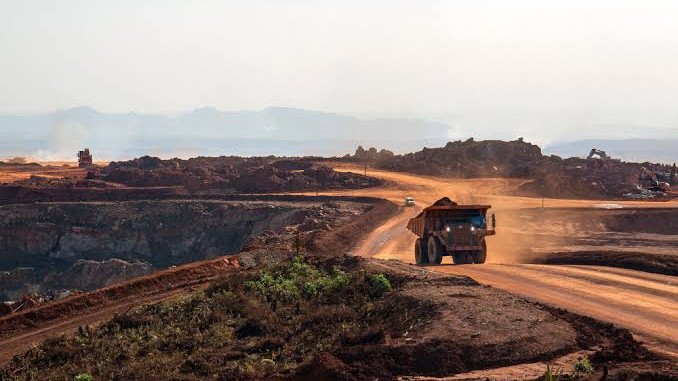
Over the past two decades, Tanzania’s mining sector has not only expanded rapidly but also become more diversified. By the mid-2000s, minerals had overtaken tourism as the country’s leading source of foreign currency. Since 2021, mining-related tax and royalty revenue has more than doubled. Gold exports rose 38.2% last year to a record $4.7 billion, and mining’s overall contribution to GDP exceeded 10% for the first time. Beyond graphite and gold, mineral sands mining is now taking place at Fungoni-Kigamboni and Tajiri, with a new processing plant under construction in Tanga. A government-approved niobium project is also under way at Panda Hill, which is expected to make Tanzania one of the world’s top four producers.
Since 2017, Tanzania has rewritten its mining rules to ensure that both the population and mining companies share in the country’s mineral wealth. Amendments to the Mining Act gave the government a 16% non-dilutive, free-carried interest in large-scale mining licenses. Local content requirements also stipulate that Tanzanian firms must hold minimum equity stakes in mining ventures and in their service supply chains. President Samia Suluhu Hassan has described this approach as “sovereign pragmatism,” replacing dependence on aid with trade and investment. Under this model, the state is acting as a direct participant in mineral wealth rather than simply collecting royalties. Investors also cite improvements in land titling and judicial efficiency as factors making Tanzania easier to operate in.
For a country with a history of resource nationalism, there were concerns that changes to the Mining Act would drive investors away rather than trigger a mining boom. Instead, Tanzania’s careful engagement with the private sector, combined with the global rush for critical minerals, has encouraged more firms to work with the government. Over the past four years, Tanzania’s mining sector has attracted roughly $3.3 billion in private investment.
The government has made clear that it wants to keep more of the mineral value chain inside its borders. A key test case is the Kabanga nickel project, one of the world’s largest undeveloped nickel deposits. A US government-backed consortium, Orion CMC, supported by Abu Dhabi’s L’imad Holding, is nearing a final decision on developing a local refinery to produce battery-grade nickel for electric-vehicle batteries and other modern technologies.
The syndicate is negotiating a $500 million to $600 million minority stake in Kabanga as Washington works to reduce dependence on China for critical minerals. If the deal succeeds, it would demonstrate Tanzania’s ability to attract international private-sector capital while ensuring that more value is retained domestically through jobs and higher tax revenue.
Despite the sector’s broader momentum, two Western-linked graphite projects have run into difficulties. After a decade of setbacks, Nachu, which had previously been promised a binding offtake agreement with Tesla, was folded into a Nasdaq-listed company whose core business is freeze-dried sweets. Mahenge, which sits on the world’s second-largest graphite reserve and is backed by an established international syndicate, has repeatedly had its investment decision delayed, most recently to November 2026. Even so, these setbacks are not unusual in fast-growing mining jurisdictions. Rome was not built in a day, and Tanzania’s mining industry will not be either.
None of this changes what Tanzania has already achieved. A country whose mining sector was, until recently, best known for a gemstone it barely profited from is now setting its own terms with some of the world’s largest mining and battery players while still attracting investment. That outcome reflects a government willing to make bold regulatory choices while thinking long term. Under President Samia’s leadership, Tanzania has combined that consistency with active outreach, drawing on Chinese, US, and Gulf capital at the same time rather than relying on a single partner. That diversification helps insulate the country from overdependence on any one market or power.
The open question is not whether Tanzania’s model works, but how quickly Western financing structures can adapt to it. If Kabanga’s final investment decision comes on schedule, it would provide concrete evidence that Tanzania has built something durable: not only a mining boom, but also a regulatory model that other resource-rich countries may study.
By Cyril Widdershoven for OIlprice.com
