Strait of Hormuz Oil Transport Costs Surge Since US-Iran Conflict Began, Economist Estimates
Key Takeaways
- •Economist Anthony Chan estimates that the all-in cost of moving a barrel of oil through the Strait of Hormuz has climbed from roughly $3.50 to between $24.00 and $41.57 since the U.S.-Iran conflict began.
- •The increase amounts to $20.50 to $38.07 per barrel in incremental expenses, combining added commercial charges with U.S. military costs allocated on a per-barrel basis.
- •Military-related expenses do not appear on commercial shipping invoices, which is why the analysis accounts for them separately from freight and insurance charges.
- •Shipping volumes through the strait have rebounded while costs remain far above pre-conflict levels, and shifts in freight and insurance change delivered crude costs even when benchmark quotations such as Brent are unchanged.
- •Roughly one-fifth of globally traded oil — about 20 million barrels per day, according to the U.S. Energy Information Administration — transits the strait, making it the main export route for Saudi Arabia, Iraq, the UAE, Kuwait, Qatar, and Iran.
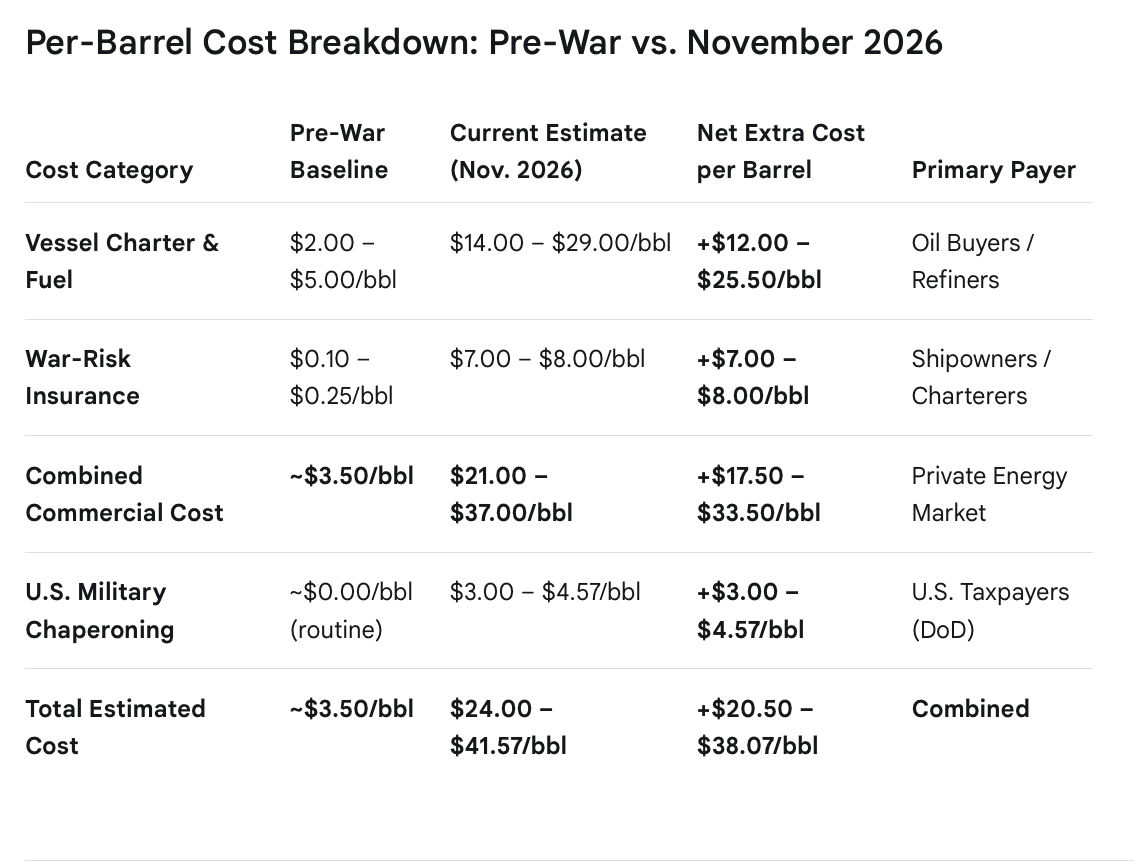
The cost of shipping oil through the Strait of Hormuz has risen sharply since the U.S.-Iran conflict began, according to an analysis by economist Anthony Chan cited in a Nov. 13 post on Econbrowser that answers what the blog's author described as a long-standing question about the true expense of moving Mideast crude.
Chan, who publishes via The People's Economist on Substack, estimated that transporting a barrel of oil through the waterway — referred to in the analysis as the SOH — previously cost about $3.50 per barrel in combined commercial transportation and insurance expenses. That figure now stands at an estimated $24.00 to $41.57 per barrel once additional commercial costs and allocated U.S. military expenses are factored in, representing an incremental cost of $20.50 to $38.07 per barrel. Unlike freight and insurance charges, the military component does not appear on commercial shipping invoices, which is why the analysis allocates it separately on a per-barrel basis.
"The cost of transporting oil through the SOH has increased dramatically since the U.S.-Iran conflict began. What previously cost about $3.50 per barrel in combined commercial transportation and insurance expenses now carries an estimated total cost of $24.00 to $41.57 per barrel when additional commercial and allocated U.S. military expenses are considered. That represents an incremental cost of $20.50 to $38.07 per barrel."
The Econbrowser post emphasized that the recovery in shipping volumes through the strait has not been matched by a recovery in costs — a gap that persists even before free-on-board (f.o.b.) prices are considered. F.o.b. quotations cover a cargo's value at the port of loading, meaning freight, insurance and related charges sit on top of benchmark prices such as Brent. That structure means shifts in freight and insurance costs change the delivered cost of a cargo even when the benchmark quotation itself is unchanged.
The Strait of Hormuz, the narrow passage between the Persian Gulf and the Gulf of Oman bordered by Iran, Oman and the United Arab Emirates, is one of the world's most critical energy chokepoints. Roughly one-fifth of globally traded oil — on the order of 20 million barrels per day in recent years, according to the U.S. Energy Information Administration — transits the waterway, making it the principal export route for producers including Saudi Arabia, Iraq, the United Arab Emirates, Kuwait, Qatar and Iran. That concentration is what gives per-barrel transport costs at the strait relevance for a large share of the world's seaborne crude trade.
Marine war-risk insurance premiums and freight rates routinely rise when conflict heightens the perceived risk to commercial shipping lanes. Chan's figures indicate that even where physical flows through the strait have rebounded, the all-in cost of moving each barrel remains far above the roughly $3.50 per barrel level recorded before the conflict, once commercial and military-related expenses are counted. As an independent estimate that folds allocated military spending into a per-barrel figure, the analysis captures a broader accounting of transport costs than freight and insurance quotes alone reflect.

