South Central Natural Gas Storage Runs 11.2% Below Year-Ago Levels, Trailing Five-Year Average
Key Takeaways
- •South Central natural gas stocks are 11.2% below September 2025 levels and also trail the five-year average, according to NGI reporting published September 18, 2026.
- •The region hosts substantial underground storage capacity and serves as a critical supply corridor for LNG export facilities along the Gulf Coast.
- •Persistent heat and strong LNG demand have held storage injections well below seasonal norms during the April-through-October refill season.
- •Natural gas futures erased steep early losses on Friday, with strong LNG demand helping the October contract rebound from a test of technical support.
- •El Niño is expected to make the West sharply colder this winter while easing Northeast heating demand, leaving the West as the only region where the American Gas Association sees natural gas heating bills rising.
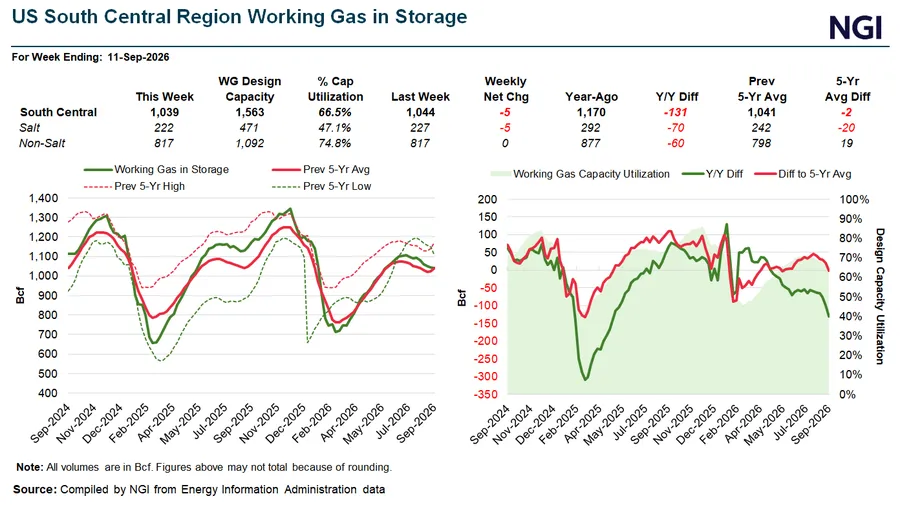
Natural gas stored in the South Central region — the storage hub anchored by Texas and its neighboring states — is lagging the five-year average and, notably, fell far short of September 2025 levels, according to reporting by Natural Gas Intelligence (NGI) published on September 18, 2026.
At a Glance
- South Central stocks are 11.2% below 2025 levels
- Regional storage trails the five-year mean
- Heat and LNG are driving high demand
The double-digit year-over-year shortfall carries significance beyond the regional tally. The South Central region hosts substantial underground storage capacity and serves as a critical supply corridor for LNG export facilities along the Gulf Coast. Underground storage plays a central role in the North American gas market by balancing seasonal swings between the summer injection season and winter heating demand, and the report pointed to heat and LNG as the forces driving high demand in the region.
Year-over-year and five-year comparisons are the market's standard gauges of storage health, indicating how much cushion operators hold heading into winter. Inventories are typically rebuilt during the April-through-October injection season, so a deficit of this size in September — deep into the refill window — underscores how far regional builds have run below normal seasonal pace.
The storage picture emerged against a volatile session in natural gas markets. In same-day coverage, NGI reported that spot natural gas prices tumbled across much of the United States on Friday as milder weekend weather pressured northern markets, while steep Southeast premiums continued to unwind despite persistent heat across the South Central states.
Futures followed a choppy path. Natural gas futures erased steep early losses on Friday, with strong LNG demand helping the October contract rebound from a test of technical support even as expectations for loosening shoulder-season balances — the transitional stretch between peak summer power burn and the onset of winter heating demand — weighed on much of the winter strip.
Forward prices had firmed during the Sept. 9–16 trading period, NGI reported, as record September heat kept power burn running at summer levels across the South and held storage injections well below seasonal norms. With the refill window narrowing, whether the regional deficit can be pared before heating demand arrives is likely to remain a focal point as observers weigh the path into winter.
Looking toward the heating season, El Niño is expected to turn the West sharply colder this winter while easing heating demand across the Northeast, leaving the West as the only region where the American Gas Association (AGA) sees natural gas heating bills rising.
Separately, NGI announced that several modifications to the spot market price tables appearing across its data services will take effect in October, part of an ongoing effort to ensure the price indexes it publishes reflect current market conditions in the North American natural gas market.
Related Coverage from NGI (September 18, 2026)
- Weekend Cooldown Knocks Natural Gas Cash Lower
- Calm Before the Storm? Natural Gas Premiums Collapse Into Shoulder Season
- El Niño Not Expected to Warm All Lower 48 as West Turns Colder
- Natural Gas Futures Bounce Off Support as LNG Demand Blunts Cooler Outlook
- Changes to NGI's Natural Gas Price Indexes to Take Effect in October
- Record September Heat Lifts October Natural Gas Forwards
The original report, "Why Double-Digit Year/Year South Central Storage Shortfall Matters", was written by Kevin Dobbs, who joined NGI's staff in April 2020. He previously worked as a financial reporter and editor for S&P Global Market Intelligence, covering financial companies and markets, and earlier in his career served as an enterprise reporter for the Des Moines Register. He holds a bachelor's degree in English from South Dakota State University. The source page lists a contact email (kevin.dobbs@naturalgasintel.com) and an X account (https://twitter.com/KNatgas).

