Saga Metals Races to Define Wolverine Rare Earths Discovery in Labrador
Key Takeaways
- •Saga Metals closed its $1-million acquisition of Wolverine owner Catalyst Rare Metals in July and has completed about 500 metres across three holes since drilling began in late August, with at least 3,000 metres planned this year.
- •Prior drilling by Catalyst included hole WOLRC25-003 returning 48.8 metres grading 0.77% TREO and hole WOLRC25-006 returning 38.1 metres at 0.71% TREO from surface, with heavy rare earth oxides averaging 24% to 28% of TREO.
- •Wolverine's mineralized layer dips about 20 degrees and extends only 25 to 50 metres deep across 26 sq. km, which the company describes as a low cost, low strip ratio mining target.
- •The project lacks road and power connections, and Canada currently has no producing rare earths mines, with only Defense Metals' Wicheeda project reaching preliminary feasibility stage.
- •Saga shares traded at 47¢ in Toronto, valuing the company at $49.9 million within a 12-month range of 22¢ to 98¢.
In a small, treeless valley in remote northeast Labrador, a camp of white tents hums with activity as workers support the broader effort to explore the rare earths lying just below the surface.
There is a sense of urgency at the Saga Metals (TSXV: SAGA; US-OTC: SAGMF) camp, where young geologists examine cores freshly drilled by rotating crews working around the clock on a nearby plateau, and helicopters deliver supplies to newly arrived staff beginning weeks-long shifts. The Wolverine project sits 12 km west of the Atlantic Ocean and 240 km north of Labrador's largest community, Happy Valley-Goose Bay.
"Geologically, Wolverine has massive upside in exploration potential," Michael Garagan, Saga's chief geological officer and director, told The Northern Miner inside a tent during a September visit.
"If we can continue to prove the size of it, it would have a serious impact on Labrador, especially for the north coast. There's Vale's (NYSE: VALE) Voisey's Bay in the north, and Rio Tinto's (LSE, ASX, NYSE: RIO) IOC mine in Labrador City – those are your only producing mines at the moment. If we could move this forward even close to that, we'd bring quite a bit of employment and hopefully a spotlight onto the province for its critical mineral potential."
As Western governments rush to secure domestic supplies of metals needed for technology, Wolverine emerges as another potential source of heavy rare earths to feed that demand. The project also strengthens Saga's profile as a critical metals explorer in Labrador, a region where iron ore has dominated mineral production for decades. Heavy rare earths are of particular strategic interest because they are scarcer than the light rare earths that dominate most deposits, and they are essential to the high-strength magnets used in electric vehicles, wind turbines and defense applications – supply chains that governments in the United States, European Union and elsewhere have targeted for onshoring.
Drilling program underway
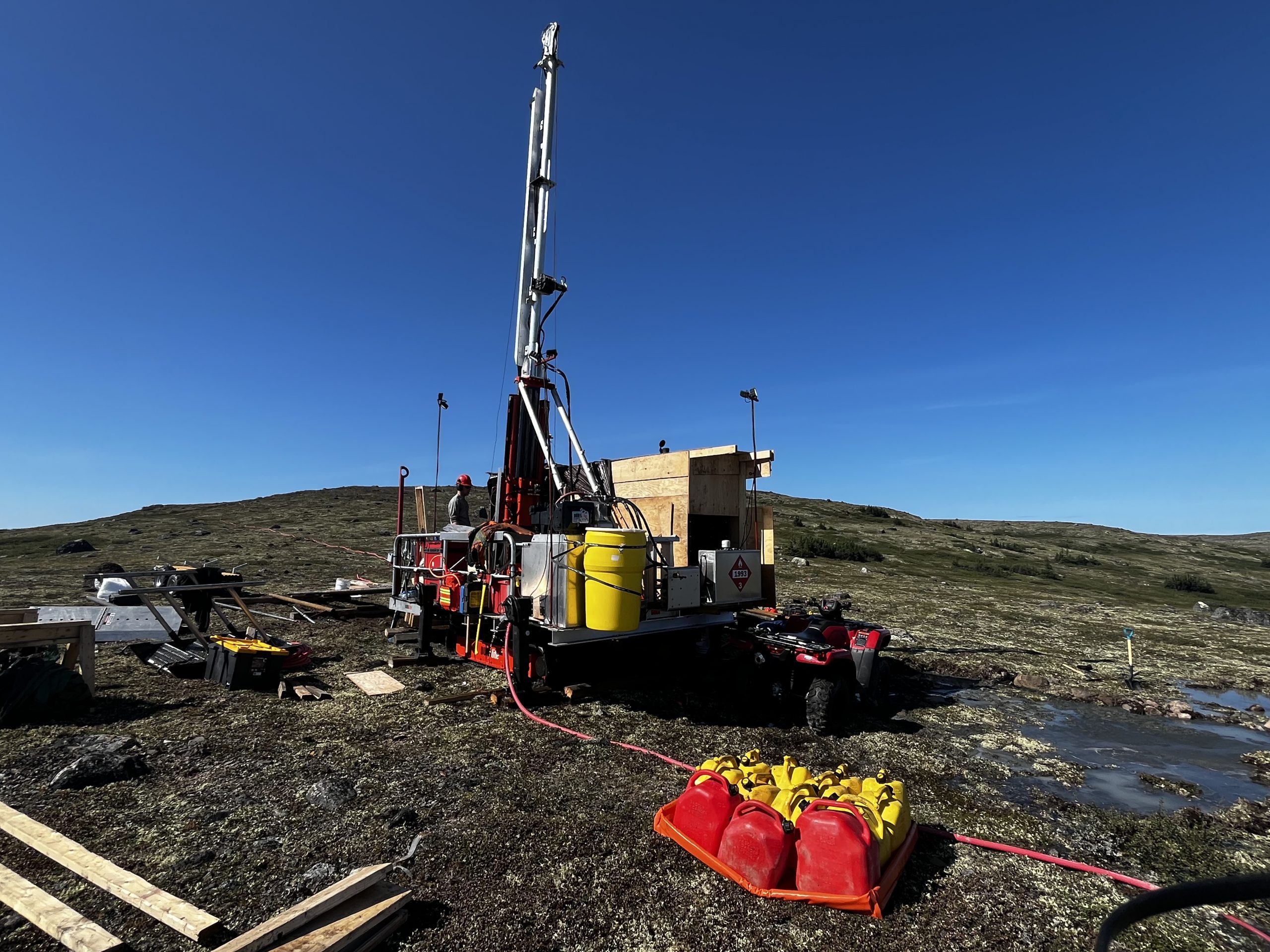
Saga only recently closed its $1-million cash-and-shares acquisition of private explorer Catalyst Rare Metals, the owner of Wolverine, in July, and already plans at least 3,000 metres of diamond drilling this year before winter sets in. Since drilling began in late August, it has completed about 500 metres across three holes.
The Geological Survey of Newfoundland and Labrador first identified rare earths at the site in 1991. Altius Minerals (TSX: ALS) staked the ground as the Nuiklavik project in 2006 before selling it to Rare Element Resources (US-OTC: REEMF) in 2010. Rare Element later allowed the claims to lapse, and Viridian Metals (CSE: VRDN; US-OTC: VIRMF) acquired the Wolverine property in 2022, starting the first modern drilling in 2023. Viridian spun the project out into a company renamed Catalyst in 2025.
Saga's program aims to confirm the continuity of grades Catalyst encountered in the 817 metres it drilled last year. Highlights include hole WOLRC25-003, which returned 48.8 metres grading 0.77% total rare earth oxides (TREO) from 1.5 metres depth, including 18.3 metres at 1.06% TREO. Hole WOLRC25-006 cut 38.1 metres grading 0.71% TREO from surface, including 4.6 metres at 1.53% TREO, with a 1.5 to 3-metre portion grading 2.03% TREO, Saga reported in July.
Heavy rare earth oxides averaged 24% to 28% of TREO in Catalyst's drilling and surface sampling, Saga said. Heavy rare earths such as dysprosium and terbium are used in high-performance magnets.
However, Catalyst's rotary drilling reached no deeper than 50 metres, while Saga's first hole went down 182 metres.
Wolverine is early-stage for rare earths development in Canada, where there are no producing rare earths mines and only one project – Defense Metals' (TSXV: DEFN) Wicheeda in British Columbia – has advanced to the preliminary feasibility study stage. Search Minerals' (TSXV: SMY) Deep Fox/Foxtrot in southeast Labrador is the only project in Atlantic Canada to reach the preliminary economic assessment stage. That gap underscores how far any Canadian rare earths discovery must travel before reaching production, typically requiring years of drilling, resource estimation, feasibility work, permitting and – in Wolverine's case – new infrastructure.
Shallow and large
Wolverine's deposit stands out because its surface host rock layer – mineralized volcanic tuff formed more than 1 billion years ago – dips gently at about 20 degrees and extends down just 25 to 50 metres across 26 sq. km.
"That makes for an excellent low cost/low strip ratio mining target," Garagan said.
Wolverine lies within the same Labrador-Greenland alkaline/peralkaline rare earth elements province as Critical Metals' (Nasdaq: CRML) Tanbreez deposit in Greenland and Torngat Metals' Strange Lake, just across the Labrador border in northern Quebec. A resource estimate for Wolverine has yet to be defined, but the project could host heavy rare earths comparable to those projects, whose indicated resources show heavy rare earths content of 24% to 39%.
Asked when the company is targeting an initial resource for Wolverine, Garagan could not specify.
"We are only three holes into this program," he said. "There's a lot more to learn before we commit to a date for a resource."
Infrastructure challenges
Like many critical metal projects in Canada, Wolverine lacks road and power connections. The nearest all-season road is far to the south in Happy Valley-Goose Bay, and while the town of Hopedale, 50 km east, has ferry access, a road would have to be built to connect Wolverine to tidewater if it becomes a mine.
The federal First and Last Mile Fund, which offers up to $1.5 billion for mining and road projects, could be an option for roads to Wolverine. Its proximity to tidewater is a meaningful logistical consideration, as shipping concentrate by sea is a common route for remote Canadian and Greenlandic mineral projects without rail or road links.
"We're still a good year away from really being able to talk about those components of the project more," Garagan said. "We are still working on identifying ore bodies."
The case for rare earths
Whether early-stage or advanced, rare earth explorers such as Saga face volatile and opaque pricing because the metals lack transparent exchange-traded benchmarks and China dominates global processing and supply. That dominance has drawn renewed policy attention in recent years as China has imposed export controls on some rare earth products, prompting importing countries to accelerate efforts to build alternative supply chains.
Garagan acknowledges that it is much easier for an explorer to raise money for a gold project, but the broader political momentum around rare earths suggests change could be approaching.
"We still see that there's changing sentiments," he said. "I don't know if the markets have fully caught up to those changes yet. The changing atmosphere around the industry and the changing involvement of nations around the globe on how we look at critical minerals."
Saga shares traded at 47¢ apiece on Friday in Toronto, valuing the company at $49.9 million. The stock has traded in a 12-month range of 22¢ to 98¢.
