Europe Dodges a Rhine Crisis — but Only Because Demand Is Already Weak
Key Takeaways
- •The Kaub gauge fell below 10 centimetres in mid-August and has recovered only to about 45 centimetres, still well below the 77-centimetre benchmark for normal commercial traffic.
- •LyondellBasell declared force majeure at its 170,000 t/y butadiene unit in Wesseling after restricted feedstock flows reduced crude C4 production at its crackers.
- •The assessed ARA-Karlsruhe barge freight rate rose five-fold to €215/t from about €45/t at the end of June, and the ARA-Basel rate reached €275/t in mid-August.
- •European crackers were running at only about 70% in July due to weak demand, which has cushioned the river capacity shortage that would be much harder to absorb under normal operating levels.
- •The disruption extends beyond Germany, with localised gasoline shortages in eastern France around Strasbourg and Switzerland facing higher import costs and possible draws on strategic stocks.
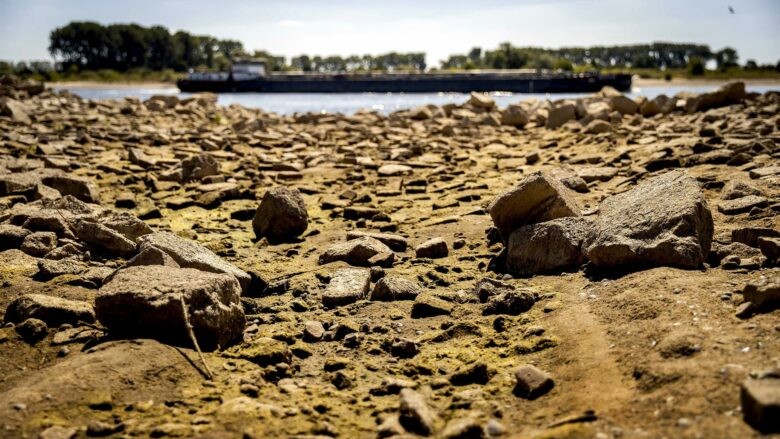
The Rhine has recovered slightly from its mid-August record low, when the water level gauge at Kaub — the river's decisive chokepoint — fell below 10 centimetres, but the improvement is largely optical. Barges still cannot carry normal loads through the chokepoint, leaving the industrial corridor that runs from Rotterdam and Antwerp to southern Germany, eastern France and Switzerland short of transport capacity. The immediate consequences are expensive freight, constrained chemical production and uneven fuel supply. The more troubling conclusion, however, is that Europe is avoiding a deeper disruption only because its factories and consumers are already demanding less. In this sense, the Rhine's low-water crisis is a stress test for an industrial system built around cheap, high-volume river transport — and a reminder that pipelines, railways and roads cannot quickly reproduce what the Rhine does.
The Kaub chokepoint
Inland waterways carry only a modest share of Germany's overall freight tonnage, but a disproportionate share of the fuels, chemicals and bulk commodities supplying the country's southern industrial belt. Kaub, on the Middle Rhine, determines how much of that cargo can move between the Amsterdam-Rotterdam-Antwerp (ARA) hub and the industrial centres farther south. When its navigable water depth fell below 10 centimetres in mid-August, the waterway was roughly 1.2 metres deep; a year earlier, the water depth was around 2.3 metres. The level has since recovered to about 45 centimetres, but that remains well below the 77-centimetre benchmark and far from a return to normal commercial traffic.
At the lowest levels, only specialised low-draft barges can cross Kaub. While the Lower Rhine may remain open, the route to the Upper Rhine is effectively shut for most vessels, fragmenting what normally functions as a single market.
Chemicals feel the fracture first
The chemical industry feels that fracture first. Several of Germany's largest steam crackers sit along the Rhine corridor and are affected by the restrictions at Kaub. The BASF, INEOS, LyondellBasell and Shell sites in this area hold around 3.1 million tonnes per year of combined ethylene capacity. BASF's Ludwigshafen complex is particularly exposed: it lies south of Kaub and moves about 40% of all incoming and outgoing goods by river.
Naphtha supply is less of a problem, since most of Germany's naphtha moves by pipeline, offering protection against a river bottleneck. But pipelines cannot redistribute the broad range of finished products made by a cracker. If those materials cannot leave, storage fills and operators must curb runs. With low water levels continuing to limit normal movement on the river, barges are forced to carry smaller loads and specialised chemical vessels are constrained.
Downstream squeeze
The effects spread quickly into smaller downstream markets. LyondellBasell declared force majeure at its 170,000 t/y butadiene unit in Wesseling after restricted feedstock flows to its crackers reduced crude C4 production. Crude C4 is produced during the steam cracking of naphtha alongside ethylene and is then processed to extract butadiene. A relatively small reduction in cracker output can therefore cause a much larger squeeze in the smaller butadiene market, and other co-products that are difficult to reroute — such as pyrolysis gasoline — face similar pressure.
Restricted inland movements of chemical products contributed to naphtha inventories in ARA reaching 598,000 tonnes in mid-August, 75% more than a month earlier. Yet the problem is not only one of movement restrictions: weaker cracker operations had already reduced naphtha consumption before the Rhine's levels became an issue, with crackers running at 70% due to weak demand for their production across the wider European market.
Refining exposure
The same dynamic is emerging in refining. Most inland German refineries receive crude through pipelines, so the Rhine does not automatically force crude runs lower. Their exposure lies in intermediate feedstocks, blending components and, above all, moving gasoline, diesel and heating oil to customers.
Karlsruhe illustrates the issue. Road trucks have been shuttling to and from the Miro refinery — capacity 320,000 barrels per day — to collect fuel, but the site normally also ships products by barge both toward ARA and upstream to Switzerland. With movements restricted in both directions, Karlsruhe must hold surplus refined products in its storage facilities while markets farther away pay shortage premiums.
Freight rates reflect the imbalance
The Rhine's freight rates reflect this physical imbalance. The assessed ARA-Karlsruhe barge rate rose five-fold, to €215/t currently from about €45/t at the end of June, while the ARA-Basel rate reached €275/t in mid-August. At extreme low water, even those assessments become partly theoretical because few normal cargoes can pass.
Road and rail: relief, not replacement
Road and rail offer relief, but not replacement. Chemicals require appropriate tankers and transportation conditions, and the volumes involved overwhelm available vehicles and infrastructure. One fully loaded barge carrying 2,400 tonnes of diesel is equivalent to 90 trucks. Germany's temporary relaxation of Sunday and public-holiday restrictions for heavy vehicles may improve flexibility, but it cannot manufacture tank cars, specialist trailers, drivers or road capacity.
Constraints beyond crackers and refineries
The constraints extend even beyond crackers and refineries. Covestro declared force majeure on polyether polyols made at Dormagen, while Salzgitter shifted coal from Rotterdam to rail for its HKM steelmaking division. Such workarounds keep selected flows moving, but they also compete for the same scarce trains and trucks needed elsewhere. The disruption is therefore cumulative: every industry solving its own bottleneck makes the alternatives tighter for the next.
Nor is this only a German problem. Eastern France has experienced localised gasoline shortages as barges serving Strasbourg carried a fraction of their normal loads. Switzerland faces higher import costs and the possibility of drawing on strategic stocks. Rotterdam and Antwerp remain supplied by sea, yet congestion and slower terminal turnover spread costs across the wider northwest European market. Low water, in this way, does not create a single European shortage but rather a dispersed problem of trapped supply and local shortfalls.
Weak demand as the cushion
For now, weak demand is preventing isolated local shortages and oversupplies from becoming a broader crisis. European crackers were operating at only about 70% in July, after years of pressure from expensive energy, weak construction and automotive demand, and cheaper imports from Asian competitors. Fuel consumption in inland Germany has also been decreasing. If chemical plants and fuel markets were operating near normal levels, however, the shortage of river capacity would be much harder to absorb. A recovery in manufacturing, higher diesel demand or winter stockpiling could therefore intensify the disruption even if water levels improve modestly.
The Rhine may have risen slightly, but Europe's industrial margin of safety has not. This summer's lesson is that weak demand can cushion a logistics failure, but it cannot solve one. When — or if — the economy rebounds and supply chains are once again required to handle normal volumes, the problem will extend far beyond the river itself.
Not a worst-case scenario
This summer should also not be mistaken for a worst-case scenario. Nor is it the first warning: the 2018 low-water episode restricted Rhine barge traffic for months and was widely estimated to have weighed on German industrial output, and low water returned again in 2022. Some shippers added low-draft vessels afterwards, but the industrial corridor remains built around the waterway. A super El Niño could bring a warmer winter, less Alpine snow and a weaker meltwater buffer. If another hot, dry summer follows, Rhine levels in July and August 2027 could fall even lower than this year's records.
By Natalia Katona for Oilprice.com

