Retail Diesel Hits All-Time High as Strait of Hormuz Closure and Russian Outages Squeeze Supply
Key Takeaways
- •AAA's national average retail diesel price reached a record $5.85 per gallon on Friday, breaking the prior high of $5.82 from June 2022.
- •Retail diesel has climbed about $2.10 per gallon since the Friday before military action against Iran began in early March.
- •The rally has been fueled by the closure of the Strait of Hormuz and Russian diesel supply outages following Ukrainian drone strikes on refineries.
- •CME ultra low sulfur diesel futures posted a record settlement of $4.6773 per gallon on Tuesday but have since eased to around $4.47 per gallon.
- •Kevin Book of ClearView Energy Partners questioned whether Strait of Hormuz infrastructure would return to normal flows even if the waterway reopens.
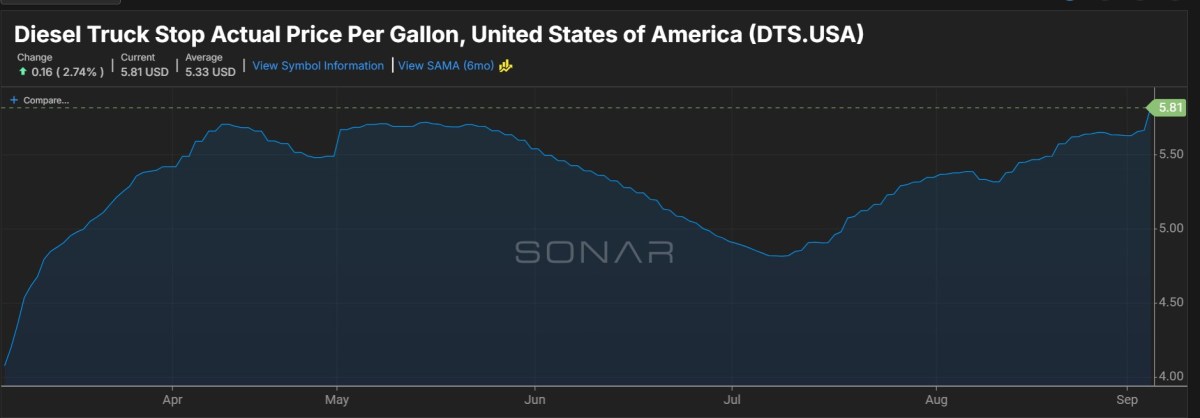
Retail diesel prices have reached an all-time high according to one key measurement.
The daily average national retail price for diesel, published by AAA, was set Friday at $5.85 per gallon. A day earlier, the price of $5.7832/g had marked the highest level since military action began against Iran at the start of March.
The $5.85 figure broke through the previous all-time high of $5.82/g, set in June 2022, a few months after Russia invaded Ukraine. Price data shows the AAA price on the Friday before attacks against Iran began — attacks that were followed by Iranian counterattacks — stood at $3.758/g, meaning the latest price is up about $2.10 since that day.
The last four days have seen a remarkable surge in retail diesel prices as measured by AAA, adding just under 25 cents per gallon during that time. The DTS.USA data stream in SONAR for Friday showed a slightly lower average of $5.81/g. Retail prices also tend to lag moves in wholesale markets, meaning pump prices can keep adjusting after futures markets turn.
The retail surge followed a sharp rise in prices on the ultra low sulfur diesel (ULSD) contract on CME, which is the starting point for the multi-step process that ultimately leads to the price at the pump.
ULSD settled at just under $4.50/g on August 21. It then plunged to about $4.25/g over the next four days on hopes for more relief from restricted flow in the Strait of Hormuz, though that would not have had any impact on the curtailment of diesel supplies out of Russia. That latter development has resulted from successful drone strikes by Ukraine on the Russian refining sector, which is heavily oriented toward the production of middle distillates such as diesel.
But hope is not fundamentals, and ULSD took off from there, climbing to a settlement of $4.6822/g on Wednesday. That recent upward move also comes after a month that was essentially a bull run; a month ago, on August 4, ULSD settled at $3.7705/g. Setting aside what appears to be a one-day outlier settlement from 2022, the all-time high ULSD settlement came Tuesday of this week at $4.6773/g.
Ironically, even as media reports are filled with news of the all-time diesel high, the CME price has softened. ULSD declined 8.86 cts/g on Thursday, and by approximately 10:30 a.m. Friday it was down just under 12 cts/g at $4.4739/g.
Kevin Book, managing director of ClearView Energy Partners, summed up the market situation for diesel in an interview Friday on CNBC. He described middle distillates such as diesel as "at the top of the list as far as the energy policy discussion right now."
He noted that U.S. refineries are running "flat out" — not surprising, given that crack spreads for all products, but diesel in particular, are at historic highs — but that some Middle East supplies have been blocked by the closure of the Strait of Hormuz "and are compounded by outages in Russia." The Strait of Hormuz is a chokepoint for a significant share of globally traded oil and refined products, which is why its closure has outsized effects on product markets far beyond the region itself. Because diesel powers trucks, agriculture, and construction equipment, rising pump and wholesale costs feed into freight and goods distribution costs across the economy.
Book expressed skepticism about a quick slide in prices should the Strait open fully. "I think that there are real questions about the infrastructure on the other side," he said.
While there have been refinery restarts, and if the Strait returns to normal, "it looks a little bit better."
"But will it go back to flowing as it did?" Book said. "It doesn't seem obviously that way right now."
