Precious Metals Sector Posts Impressive Relative Breakout as Tech Selloff Deepens
Key Takeaways
- •Technology stocks, particularly artificial intelligence names, plunged last week and dragged the broader market lower, with the Democratic Party's strong election gains cited as a catalyst fueling fears of curtailed data center expansion.
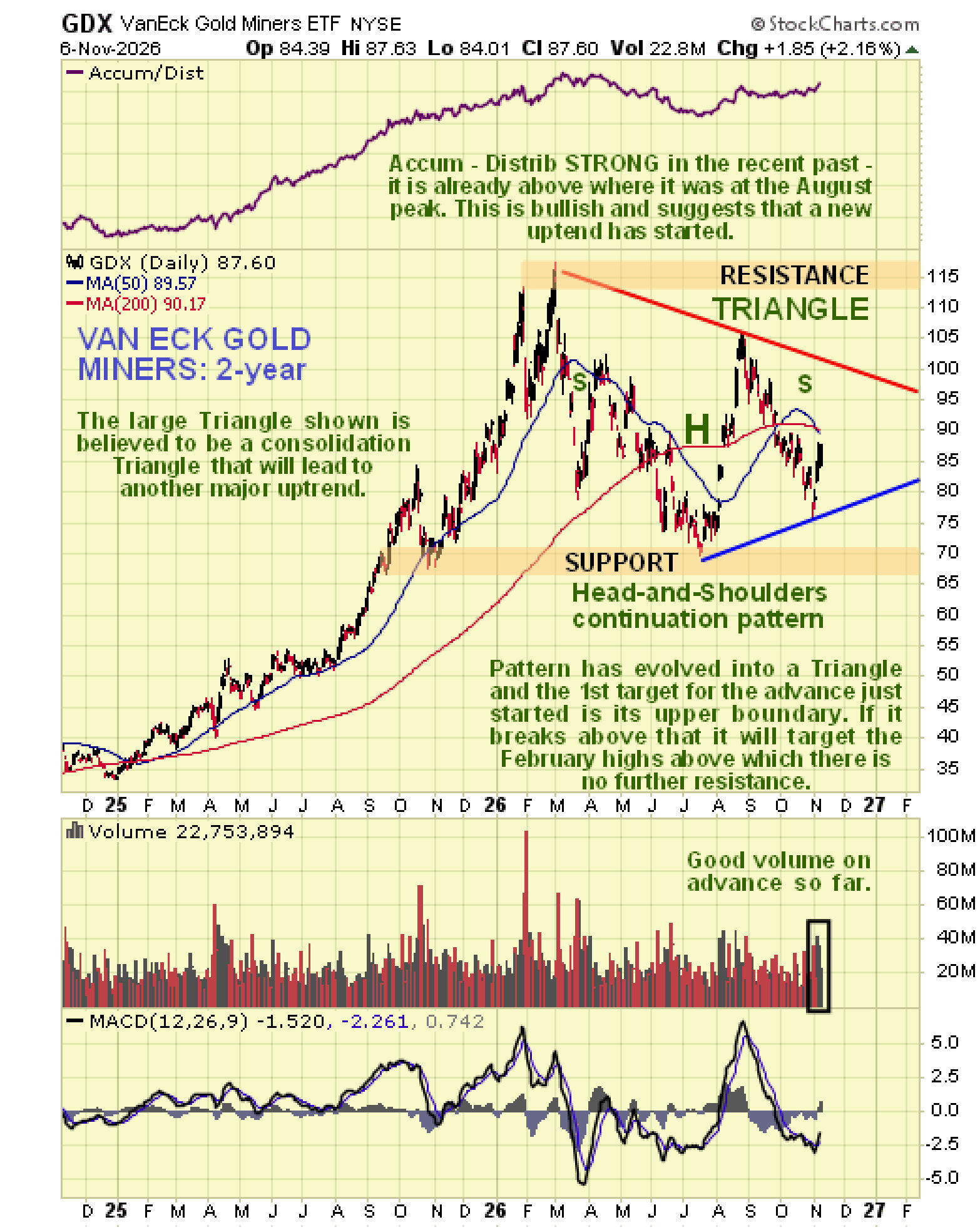
- •The VanEck Gold Miners ETF (GDX) began rallying off the lower boundary of a large symmetrical triangle on strong volume, while its accumulation line gained during the correction from the late-August peak, a divergence the analyst views as strongly bullish.
- •A relative chart of GDX against the Nasdaq Composite showed a dramatic breakout last week from a double bottom formed in October, occurring during a week when the tech benchmark was falling steeply.
- •Maund argues an all-out market crash is unlikely because index-fund giants own roughly 70% of the market and the Federal Reserve can inject unlimited money, expecting instead occasional sharp sentiment-driven selloffs.
- •Oil's decisive breakdown and the sector's entry into its historically most bullish seasonal window are seen as favorable for precious metals, and Maund plans separate stock-by-stock analyses starting with silver stocks.
Precious Metals Sector Posts Impressive Relative Breakout as Tech Selloff Deepens
Precious metals equities delivered a rare display of strength last week, advancing even as technology stocks and the broader market sold off sharply. In commentary published on SilverSeek on November 9, market analyst Clive Maund describes the move as an impressive relative breakout for the sector and argues that it signals capital rotating out of the technology trade and into gold and silver mining shares as a safe haven. Because mining shares are widely treated as a leveraged proxy for the metals themselves, their performance against broad equity benchmarks is closely watched as a gauge of where defensive capital is flowing.
Last week brought dramatic developments across financial markets, with technology stocks — and artificial intelligence names in particular — taking a steep plunge that dragged the broader market down with it. Maund says the selloff did not catch him off guard: having long regarded the AI trade as "a bubble in search of a pin," he had been expecting it to pop for some time. He identifies the catalyst as the Democratic Party's strong gains in the recent election, which stoked fears that the party will put the brakes on the data center buildup — the computing infrastructure that underpins the training and operation of AI models.
What surprised observers, he writes, was the resilience of the precious metals sector. Rather than falling with the market, the sector held its ground and actually rose — a sign, in his assessment, that some of the money fleeing technology is rotating into the downtrodden precious metals sector as a safe haven. The significance becomes even clearer, he argues, when the sector's performance is measured against the broad market, and especially against the tech sector.
GDX: Converging Chart Patterns and Rising Accumulation
Before turning to the relative analysis, Maund briefly reviews the chart of the VanEck Gold Miners ETF (GDX), a widely used benchmark fund for gold mining equities. On the two-year chart, the Head-and-Shoulders continuation pattern he identified earlier — now approaching completion — sits within a large Symmetrical Triangle that is itself nearing completion. Just last week, GDX began to rally off the lower boundary of the triangle on good volume.
A key observation, he notes, is that during the substantial correction back from the late-August peak, the Accumulation line did not drop — it actually made gains. Maund views this as a strongly bullish divergence, and argues that on that basis alone it is reasonable to expect a sizable uptrend to develop from here. He adds that the sector has just entered the most bullish time of year — a seasonal window that has historically delivered some of gold's strongest returns.
GDX vs. the Nasdaq: A Dramatic Relative Breakout
Last week's sector gains were somewhat muted and were masked by the heavy drops in tech and in the broad market. Plotting GDX against the tech-heavy Nasdaq Composite index — using a three-month chart to focus on recent action — throws the extent and significance of the outperformance into sharp relief. Relative charts of this kind divide one asset's price by another's, stripping out overall market direction to isolate how the two are performing against each other.
The relative chart shows a dramatic breakout last week from a relative Double Bottom that formed during October. The breakout carries particular weight because it occurred in a week when the benchmark against which GDX is measured was falling steeply. Given that GDX actually rose while the tech sector and the market as a whole tanked, Maund concludes that some of the "funk money" fleeing tech sluiced into the precious metals sector as a safe haven.
The Case Against an All-Out Market Crash
The rally in the precious metals sector as the broad market and tech plunged raises the question of whether the dynamic would persist through an all-out market crash. Maund contends that such a crash may not happen at all, pointing to the market's ownership structure: with BlackRock, State Street, and Vanguard — the trio that anchors the index-fund industry — alone owning 70% of it, the stock market is now largely held by Big Money. If it can get society at large to foot the bill to keep the market propped up, he argues, it will.
In his view, the Federal Reserve does not answer to the American people; it exists to serve the interests of Big Money and can create as many trillions of dollars out of thin air as it likes, with no accountability or oversight. That means it can inject unlimited quantities of money into the market to keep it elevated or stop it from dropping, or buy Treasuries to keep a lid on interest rates — leaving the general population to foot the bill through rampant inflation and a weakening currency.
The dollar's continued strength relative to other currencies, he explains, reflects the fact that similar policies are being applied all around the world. Even though the dollar may look like "the cleanest shirt in the laundry basket," it continues to lose purchasing power at a rapid rate.
Rather than an all-out massive crash, Maund expects occasional "crashlets" such as the one witnessed last week, caused by abrupt changes of sentiment and throwing up trading buying opportunities. The ongoing robust inflation — despite deflationary forces also being in play — has to be positive, he argues, for investments with real intrinsic value such as gold and silver, metals that have historically served as stores of value when currency purchasing power erodes.
Oil Breakdown Seen as a Stabilizing Factor
Another positive factor for markets, in his assessment, is that oil has broken down quite decisively and looks set to continue dropping. The drubbing the Republicans suffered last week has curbed their enthusiasm for another assault on Iran, and the election result in Israel is thought likely to have a similar effect. If oil prices continue to ease, that could have a stabilizing effect on markets that are, in any case, buoyed by endless central bank money pumping — creating a favorable environment in which the precious metals sector can advance.
Maund says he will proceed to examine a range of precious metals stocks in separate articles that look set to make good gains, starting with silver stocks, which have not moved — or have not moved much — yet. For readers following the rotation argument, the immediate markers to watch are whether GDX can sustain its new relative strength against the Nasdaq and what Maund's upcoming stock-by-stock analysis reveals about the breadth of the move.
Editorial note: the views and technical interpretations expressed are those of the author and are presented for informational purposes only; they do not constitute investment advice.
About the Author
Clive Maund (clivemaund.com)
The years following 2005 saw the boom phase of the gold and silver bull market, which peaked in 2011 — with gold touching roughly $1,900 an ounce and silver nearly $50 at the high. While there is ongoing debate about whether that was the final high, Maund does not believe it was, citing the continuing global debasement of fiat currency. In his view, the bear market since 2011 is very similar to the two-year reaction of the mid-1970s, which was preceded by a powerful advance and was followed by a gigantic parabolic ramp that carried gold to a then-record near $850 an ounce by January 1980. Precious metals, he argues, should come back into their own when the various asset bubbles elsewhere burst — something that, in his assessment, looks set to happen soon.

