Posco Chairman Chang In-hwa Calls for Deeper Korea-Australia Resource Cooperation
Key Takeaways
- •Chang In-hwa called for stronger Korea-Australia resource supply chains at the 47th Korea-Australia Business Council joint meeting in Adelaide, attended by roughly 200 officials.
- •Posco introduced the Australia Critical Resources Research Center, its first overseas resource research institute, at the meeting.
- •The meeting covered three cooperation pillars: steel, secondary battery materials and critical minerals; innovation and R&D; and energy transition and decarbonization.
- •Australia supplies about 70 percent of Posco Group's raw materials, and the company has imported more than 1.5 billion tons of Australian raw materials since 1971.
- •The proposal is part of Posco's Triple Core strategy covering industrial, strategic, and energy resources, matching both governments' moves to diversify critical mineral supply chains.
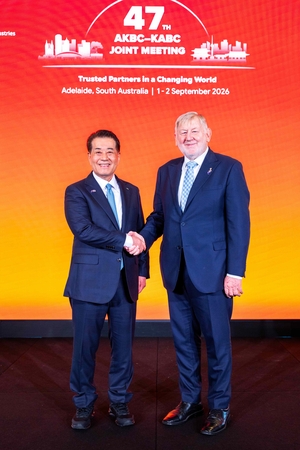
Posco Group Chairman Chang In-hwa called for stronger resource supply chains between Korea and Australia at the 47th Korea-Australia Business Council annual joint meeting, held in Adelaide on Wednesday.
Roughly 200 government and business officials from both countries took part in the gathering, among them Australian Foreign Minister Penny Wong, Trade and Tourism Minister Don Farrell, and Martin Ferguson, chairman of the Australia-Korea Business Council.
In his remarks, Chang highlighted the potential of supply chains that pair Australia's resource endowments with Korea's refining and processing technologies, framing critical minerals as a new frontier for industrial cooperation between the two countries. The pitch reflects a broader industry pattern: Australia is a leading global producer of iron ore and lithium, while Korea, resource-poor but strong in processing and battery manufacturing, has sought stable overseas mineral supplies to support its steel and battery industries. Chang also urged closer collaboration in natural gas, renewable energy, defense, space, and research and development.
The joint meeting addressed cooperation across three pillars: steel, secondary battery materials and critical minerals; innovation and R&D; and energy transition and decarbonization. Posco Group used the occasion to introduce the Australia Critical Resources Research Center, its first overseas resource research institute, and discussed broadening energy cooperation into renewable energy projects.
Ahead of the joint meeting on Tuesday, Chang held talks with Farrell and Australian Industry and Innovation Minister Tim Ayres, seeking cooperation and support for the group's steel, lithium and energy projects in Australia. He also met with Pilbara Minerals to discuss lithium business opportunities.
Chang's proposal forms part of Posco's Triple Core strategy, which centers on industrial resources such as steel, strategic resources, and energy resources. The emphasis on critical minerals also aligns with policy shifts in both countries, as governments including Australia's and Korea's have moved in recent years to diversify critical mineral supply chains.
Australia supplies about 70 percent of Posco Group's raw materials, and the group has been pursuing steel, secondary battery materials and energy businesses there. The steelmaker has imported more than 1.5 billion tons of Australian raw materials since 1971 and was involved in the development of the Roy Hill iron ore mine from its early stages in 2010.
In addition, Posco operates a lithium hydroxide plant with Pilbara Minerals, holds a stake in a lithium mine owned by Mineral Resources, and has expanded its natural gas business since acquiring Senex Energy in 2022.
Source: Korea Herald Business
