PBOC Sets USD/CNY Central Rate at 6.7804, Above Estimate of 6.7104
Key Takeaways
- •The PBOC fixed the USD/CNY central parity rate at 6.7804, weaker than the market estimate of 6.7104, a gap exceeding 0.07 yuan.
- •The onshore yuan is permitted to trade within a band of plus or minus 2% around the daily fixing set under the PBOC's managed floating exchange rate framework.
- •The daily fixing is published each morning by the China Foreign Exchange Trade System and is watched as a signal of the central bank's currency stance.
- •A weaker yuan fixing can support export competitiveness by making Chinese goods cheaper in foreign-currency terms.
- •The PBOC injected 1 billion yuan via 7-day reverse repos at an unchanged 1.4% rate, producing a net drain of 4 billion yuan as 5 billion yuan matured.
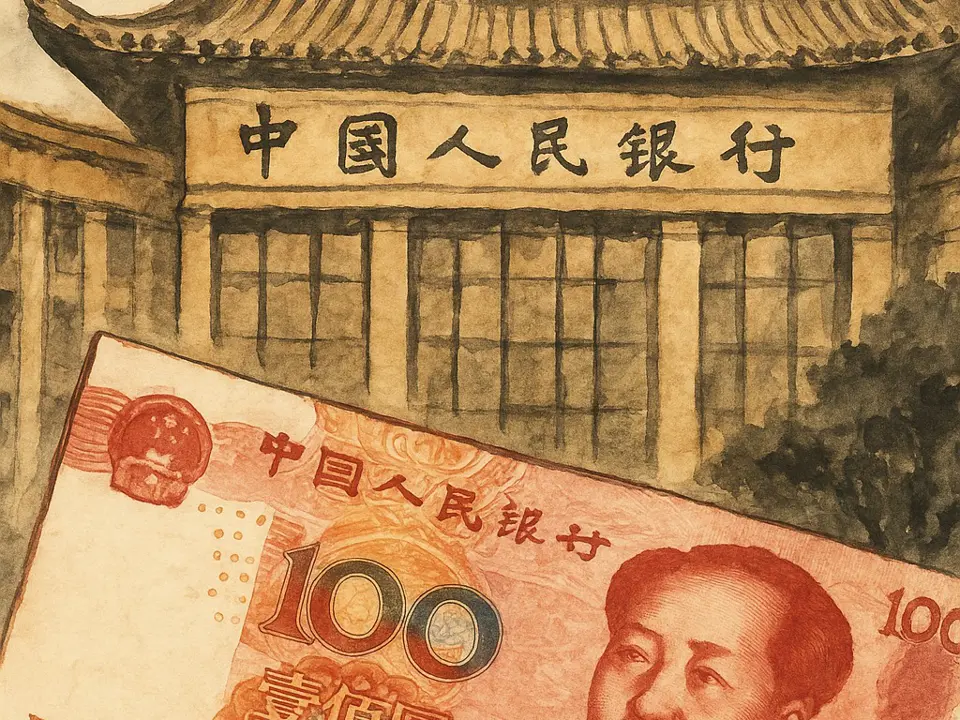
The People's Bank of China (PBOC) set the central parity rate for the USD/CNY pair at 6.7804 for the trading session ahead, a weaker fixing for the yuan than the market estimate of 6.7104.
The central parity rate, also known as the reference rate or daily fixing, serves as the midpoint around which the onshore yuan (CNY) is permitted to trade. Under the PBOC's managed floating exchange rate framework, the yuan is allowed to fluctuate within a band of plus or minus 2% around this daily reference rate.
The daily fixing is published each morning by the China Foreign Exchange Trade System (CFETS) and is closely watched by markets as a signal of the central bank's stance on the currency. A fixing that is stronger or weaker than analyst estimates is often interpreted as an indication of official policy intentions regarding exchange rate management. The gap between the fixing and analyst estimates—in this case more than 0.07 yuan, with the official rate set at a weaker level for the yuan than expected—is the metric traders typically focus on, as persistently large deviations in one direction are read as a willingness to tolerate, or lean against, currency moves. Fixings that guide the yuan weaker can support export competitiveness by making Chinese goods cheaper in foreign-currency terms, a consideration that features regularly in discussion of Chinese exchange rate policy.
The yuan trades in two main forms: the onshore yuan (CNY), which is governed by the daily fixing and trading band, and the offshore yuan (CNH), which trades more freely in markets such as Hong Kong. The relationship between the two is itself watched as a gauge of market pressure on the currency.
In its open market operations on the same day, the PBOC injected 1 billion yuan via 7-day reverse repos, leaving the rate unchanged at 1.4%. With 5 billion yuan of such operations maturing today, this resulted in a net drain of 4 billion yuan from the money market.
Reverse repos are a routine liquidity management tool used by the PBOC to regulate short-term cash conditions in the banking system. The modest scale of the net drain suggests routine operations rather than a significant shift in liquidity stance; market participants typically watch these daily operations alongside the fixing for a fuller picture of the central bank's policy posture.
Source: investinglive.com
