PBOC Expected to Set USD/CNY Reference Rate at 6.6757, per Reuters Estimate
Key Takeaways
- •The People's Bank of China is projected by Reuters to set the daily USD/CNY reference rate at 6.6757, with the fixing due at roughly 0115 GMT ahead of onshore trading.
- •The onshore yuan is allowed to trade up to 2% above or below the central bank's daily midpoint, while the offshore yuan in centers such as Hong Kong trades freely without an official range.
- •The midpoint calculation draws on the previous day's close, movements in major currencies, capital flows, growth momentum, and financial stability goals, with a counter-cyclical factor occasionally adding policy discretion.
- •A midpoint stronger than survey estimates is typically interpreted as the central bank resisting depreciation pressure, whereas a weaker fixing can signal tolerance for a softer currency amid dollar strength or domestic headwinds.
- •If the yuan nears either edge of its trading band, the PBOC may smooth volatility through direct currency buying or selling, liquidity adjustments, or guidance through state-owned banks.
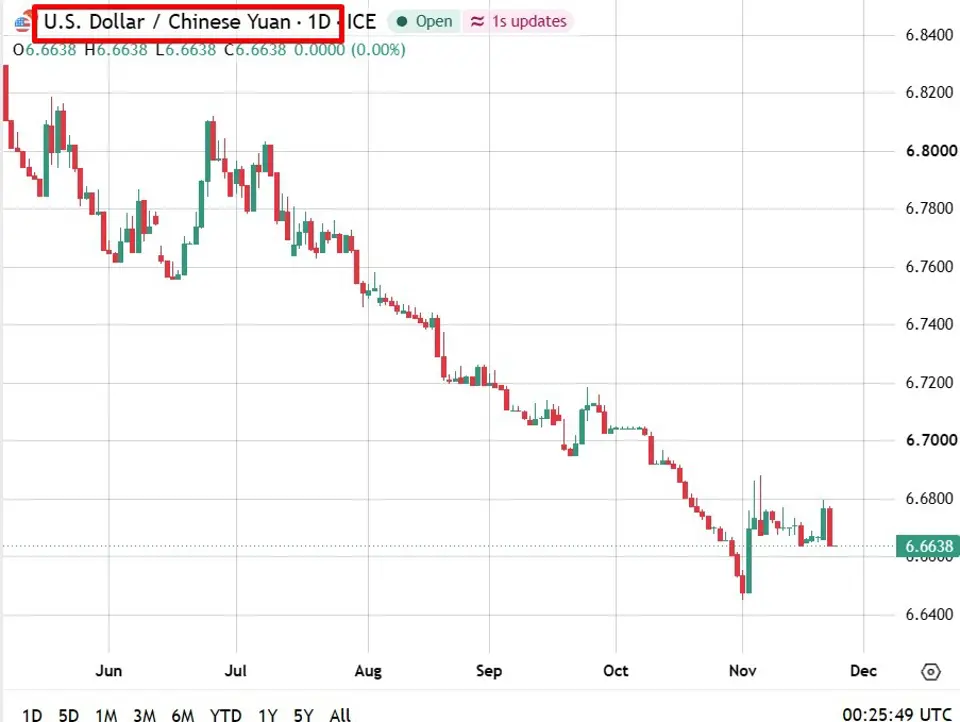
The People's Bank of China (PBOC) is expected to set the daily USD/CNY reference rate at 6.6757, according to a Reuters estimate. The fixing is due at approximately 0115 GMT (2115 US Eastern time), just ahead of the onshore trading session, and remains one of the most closely watched signals in Asian foreign exchange markets.
How China's Managed Float Works
China operates a managed floating exchange rate system under which the renminbi, or yuan, is allowed to trade within a prescribed band around a central reference rate — the midpoint — set each trading day by the PBOC. The current trading band permits the currency to move plus or minus 2% from the official midpoint during onshore trading hours. The onshore unit, known as CNY, is subject to that band, while the offshore-traded yuan (CNH) trades freely in centers such as Hong Kong without an official range — a structure that makes the gap between the two rates a common lens for viewing pressure on the currency.
Each morning, the PBOC determines the midpoint based on a range of inputs, including the previous day's closing price, movements in major currencies — particularly the US dollar — and broader international foreign exchange conditions. Domestic considerations such as capital flows, growth momentum and financial stability objectives also feed into the calculation. At times the central bank has also applied a so-called counter-cyclical factor to the quote mechanism, an adjustment that gives it additional room to lean against one-way moves in the market. The midpoint is not a purely mechanical exercise, which gives policymakers discretion to guide market expectations.
Intervention and Policy Signaling
Once the midpoint is announced, onshore USD/CNY is free to trade within the allowable band. If market pressures push the yuan toward either edge of that range, the central bank may step in to smooth volatility. Intervention can take the form of direct buying or selling of the currency, adjustments to liquidity conditions, or guidance through state-owned banks.
As a result, the daily fixing is often interpreted as a policy signal rather than a purely technical reference point. A stronger-than-expected midpoint is typically read as a sign that the PBOC is leaning against depreciation pressure, while a weaker fixing can indicate tolerance for a softer currency — often in response to dollar strength or domestic economic headwinds. In practice, analysts measure the published midpoint against survey-based estimates such as the Reuters projection cited above, and the size of that gap is frequently used to gauge how much discretion shaped the day's rate.
Why the Fixing Matters
In periods of heightened global volatility — such as shifts in US rate expectations, trade tensions or capital flow pressures — the fixing takes on added significance. For investors, it offers a window into Beijing's currency priorities as policymakers balance competitiveness, capital stability and financial market confidence.

