Splash Wrap: The Rising Price of Passage
Key Takeaways
- •SK Gas paid a record $5.3m at auction for a September 1 Panama Canal transit, exceeding the $4.6m record set earlier in the month as drought forces further restrictions.
- •Jebel Ali fell from 10th to 32nd in global port rankings after second-quarter throughput dropped more than 90% year-on-year amid collapsing Hormuz traffic.
- •Global container port congestion reached an all-time high, with more than 4.3m teu of capacity waiting to berth, exceeding covid peaks.
- •MSC, Maersk and CMA CGM have begun restoring Suez and Bab el-Mandeb routings despite the unresolved security crisis, with normal Red Sea traffic possibly returning by year-end.
- •The industry lost Klaus-Michael Kühne, the German billionaire who built Kuehne+Nagel into a global logistics leader and was Hapag-Lloyd's largest shareholder.
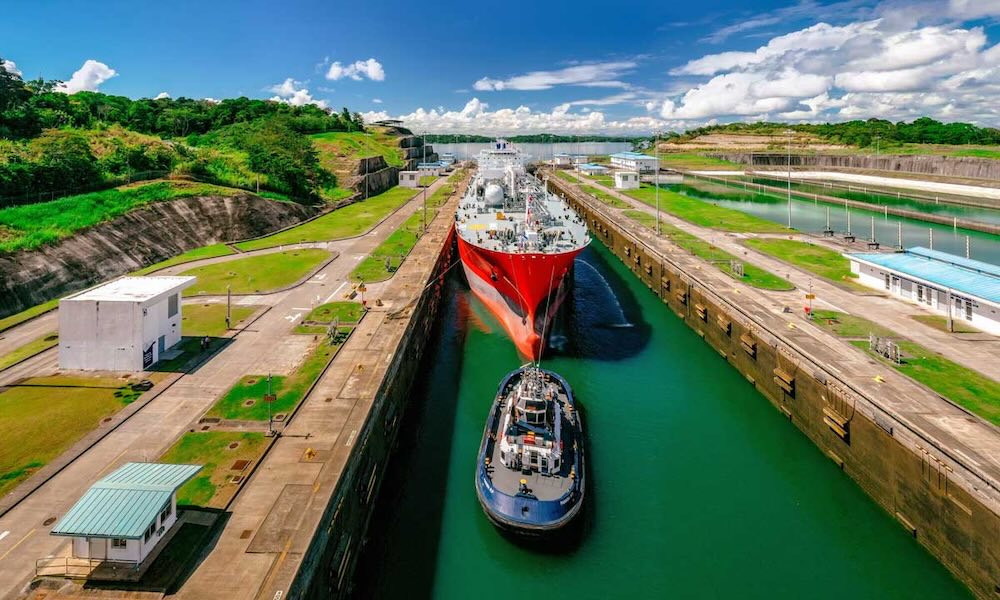
Shipping spent this week paying ever more extravagant sums for something that used to be taken largely for granted: passage.
War, drought, congestion and regulation have turned the journey from A to B into an increasingly complicated calculation of risk, availability and price. This week showed just how expensive keeping those routes open has become.
Nothing illustrated that better than the Panama Canal. South Korea's SK Gas paid a record $5.3m at auction to secure a September 1 passage for an LPG carrier, smashing a record of $4.6m set only earlier this month.
Panama's worsening drought is forcing further restrictions from September, continuing the low-water crisis that began gripping the canal in 2023 and has repeatedly curtailed daily transits and vessel draft limits. Vessels arriving without reservations have faced waits stretching towards 11 days. Further south, the Amazon drought is also biting, with containerlines introducing surcharges of as much as $1,900 to keep Manaus, the river-borne hub for Brazilian trade, connected.
At Hormuz, passage carries a different premium. Iran's decision to blacklist dozens of ships has created another compliance headache for owners already navigating a corridor through which roughly a fifth of global oil consumption normally transits, and where nationality, ownership, cargo interests and previous trading history can determine whether a ship becomes a target.
More importantly, Tehran is now threatening the shuttle tanker system that has emerged as one of the defining workarounds of the war.
The Saudi VLCC Amzan was struck west of Yanbu this week as the Houthis extended their campaign deep into the northern Red Sea, putting further pressure on another route Saudi Arabia has relied upon to reduce its dependence on Hormuz.
The consequences of all this disruption are now visible in port league tables.
Jebel Ali, the Middle East's great container hub, has crashed from 10th to 32nd in the global rankings. Throughput fell more than 90% year-on-year in the second quarter as Hormuz traffic collapsed. Across the first half, Dubai handled less than half the volumes recorded a year earlier.
There were, however, tentative signs of one old route coming back.
More than 1,000 days after the seizure of the Galaxy Leader — the car carrier hijacked by the Houthis in November 2023, an act widely seen as opening the current era of Red Sea attacks — container analyst Lars Jensen suggested box shipping could be approaching normal Red Sea and Suez traffic levels by year-end.
MSC has restored Suez routings on four east-west services, while Maersk and CMA CGM have steadily increased Bab el-Mandeb passages. The extraordinary part is that the underlying security crisis has not disappeared. The liners are simply becoming more willing to price and manage the risk. And they have another incentive.
Global boxport congestion hit an absolute record this week, with more than 4.3m teu of containership capacity waiting to berth, according to Linerlytica. Drewry argued yesterday that the container system has spent years optimising for cost rather than resilience. At 90% berth utilisation, a terminal can take roughly a week to recover from a single day of disruption.
Shipping's new currency, increasingly, is spare capacity. That idea extends far beyond ports.
DNV's latest Maritime Forecast to 2050 warned owners against betting their fleets on a single regulatory or fuel outcome. Build strategies that survive several possible futures, the class society advised — a message aimed at an industry facing still-uncertain IMO greenhouse gas rules and a fragmented landscape of competing fuels. In Washington, meanwhile, the IAEA launched ATLAS, bringing more than 50 countries together to work through the enormous regulatory obstacles surrounding nuclear-powered commercial shipping.
Both stories amount to much the same strategic advice: optionality has value.
The industry also lost one of its towering business figures this week with the death of Klaus-Michael Kühne, the German billionaire who helped transform his family freight forwarding business, Kuehne+Nagel, into one of the dominant forces in global logistics, and who was also the largest shareholder in Hapag-Lloyd and a major investor in shipping lines including other carriers.
Among this week's interviews, Paratus founder Gus Majed captured the mood. Middle East risk, he argued, has been permanently repriced. "War closed one artery and climate is squeezing two more," he said ahead of his turn moderating the tanker panel at next month's Splash Singapore conference. The World Bank's Jan Hoffmann, in conversation with Splash Ports, discussed how uncertainty, congestion and concentrated liner networks are reshaping global trade.
This week's standout feature came via SplashTech, with reporters asking technology experts about how vendor-neutral interfaces, common data definitions and genuine interoperability are emerging as prerequisites for the next phase of maritime digitalisation.
Container port congestion has been to the fore in the reporting this week – with ship queues around the world now surpassing the peaks experienced during covid, helping keep freight rates at elevated levels. Global ship waiting times have nearly doubled since 2019, schedule reliability is deteriorating and container volumes have outpaced capacity growth at many major ports. The growing queues at ports around the world form the basis for this week's Splash Wrap podcast.

