From JPY to EURC: What Could Come Next for On-Chain FX Markets?
Key Takeaways
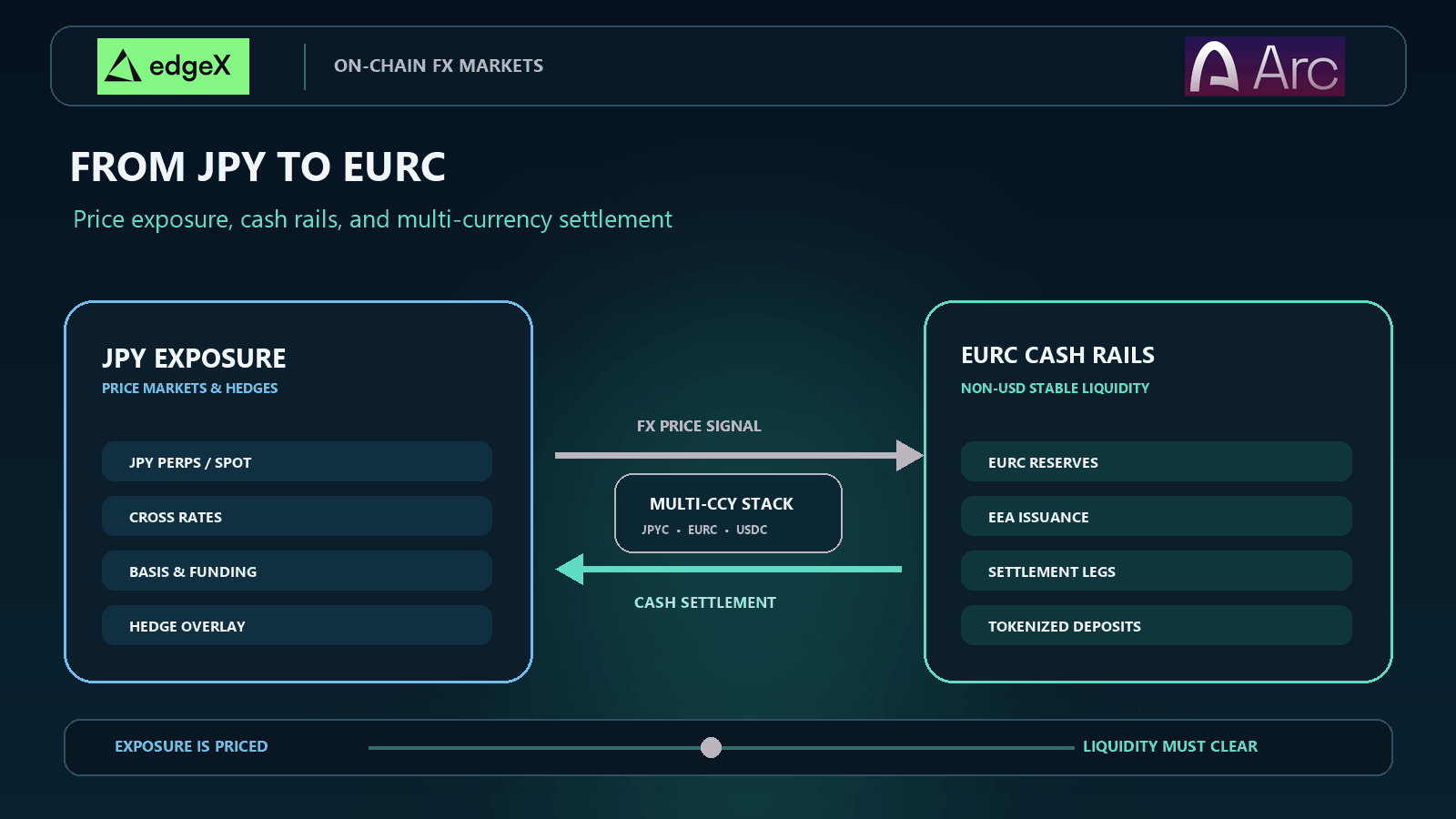
- •edgeX has announced FX perpetuals starting with JPY on Arc's native FX path, followed by plans for more pairs, FX spot against non-USD stablecoins, and non-USD margin, ahead of the Arc mainnet launch scheduled for September 16, 2026.
- •A JPY perpetual gives price exposure to a yen pair without creating a yen bank balance, a yen payment instrument, or redeemability through Japanese banking channels.
- •Circle's EURC is a euro-backed stablecoin redeemable 1:1 for euro across multiple public chains, with circulation and reserve figures and attestation materials published on its transparency page.
- •Scaling multi-currency on-chain FX requires adequate mint and redeem capacity, order-book depth across Tokyo, London, and New York sessions, oracle and mark logic matched to the cash instrument, conservative collateral rules, and regulatory clarity by currency zone.
- •The BIS has argued a next-generation monetary system should rest on tokenized central-bank reserves, commercial-bank money, and government bonds, while the ECB has suggested tokenized deposits may prove preferable to stablecoins for some wholesale settlement uses.
Quick Answer
On-chain FX is moving beyond a dollar-only map. JPY markets show how crypto venues can list foreign-exchange exposure first. EURC shows how a non-USD cash instrument can circulate on public chains with issuer transparency and euro redeemability. What comes next is less about inventing more ticker symbols and more about whether markets can settle, hedge, and hold multiple currencies with reliable depth and clear exit paths.
The practical path is staged. Venues can start with USDC-margined FX perpetuals. They can then add spot pairs against non-USD stablecoins if liquidity and custody support them. Over time, tokenized deposits and public-money rails may compete with or complement private stablecoins as settlement assets. Traders should judge each step by the cash instrument, the market type, and the controls around conversion, not by the label “on-chain FX” alone.
On-Chain FX Is Not One Market Type
Foreign exchange is the market for exchanging one currency claim for another. Moving that activity on-chain does not automatically create the same instrument. A platform can offer:
| Market form | What the trader holds or receives | What it is useful for | What it does not automatically provide |
|---|---|---|---|
| FX perpetual | Price exposure to a currency pair | Hedging or expressing a view without holding the foreign cash | Direct redeemability into bank money |
| Spot stablecoin pair | One stablecoin exchanged for another | On-chain conversion and inventory management | Guaranteed off-chain bank settlement in every jurisdiction |
| Non-USD collateral | Margin denominated in a local-currency stablecoin or deposit token | Reducing forced conversion back into dollars | Identical risk treatment across venues |
| Payment conversion | Settlement of a cross-border transfer | Moving value between currency zones | Market-making depth for active traders |
These forms can support one another, but they fail in different ways. A perpetual can have a clean price feed and thin exit liquidity. A stablecoin can redeem at par with its issuer and still trade at a discount on a stressed venue. A payment rail can settle quickly and still leave the recipient with conversion, compliance, or banking friction.
That is why the phrase “on-chain FX” needs a second question: exposure, cash, collateral, or payment? The answer changes the risk map.
JPY Is Already a Bridge Currency for Crypto FX Exposure
Yen markets matter because Japan is a major funding and trading currency in traditional FX, while crypto markets still settle most activity in dollars. A JPY perpetual lets a trader express yen risk against USDC or another account unit without opening a Japanese bank relationship. For many desks, that is the first useful step.
edgeX’s archived launch material describes on-chain FX perpetuals beginning with JPY on Arc’s native FX path, with later exploration of more pairs, FX spot against non-USD stablecoins, and non-USD margin. That sequence is instructive even before every product is live. It starts with price discovery, then asks whether cash instruments and collateral rules can support a fuller FX stack.
JPY exposure also forces market-structure questions that dollar-only books can hide:
- Which Tokyo, London, or New York session carries the real depth?
- How should funding behave when traditional FX desks are quiet?
- What happens if the yen gap moves faster than the crypto order book can absorb?
- Is the reference a spot FX index, a futures curve, or a venue-specific mark?
A JPY market can be valuable without being a complete yen cash system. Traders still need a path from profit and loss in account currency back to bank money, tax reporting, and local payment needs. The bridge is useful precisely because it is incomplete.
EURC Shows How a Non-USD Cash Instrument Can Matter
EURC is different from a yen perpetual because it is a cash claim, not only a price bet. Circle describes EURC as a euro-backed stablecoin redeemable 1:1 for euro, available across multiple public chains, and used in crypto capital markets, FX trading, borrowing, and lending. Circle's transparency page publishes circulation and reserve figures and attestation materials for both USDC and EURC.
That combination matters for on-chain FX design. A euro cash token can support:
- Spot FX against USDC or other stablecoins.
- Euro-denominated balances for European users who do not want every inventory cycle to route through dollars.
- Settlement of tokenized assets or payments that need a euro unit rather than a pure price feed.
- Collateral experiments in which margin stays closer to the trader's home currency.
None of those uses is automatic. EURC still depends on issuer access, chain support, exchange listings, banking connectivity, and local rules. Circle's EEA materials place EURC inside the MiCA-era regulatory conversation. The European Central Bank has argued that stablecoins combine a monetary function and a technological settlement function, and that Europe should not confuse the instrument with the outcome it wants from digital money infrastructure.
For market participants, the lesson is practical. EURC is evidence that non-USD cash can exist on public rails with disclosed reserves. It is not proof that every FX pair against EURC already has institutional depth, nor that euro stablecoins will dominate future settlement by default. A yen-linked cash instrument is a separate track. JPYC Inc. presents itself as a yen-linked stablecoin issuer with a public-chain issuance record, which is relevant context for Japan-facing rails, but it does not make yen cash interchangeable with yen price exposure.
What Has to Improve Before Multi-Currency FX Scales
Listing another pair is easy compared with supporting it under stress. Multi-currency on-chain FX needs several layers to move together.
1. Issuance and redemption capacity
A stablecoin only anchors FX if users can move between bank money and the token with predictable timing and controls. Thin mint and redeem capacity turns every dislocation into a wider basis between on-chain prices and off-chain FX.
2. Market depth that survives sessions
Currency pairs trade around the clock in theory, but liquidity still clusters. An on-chain book needs market makers who can warehouse inventory across Tokyo, London, and New York hours, not only during crypto-native peaks.
3. Oracles and mark logic that match the cash instrument
If the cash leg is EURC and the reference is a traditional EURUSD print, the venue must define what happens when stablecoin basis, banking windows, or index stalls intervene. A clean chart is not the same as a clean settlement mark.
4. Collateral and haircut rules
Non-USD margin can reduce conversion friction, but only if the platform values the asset conservatively, limits concentration, and explains when the asset stops counting as available collateral. Shared accounts can transmit stress from one currency balance into unrelated positions.
5. Regulatory clarity by currency zone
MAS is consulting on legislation to implement a single-currency stablecoin framework that can cover the Singapore dollar or any G10 currency, with licensing, value-stability, and user-protection requirements. That kind of regime does not create liquidity by itself. It does create a clearer path for institutions that need to distinguish regulated cash tokens from generic crypto labels.
| Scaling bottleneck | Why it matters for FX | What "good" looks like |
|---|---|---|
| Mint and redeem rails | Anchors on-chain prices to bank money | Predictable access windows, disclosed reserves, workable off-ramps |
| Order-book depth | Determines real hedge and exit quality | Two-sided size across sessions, not only tight top-of-book spreads |
| Oracle and mark design | Controls liquidations and funding | Explicit handling of gaps, stale prints, and stablecoin basis |
| Collateral policy | Decides whether multi-currency balances help or hide risk | Haircuts, concentration limits, and withdrawal boundaries |
| Local licensing | Shapes who can issue, hold, and distribute cash tokens | Clear issuer status and user protections by jurisdiction |
Tokenized Deposits and Public-Money Rails May Reshape the Next Layer
Private stablecoins are not the only candidates for on-chain FX settlement. The BIS has argued that a next-generation monetary system should rest on a tokenized "trilogy" of central-bank reserves, commercial-bank money, and government bonds, while treating stablecoins as a more limited or subsidiary instrument unless well regulated. The ECB speech makes a similar architectural point: the settlement function needs a common anchor, and tokenized deposits may prove preferable to stablecoins for some wholesale uses.
That debate matters for FX markets because currency exchange is ultimately about claims on different monetary systems. If tokenized deposits become usable across institutions, FX could settle as a movement between bank liabilities rather than only between private issuer tokens. None of this erases the current role of USDC and EURC. Stablecoins can remain the practical public-chain cash of crypto markets while banks and central banks build parallel or interoperable rails.
How Traders and Investors Should Evaluate the Next FX Pairs
Start with the instrument. Is the listing a perpetual, a spot pair, a payment conversion product, or a collateral feature? If the venue says "JPY," ask whether that means price exposure, yen cash, or both.
Then inspect the cash path. For EURC or any other non-USD token, review issuer disclosures, chain support, redemption access, and whether the trader's actual off-ramp is direct or intermediated through an exchange. A published reserve report is necessary evidence. It is not a substitute for venue liquidity.
Next, test market quality under the hours that matter. Check spread, depth, funding behavior, and gap risk around traditional FX sessions and weekend crypto conditions. A pair that looks efficient at one timestamp can become expensive when inventory has to move through thin books.
Finally, map the account design. Multi-currency balances are only helpful if valuation, haircuts, withdrawals, and liquidation rules are explicit. The worst outcome is a balance that appears diversified in currency labels while remaining concentrated in one risk engine and one exit corridor.
Investor Summary
On-chain FX is expanding from dollar-centered crypto plumbing toward a broader set of currency claims. JPY markets show how venues can introduce foreign-exchange exposure before full local-currency cash systems exist. EURC shows that a non-USD cash token can operate on public chains with redeemability and reserve transparency. Tokenized deposits and public settlement rails may later change the cash leg again.
Investors should separate three questions. Which instruments are live? Which are announced or exploratory? Which still depend on banking, licensing, and market-making capacity that has not yet been proven under stress? The opportunity is real, but it compounds only where conversion, custody, and liquidity hold up together.
Final Takeaway
The path from JPY to EURC is not a straight line from one ticker to the next. It is a shift from dollar-only assumptions to a multi-currency design problem. Price exposure can arrive first. Cash instruments arrive when issuance, redemption, and distribution work. Institutional scale arrives when private tokens, bank liabilities, and public rails can interact without breaking settlement finality.
Traders and investors should welcome broader FX choice without confusing labels for infrastructure. The next useful market is the one that can be entered, valued, hedged, and exited with clear rules when the currency gap is real.
Trade Perpetual Markets on edgeX With Arc Settlement
Put your USDC to work across a market layer built for active traders. edgeX brings an order-book trading experience to perpetual markets across crypto, U.S. stocks, commodities, and FX, with its white paper describing the execution stack behind the platform. Arc is designed to provide the stablecoin-native settlement environment underneath. The announced integration is designed to keep margin and settlement in native USDC, so the trading workflow and the settlement asset work together instead of being split across disconnected systems.
Ready to trade beyond a single market? Explore edgeX to find the platform and available perpetual markets. For the Arc-specific path, see edgeX on Arc and follow the announced rollout. edgeX has announced plans for new FX perpetuals alongside its existing markets, with the Arc mainnet launch scheduled for September 16, 2026. Availability, markets, and launch details may change.
Perpetual contracts are built for traders who want flexible, always-on market access, but they are not passive products. Leverage, funding rates, oracle design, liquidity, and liquidation can all affect outcomes. Review the product terms and risk controls before trading.
Frequently Asked Questions
Is a JPY perpetual the same as holding yen?
No. A JPY perpetual gives price exposure to a yen pair under the venue's contract rules. It does not by itself create a yen bank balance, a yen payment instrument, or a claim redeemable through a Japanese banking channel.
Why does EURC matter for on-chain FX?
EURC is a euro cash token with published redeemability and reserve disclosures. That makes it more than a price reference. It can support spot conversion, euro balances, and settlement use cases when venues and banking rails support them.
Will non-USD stablecoins replace USDC?
Not necessarily. USDC remains central to much of crypto settlement. Non-USD instruments can reduce conversion friction for local users and create new FX pairs, but dollar rails can remain dominant where liquidity, custody, and integrations are deepest.
What is the difference between stablecoins and tokenized deposits?
Stablecoins are usually issuer tokens backed by reserves under a stated framework. Tokenized deposits are bank liabilities represented in token form. They can serve similar settlement jobs in some workflows, but the credit, legal, and access models differ.
What should traders check before using a new on-chain FX pair?
Check whether the product is exposure or cash, how the mark price is formed, how deep the book is across sessions, how mint and redeem access works, and how the venue treats collateral, withdrawals, and liquidations.

