Oil Prices Rise as Supply Outlook Improves While Hormuz Attacks Keep Traders Cautious
Key Takeaways
- •Brent crude rose 1.5% to $93.84 a barrel and WTI gained 1.6% to $87.10 on Tuesday, though crude prices remain down more than 14% over the past month amid hopes for an easing of the Iran war.
- •The International Energy Agency revised its December-quarter outlook to a supply surplus of 1.7 million barrels per day above demand, the first oversupply quarter since the conflict began in late February, after previously forecasting a shortfall.
- •OPEC data showed large production increases from Saudi Arabia, Iraq and Kuwait, while Goldman Sachs lowered its Brent and WTI price forecasts across 2026 and 2027 periods.
- •Iran presented a two-day plan on Monday to reopen the Strait of Hormuz and end hostilities with the United States, while at least four tankers have been attacked in the strait since Friday, sustaining concerns over Gulf oil flows.
- •Despite strong builds in U.S. crude, gasoline and diesel inventories last week, analysts noted stockpiles remain far from normal levels and several more weeks of similar data are needed to confirm a shift in conditions.
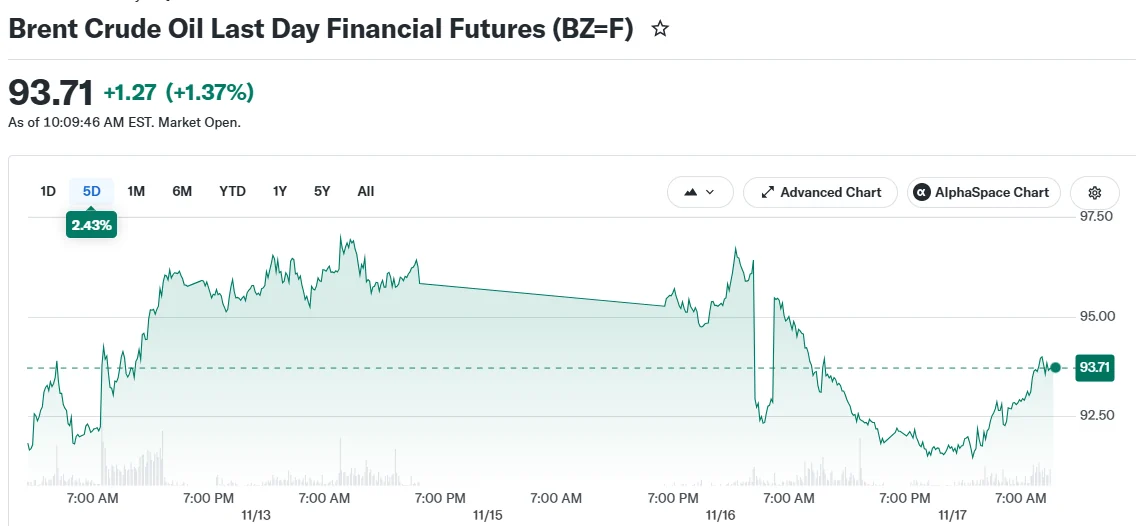
Oil prices moved higher on Tuesday as traders weighed improving supply data against renewed security risks in the Gulf. January Brent futures, the global crude benchmark, rose 1.5% to $93.84 a barrel by 09:48 ET, while U.S. West Texas Intermediate crude gained 1.6% to $87.10 a barrel.
The gains followed a sharp decline. Crude prices remain down more than 14% over the past month as hopes for an easing of the Iran war pressured the market lower, although messages from both sides have remained mixed.
Supply Outlook Shifts to a Surplus
The International Energy Agency said late last week that global oil supply is expected to average about 105 million barrels per day in the December quarter. That would put supply 1.7 million barrels per day above expected demand and mark the first quarter in which supply exceeds demand since the war began in late February.
The agency had previously forecast a shortfall for the fourth quarter. The revision underscores how significantly the supply outlook has changed in a matter of weeks.
Data from the Organization of the Petroleum Exporting Countries (OPEC) also indicated higher production. Saudi Arabia, Iraq and Kuwait each reported large output gains last month, while Middle Eastern exports have continued to recover.
Goldman Sachs has also lowered its Brent and WTI crude oil price forecasts across multiple periods, according to a post by Walter Bloomberg on X:
GOLDMAN SACHS CUTS OIL PRICE FORECASTS FOR 2026 AND 2027
Goldman Sachs has lowered its Brent and WTI crude oil price forecasts across multiple periods.
WTI Crude:
2026: $85/bbl, down from $87
Q4 2026: $91/bbl, down from $96
Q1 2027: $85/bbl, down from $87Brent…
— *Walter Bloomberg (@DeItaone) November 16, 2026
Despite the broader supply improvement, tight U.S. inventories remain a concern. TradeStation analyst David Russell said weaker diesel demand and exports had helped rebuild stockpiles, but added that domestic inventories remained far from normal levels.
Russell said traders would need to see several more weeks of similar data to determine whether conditions had shifted. Weekly U.S. figures released last week showed strong builds in crude oil, gasoline and diesel inventories.
Iran Talks and Strait of Hormuz Risks
Diplomatic developments have remained a major influence on oil prices. On Monday, Iran presented a two-day plan to reopen the Strait of Hormuz and end hostilities with the United States. Iran said responsibility now rested with Washington to end the conflict, leaving traders watching for the U.S. response.
At the same time, at least four tankers have been attacked in the strait since Friday. The incidents have sustained concerns about potential disruptions to oil flows from the Gulf and limited the extent of the market’s decline. The waterway is one of the world’s most important oil transit chokepoints, which is why threats to shipping there command outsized attention from crude markets even when supply data improves.
Last week, President Trump wrote on Truth Social that the United States did not need a deal with Iran. He said he would rather have Vice President JD Vance focus on investigating alleged corruption in Democrat-run cities. The post came after hopes for talks had pushed oil prices to two-month lows.
Prices reversed their early losses after the post. On Thursday, WTI settled 2.6% higher at $88.74 a barrel, while Brent rose 3.3% to $95.82 a barrel.
Peter Cardillo of Spartan Capital said the oil market was not taking the change in focus very seriously. He noted that prices eased after an initial spike and said a major reversal was unlikely unless either side carried out a military strike.
On Tuesday, Brent traded near $93.84 a barrel and WTI near $87.10 a barrel.

