Oil Prices Rise After Hormuz Ship Attacks and Strike on Saudi Aramco Facility
Key Takeaways
- •Brent crude rose 14 cents to $105.83 a barrel and WTI gained 57 cents to $94.71 by 0938 GMT, with WTI earlier reaching a two-week high of $95.41.
- •Houthi rebels attacked a Saudi Aramco administrative building in Dhahran, sparking a limited fire, during a week-long barrage that hit Riyadh's airport four times and killed 13 people in a Saturday strike.
- •A container ship and a tanker were struck by unknown projectiles in the Strait of Hormuz, and Iran's Revolutionary Guards Navy said a container ship sank there after hitting a naval mine.
- •Iranian officials told Reuters that new ship-targeting tactics began roughly 10 days ago and aim to keep oil prices high ahead of the November U.S. midterm elections.
- •The U.S. temporarily lifted sanctions on Russian fuel after Russia agreed to supply diesel globally, while the IEA expects tight diesel supplies to persist into next year and a hurricane has taken more than 60% of U.S. Gulf Coast oil production offline.
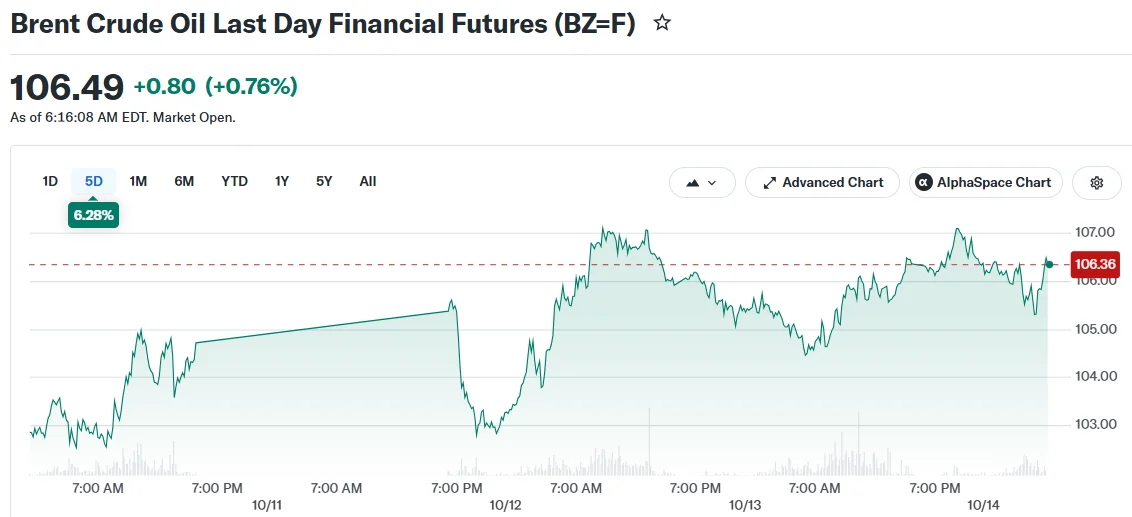
Oil prices edged higher on Wednesday after attacks on ships near the Strait of Hormuz and a strike on a Saudi Aramco facility. Brent crude futures, the international benchmark, rose 14 cents to $105.83 a barrel by 0938 GMT, while U.S. West Texas Intermediate crude, the U.S. benchmark, gained 57 cents to $94.71. Both contracts rose by more than $1 in early trading, and WTI reached a two-week high of $95.41.
Attacks on Saudi sites and ships
Houthi rebels attacked an administrative building belonging to Saudi Aramco, the kingdom’s state-owned oil company, in Dhahran, Saudi Arabia’s energy ministry said. The strike caused a limited fire.
🇸🇦🇾🇪 Houthi missiles hit Saudi Aramco's headquarters, setting part of the oil giant's office complex in Dhahran on fire. Luckily nobody was hurt, but the missiles kept coming, with more shot down over Dhahran and other cities and shrapnel raining down on a neighborhood. This… pic.twitter.com/783qu8kYIw — Mario Nawfal (@MarioNawfal) October 14, 2026
🇸🇦🇾🇪 Houthi missiles hit Saudi Aramco's headquarters, setting part of the oil giant's office complex in Dhahran on fire. Luckily nobody was hurt, but the missiles kept coming, with more shot down over Dhahran and other cities and shrapnel raining down on a neighborhood. This… pic.twitter.com/783qu8kYIw — Mario Nawfal (@MarioNawfal) October 14, 2026
The Houthis, who control territory in parts of Yemen, have fired ballistic missiles and drones at Saudi Arabia over the past week. Reuters reported that the attacks were retaliation for the kingdom’s support of Yemeni government forces. Riyadh’s international airport has been hit four times. A strike on Saturday killed 13 people, and Saudi authorities briefly closed the airport earlier this week.
Saudi-led coalition forces launched a new offensive in Yemen earlier this month. The operation aims to retake Houthi-held areas, including territory near the Bab el-Mandeb Strait, a key oil shipping route that links the Red Sea and the Gulf of Aden.
In the Strait of Hormuz, the United Kingdom Maritime Trade Operations authority, which logs security incidents reported by merchant ships, said a container ship and a tanker were hit by unknown projectiles on Tuesday. Reports this week said at least two ships had been struck. Iran’s Revolutionary Guards Navy said a container ship sank south of the strait after hitting a naval mine and catching fire. Iran has largely closed the waterway for months.
Before the war, roughly one-fifth of the world’s oil and liquefied natural gas moved through the Strait of Hormuz, a concentration of flows that gives the waterway outsize weight in global energy supply. The war began in late February with a joint U.S. and Israeli assault.
Market reaction and supply outlook
Iranian officials told Reuters that they are using new tactics to target ships. One official said the approach began about 10 days ago, while officials declined to provide details. Reuters reported that the objective is to keep oil prices high and influence the U.S. midterm elections in November. Polls suggest Republican candidates may face voter backlash over the energy shock.
UBS analyst Giovanni Staunovo said the attacks were supporting prices because traders were concerned about lower exports from the region. He added that exports had held up so far.
President Donald Trump said last Friday that Russia had agreed to supply diesel to global markets. His administration temporarily lifted U.S. sanctions on Russian fuel. Nissan Securities strategist Hiroyuki Kikukawa said increased Russian diesel exports should limit sharp price movements.
Diesel underpins trucking, agriculture and industrial activity, giving refinery availability broad economic significance. The International Energy Agency said a lack of operating Russian refinery capacity means little change is expected in the market, and that tight diesel supplies could continue into next year.
Investors are also monitoring the U.S. Gulf Coast, a center of American offshore oil production, where a hurricane took more than 60% of production offline. Deutsche Bank analysts expect a strong September U.S. consumer price index reading, a widely watched gauge of U.S. inflation. The U.S. inflation report was due later on Wednesday.
Beyond the inflation report, the factors analysts flagged as swing points for supply were whether regional exports continue to hold up and how much additional Russian diesel reaches the market.
Brent traded at $105.83 a barrel and WTI at $94.71 at 0938 GMT. The original was published by CoinCentral: https://coincentral.com/oil-prices-rise-as-hormuz-ship-attacks-and-saudi-aramco-strike-lift-brent-crude/

