Oil Prices Hit Three-Week Highs as Iran War Keeps Strait of Hormuz Disrupted
Key Takeaways
- •Brent crude rose 1.3% to $92.82 a barrel, while West Texas Intermediate reached $86.75, marking a fifth straight session of gains for both benchmarks.
- •The oil rally is being driven by the U.S.-Iran conflict and the continued disruption of shipping through the Strait of Hormuz, which previously carried about one-fifth of the world’s crude supply.
- •Commercial traffic through the Strait of Hormuz remains far below pre-war levels, and Iran has denied U.S. claims that the waterway is open.
- •The United Arab Emirates suspended all financial and economic transactions with Iran until further notice, adding to regional tensions.
- •U.S. distillate inventories fell for a third consecutive week, while crude inventories unexpectedly rose by 4.4 million barrels.
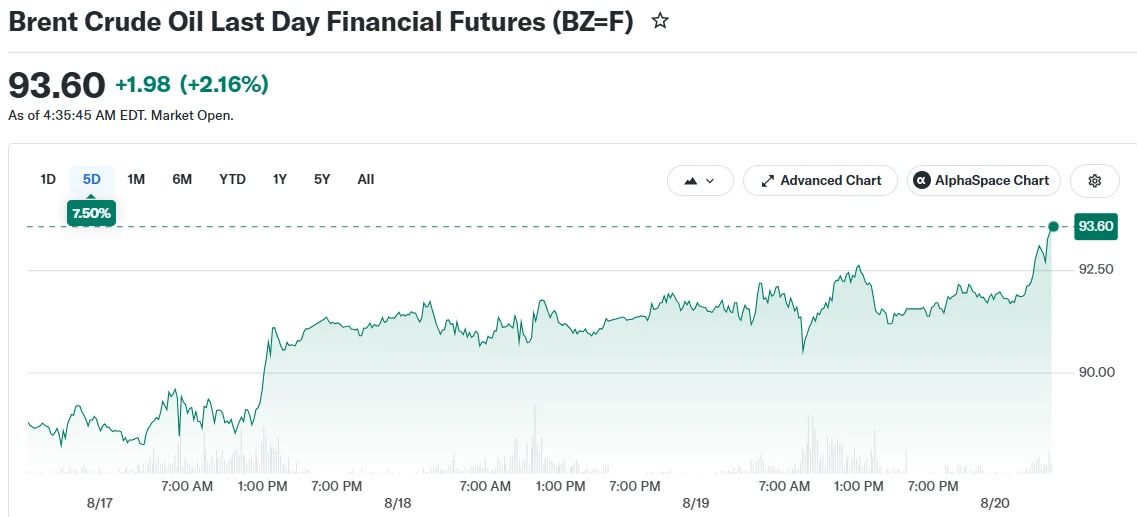
Oil prices climbed to their highest levels in three weeks on Thursday, with Brent crude rising 1.3% to $92.82 a barrel and West Texas Intermediate reaching $86.75. The advance marked a fifth consecutive session of gains for both benchmarks, which serve as the two most closely watched price references for global crude and can quickly reflect shifts in supply risk, shipping flows, and refinery costs.
The rally is being driven by the ongoing war between the United States and Iran, which began with American and Israeli strikes on Iran on February 28. Since then, Iran has effectively blocked the Strait of Hormuz, the narrow waterway between Iran and Oman that links the Persian Gulf to global shipping routes, cutting off a passage that previously carried around one-fifth of the world's crude supply. Because so much oil moves through that corridor, even limited disruptions can ripple through markets and keep traders focused on whether shipments are moving normally.
BREAKING: President Trump posts an image claiming that the Strait of Hormuz is now "new US territory." US oil prices extend gains toward $85 per barrel. pic.twitter.com/JZvodNadlG
— The Kobeissi Letter (@KobeissiLetter), August 18, 2026 (post)
Recent shipping data shows commercial traffic through the Strait of Hormuz remains at a fraction of pre-war levels, despite U.S. claims that the waterway is open. Iran has denied those claims, and the two sides appear no closer to a resolution.
"Tensions in the Middle East remain high, leaving room for further supply disruptions," said UBS analyst Giovanni Staunovo. "Lower oil exports from the Middle East are once again tightening the oil market."
The United Arab Emirates added further pressure by suspending all financial and economic transactions with Iran until further notice. The decision has put a renewed focus on the strained relationship between two of the Gulf's biggest players, underscoring how the conflict is affecting not just oil shipping but also broader regional trade and diplomacy.
Trump Threatens "Economic D-Day" for Iran
U.S. President Donald Trump escalated his rhetoric on Wednesday, announcing what he called the "most crushing economic operation ever taken against any country." He described the campaign as economic warfare on an unprecedented scale and warned other nations against doing business with Iran.
BREAKING: Trump announces "the most crushing economic operation ever taken against a country" against Iran. Trump implies the US will directly target China and Russia, saying "any country that allows its financial institutions, businesses, airports, or government entities to… pic.twitter.com/Hu3fzEyC0x
— The Hormuz Letter (@HormuzLetter), August 19, 2026 (post)
Trump did not give details on what the new restrictions would include. He also reiterated that the United States holds control of the Strait of Hormuz and that talks with Iran could resume "at some point."
Iran has pushed back, saying no real dialogue has taken place. Tehran has also demanded that Washington fulfil the terms of a June memorandum of understanding before any progress can be made. That agreement lapsed earlier this week with no signs of renewal.
Hiroyuki Kikukawa, chief strategist at Nissan Securities Investment, said the market is likely to maintain a gradual upward trend given the uncertainty around peace talks and tensions involving the UAE, Oman, and Iran.
On the supply side, U.S. distillate stockpiles, which include diesel and heating oil, fell for a third straight week. Crude inventories rose by 4.4 million barrels, an unexpected build. The mixed inventory picture suggests traders are weighing both weaker stockpiles in refined fuels and a headline increase in crude.
Emergency reserve releases by major economies, including the United States, have helped offset some of the disruption caused by the conflict. However, analysts expect the Middle East conflict to continue supporting crude prices in the months ahead.
The September WTI contract expired Thursday, with the more active October contract sitting at $85.52, up 1.3% on the day.
Source: CoinCentral

