Oil Prices Fall as Saudi Output Jumps 26% and U.S. Stockpiles Build
Key Takeaways
- •Brent crude fell between 0.4% and 1% on Thursday to roughly $91.79–$92.42 a barrel, though the contract remains up more than 50% this year.
- •U.S. Vice President JD Vance is considering preliminary in-person talks with Iranian security official Mohsen Rezaei, having been empowered to negotiate by President Trump.
- •Saudi Arabia reported to OPEC that its October output rose 26% to 10.56 million barrels per day, one of its highest levels in years.
- •U.S. industry data showed an unexpected 9-million-barrel build in crude inventories last week, with official confirmation expected in the Energy Information Administration's delayed Thursday report.
- •The International Maritime Organization has verified more than 130 attacks on commercial vessels in the Strait of Hormuz since the war began on Feb. 28, with at least 25 seafarers killed.
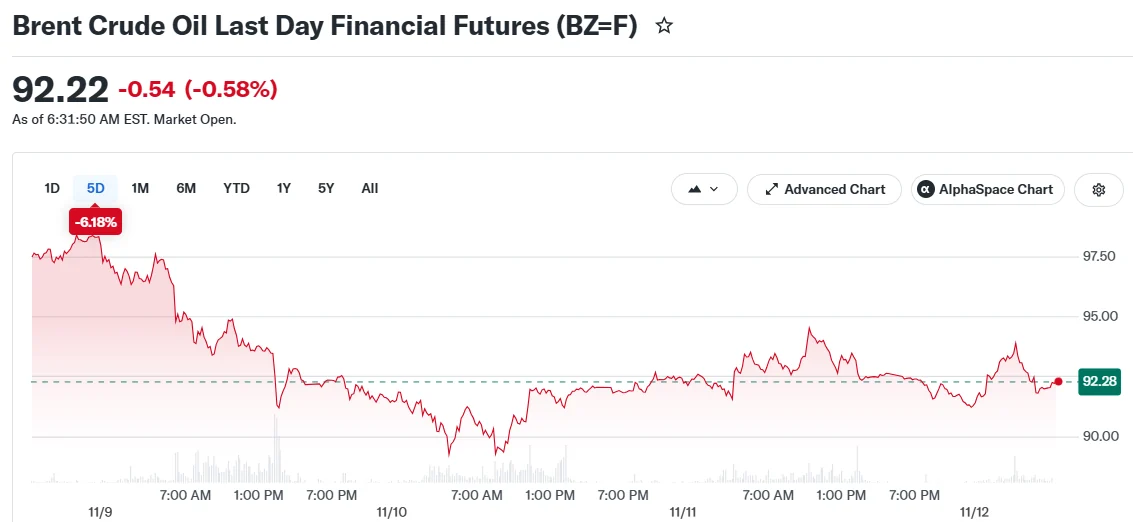
Oil prices fell on Thursday as traders weighed hopes for new talks between the United States and Iran against ongoing risks to shipping in the Middle East.
Brent crude futures, the global benchmark, dropped between 0.4% and 1% to between $91.79 and $92.42 a barrel, depending on the time of reading. West Texas Intermediate futures, the U.S. benchmark, slipped to between $85.69 and $86.15 a barrel.
Brent is still up more than 50% this year, although the contract has fallen sharply in recent days. The declines came as investors digested a sharp rise in Saudi Arabian production and an unexpectedly large build in U.S. crude stockpiles, alongside cautious optimism about potential U.S.-Iran diplomacy.
Diplomacy in Focus
The Wall Street Journal reported that U.S. Vice President JD Vance is considering in-person talks with Iranian security official Mohsen Rezaei. The paper cited U.S. and Middle Eastern officials and people familiar with the discussions. According to the report, President Donald Trump has empowered Vance to negotiate, but the discussions about a meeting remain preliminary.
Trump has said he does not believe more strikes on Iran will be needed. Vance has largely blamed the war for hurting the Republican Party in the November midterm elections. Some investors hope a Democratic victory in the midterms will lead to more progress toward peace. Strategists at Singapore-based bank OCBC said expectations of less U.S.-Iran escalation after the vote have weighed on crude.
Big gaps remain between the two sides. They disagree on an American naval blockade of Iranian ports and on frozen assets. Rezaei has also suggested that no enriched uranium will be allowed to leave Iran, a position that could reject a major U.S. demand.
Supply Picks Up
Saudi Arabia, OPEC's largest producer, told the Organization of the Petroleum Exporting Countries that its output rose 26% in October to 10.56 million barrels per day, one of the highest levels in years.
🚨 BREAKING: Saudi Arabia just SURGED oil production to near PRE-WAR LEVELS, it told OPEC — Bloomberg Almost 10.6 MILLION barrels per day! AND THERE IT IS. The whole OPEC+ group jumped too, up more than 2 MILLION barrels a day President Trump's strategy in Iran is working.… pic.twitter.com/c37e3KbS33
— Eric Daugherty (@EricLDaugh) November 11, 2026
Saudi Arabia has used its east-west pipeline to divert some shipments away from the Strait of Hormuz, a practice that has continued despite a conflict with Houthi rebels in Yemen. U.S. naval security has also helped guide oil through Hormuz to global markets.
OCBC said resilient Gulf exports, easing freight costs and softer physical-market conditions have also pressured prices. Shipping data suggests oil flows out of the region are recovering.
Analysts at ING said regional crude flows are approaching pre-war levels. They added that exports still rely on routes around Hormuz, which leaves supply open to disruption. ING expects volatility to stay high.
Attacks on shipping continue. The International Maritime Organization said on Wednesday it had verified more than 130 attacks on commercial vessels in the Strait of Hormuz since the war began on Feb. 28. At least 25 seafarers have been killed, and others are missing or injured.
The Strait of Hormuz carried roughly a fifth of the world's oil and liquefied natural gas flows before the war started in late February. The conflict began as a U.S.-Israeli war on Iran.
Saudi Civil Defense also said debris from two intercepted Houthi ballistic missiles fell in the Mecca region on Wednesday, including in the village of Sabuhah, according to the Saudi Press Agency.
OCBC kept its year-end Brent forecast at $100 a barrel. It cited tanker attacks, longer shipping routes and limited vessel availability as reasons that delivered crude costs remain high.
U.S. Stockpiles Build
U.S. industry data showed an unexpected 9-million barrel build in crude inventories last week. Crude inventories measure the oil held in U.S. storage, and a build means more barrels entered stockpiles than were drawn out over the week, a signal traders typically read as looser near-term supply-demand conditions. Such figures often point to a similar trend in official data.
The U.S. Energy Information Administration will release its weekly petroleum report later on Thursday, delayed one day for Veterans Day, giving traders an official read on whether the industry-reported build is confirmed. The International Energy Agency will publish its monthly oil-market report on Friday, offering an updated view of global supply and demand.

