New England's January Natural Gas Prices Retreat From $22 as Egress Advances
Key Takeaways
- •Forward curves at key New England natural gas hubs show a sharp winter premium for the coming heating season, followed by substantial price relief in later years.
- •The expected price pullback reflects anticipated growth in takeaway capacity, known as egress, moving Appalachian supply toward demand centers.
- •New England premium prices are projected to drop after 2027, while Appalachian basis sees little improvement and the regional January price gap remains wide.
- •New England has long had some of the most volatile US natural gas prices during cold snaps, when pipeline imports are fully utilized.
- •During peak winter demand, New England utilities turn to LNG deliveries, including imports into the Everett terminal area, to meet heating needs.
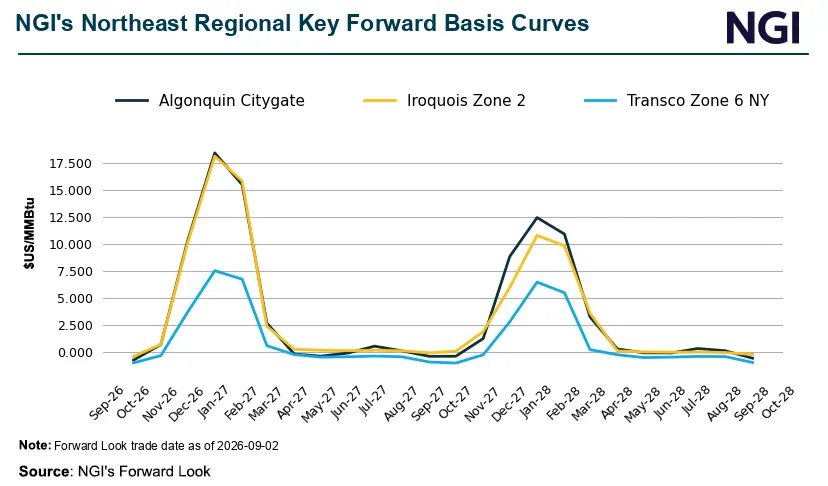
Forward curves at key New England natural gas hubs are pricing substantial relief in subsequent years following an exceptional winter premium expected in the coming heating season. The pullback points to anticipated growth in takeaway capacity — commonly referred to as egress — moving Appalachian supply toward demand centers, which the market expects to gradually erode the region's long-standing winter bottlenecks.
New England has for years carried some of the most volatile natural gas pricing in the country during cold snaps, when pipeline import capacity into the region is fully utilized and utilities turn to LNG deliveries — including imports into the Everett terminal area — to meet peak heating demand. The size of the winter premium in coming years reflects how tightly that constraint still binds.
At a Glance:
- New England premium drops after 2027
- Appalachian basis sees little improvement
- Regional January gap remains wide
Source: Natural Gas Intelligence
About the author: Jacob Dick joined the NGI staff in January 2022 and was promoted to Senior Editor, LNG in February 2024. He previously covered business with a focus on oil and gas in Southeast Texas for the Beaumont Enterprise, a Hearst newspaper. He is a native of Kentucky and holds a bachelor's degree in journalism from Western Kentucky University.
Related coverage from NGI:
-
Will Resilient Summer Demand Buck Up Natural Gas Futures? (September 4, 2026) — Natural gas futures ticked up early Friday as market participants digested a narrowing but still substantial storage surplus, choppy yet seasonally solid production, robust late-summer cooling demand and strong LNG volumes.
-
Spot Natural Gas Prices Soar as OFOs Abound (September 3, 2026) — Strong cooling demand and pipeline operational constraints drove dramatic regional price spikes in the physical natural gas market on Thursday.
-
Shrinking Surpluses, Steamy Forecasts Fail to Rally Natural Gas Futures (September 3, 2026) — Despite unseasonably hot near-term forecasts and formidable year/year storage deficits in multiple regions, natural gas futures lost ground on Thursday.
-
In-Line Storage Injection Sends Natural Gas Futures Adrift (September 3, 2026) — Utilities and other operators collectively injected 30 Bcf of natural gas into storage during the week ended Aug. 28, the US Energy Information Administration (EIA) reported on Thursday. The result met expectations and, at least initially, deflated natural gas futures.
-
Natural Gas Futures Hover Near $3 as Market Braces for EIA Storage Print (September 3, 2026) — Buyers stepped up again early Thursday as the futures market anticipated a bullish update on natural gas stored underground for the coming winter.
-
Cash Natural Gas Prices Mixed as Edouard Fades Over East Texas (September 2, 2026) — Physical natural gas prices mostly rose Wednesday as building heat supported demand from the Mississippi Valley into the Ohio Valley, while Gulf Coast hubs recovered some of Tuesday's steep losses.
