Cash Natural Gas Prices Mixed as Tropical Storm Edouard Fades Over East Texas
Key Takeaways
- •Gulf Coast natural gas hubs rebounded Wednesday as Tropical Storm Edouard weakened over East Texas after making landfall near the Texas-Louisiana border.
- •The storm did not reduce LNG feedgas nominations, and natural gas futures recovered most early losses as export terminals operated normally.
- •Natural gas futures rose Wednesday as bullish September heat forecasts encouraged traders to test the $3 level.
- •Escalating US-Iran hostilities raised concerns about energy shipment disruptions through the Strait of Hormuz, potentially boosting demand for US LNG exports.
- •US manufacturing expanded in August, with strong factory production and accelerating Texas activity supporting industrial gas demand heading into fall.
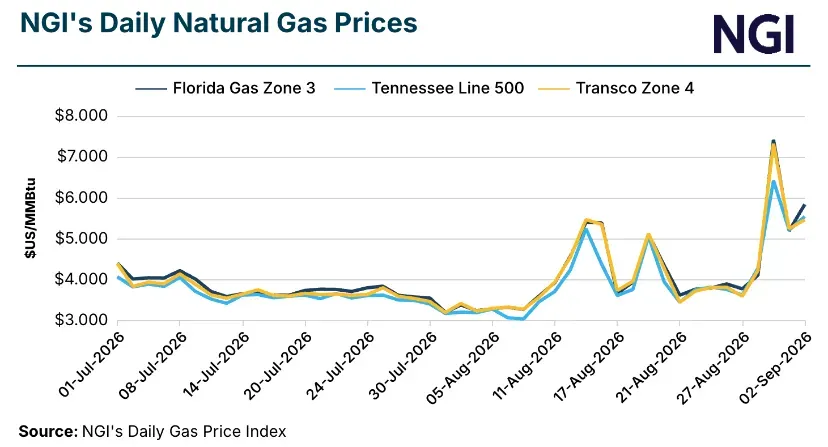
Physical natural gas prices were mostly higher Wednesday as building heat supported demand from the Mississippi Valley into the Ohio Valley, while Gulf Coast hubs recovered a portion of the steep losses posted Tuesday. The Gulf Coast is home to some of the most liquid cash market hubs in the country, sitting at the nexus of production, pipeline infrastructure and the LNG export corridor, which is why storm-related volatility there tends to ripple across national price benchmarks.
Key points from the session:
- Gulf Coast hubs rebounded as Tropical Storm Edouard weakened over East Texas after making landfall.
- Extreme heat was forecast to blanket the Ohio Valley on Thursday.
- Transco Zone 5 led declines among major hubs.
Background on Edouard's Impact
The storm came ashore near the Texas-Louisiana border, and on Tuesday physical natural gas prices fell back across the Gulf Coast and Southeast for Wednesday delivery, surrendering about two-thirds of Monday's surge past $7, as NGI reported. That Monday spike had come as the market braced for the season's first Gulf Coast tropical storm to bear down on the Texas-Louisiana LNG corridor. Ultimately, the storm did not dent LNG feedgas nominations, and natural gas futures clawed back most of their early losses Tuesday as terminals shrugged off Edouard. The episode is a reminder of how sensitive Gulf Coast cash pricing has become to export infrastructure: feedgas flowing to LNG terminals now ranks among the largest single sources of US natural gas demand, so any perceived threat to terminal operations can move spot prices sharply even when supply itself is unaffected.
Related Market Developments
Natural gas futures pushed higher Wednesday as increasingly bullish September heat forecasts gave traders another reason to test the $3 mark, while renewed US-Iran fighting added a fresh jolt from overseas, according to NGI's markets report. Weather remains the dominant swing factor for gas demand in late summer, when heat-driven power burn for air conditioning can push electric-sector consumption to seasonal peaks.
Escalating US-Iran hostilities during the week raised fresh concerns over prolonged disruptions to energy shipments through the Strait of Hormuz. The flare-up added to already simmering concerns about global LNG supply and could add demand for American exports — and impact pricing — should the conflict drag into the winter months. The United States is the world's largest LNG exporter, so any tightening of global supply tends to fall back on American cargoes.
Separately, US manufacturing continued to expand in August, with factory production remaining strong and Texas activity accelerating, providing a supportive backdrop for industrial natural gas demand heading into fall.
Source: Natural Gas Intelligence
