Shrinking Surpluses, Steamy Forecasts Fail to Rally Natural Gas Futures
Key Takeaways
- •The EIA reported a 30 Bcf storage injection for the week ended Aug. 28, in line with expectations, which weighed on natural gas futures.
- •October futures briefly traded above $3 ahead of the storage report before losing ground.
- •Spot natural gas prices spiked sharply in some regions as heat-driven cooling demand and widespread operational flow orders strained pipeline capacity.
- •Tropical Storm Edouard faded over East Texas, allowing Gulf Coast hubs to recover part of Tuesday's steep losses.
- •Escalating US-Iran tensions raised fears of prolonged disruptions to energy shipments through the Strait of Hormuz, potentially boosting demand for US LNG exports.
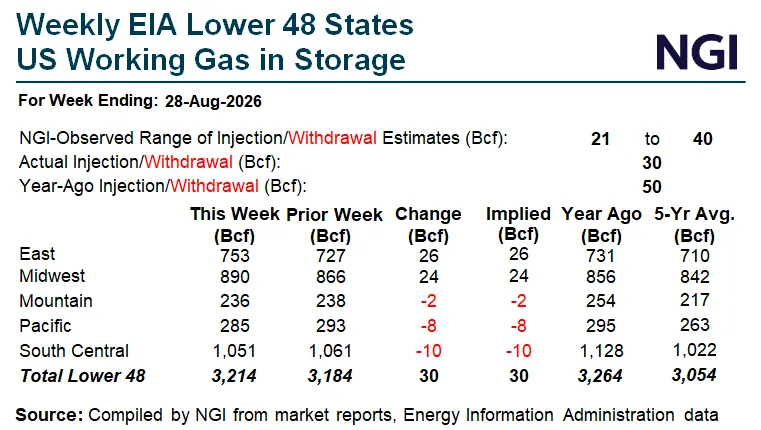
Natural gas futures lost ground on Thursday, despite unseasonably hot near-term forecasts and formidable year-over-year storage deficits across multiple regions.
Key points from the session:
- The US Energy Information Administration (EIA) reported a 30 Bcf injection for the week ended Aug. 28.
- October futures briefly tested above $3.
- A scorching September is on tap.
The EIA's 30 Bcf injection, reported Thursday, was in line with expectations. Utilities and other operators collectively injected the gas into storage during the week ended Aug. 28, and the result — at least initially — deflated natural gas futures, according to NGI's coverage of the print (In-Line Storage Injection Sends Natural Gas Futures Adrift). The muted reaction underscores how sensitive the market has become to storage outcomes: with inventories trailing year-ago levels across multiple regions, traders have been watching weekly injections closely for confirmation that stockpiles can rebuild ahead of the winter heating season, and a print that merely meets expectations offers little fresh fuel for a rally.
Heading into the report, buyers had stepped up again early Thursday as the futures market anticipated a bullish update on natural gas stored underground for the coming winter, with futures hovering near the $3 mark (Natural Gas Futures Hover Near $3 as Market Braces for EIA Storage Print).
In the physical market, strong cooling demand and pipeline operational constraints drove dramatic regional price spikes on Thursday, with spot natural gas prices soaring as operational flow orders (OFOs) abounded (Spot Natural Gas Prices Soar as OFOs Abound). OFOs are notices pipeline operators issue requiring shippers to balance their nominations, and their prevalence this week highlights how heat-driven demand can strain grid capacity even when overall supply is adequate.
Earlier in the week, physical natural gas prices mostly rose Wednesday as building heat supported demand from the Mississippi Valley into the Ohio Valley, while Gulf Coast hubs recovered some of Tuesday's steep losses as Tropical Storm Edouard faded over East Texas (Cash Natural Gas Prices Mixed as Edouard Fades Over East Texas). The episode is a reminder that late-season tropical systems remain a wildcard for Gulf Coast production and pricing heading into autumn.
Futures had pushed higher Wednesday, as increasingly bullish September heat forecasts gave traders another reason to test the $3 mark, while renewed US-Iran fighting added a fresh jolt from overseas (Natural Gas Futures Advance Ahead of Expected Lean Storage Build).
Escalating US-Iran hostilities this week raised fresh concerns over prolonged disruptions to energy shipments through the Strait of Hormuz. The flare-up added to already simmering concerns about global LNG supply and could add demand for American exports — and impact pricing — should the war drag into the winter months (Inflamed US-Iran Tensions Imperil Hormuz Shipping, Stoke LNG Supply Fears). With the United States among the world's largest LNG exporters, overseas supply risks increasingly feed back into domestic pricing, adding another layer for traders to monitor alongside weather and storage data in the weeks ahead.
The report was authored by NGI's Andrew Baker, who joined NGI in 2018 to support coverage of Mexico's newly liberalized oil and gas sector; his role has since expanded to include the rest of North America. Before joining NGI, Baker covered Latin America's hydrocarbon and electric power industries from 2014 to 2018 for Business News Americas in Santiago, Chile.
