China Lithium Futures Hit Five-Month Low as Mine Restarts Raise 2027 Oversupply Concerns
Key Takeaways
- •The most-active Guangzhou lithium carbonate futures contract closed Tuesday at 144,000 yuan per tonne and fell further to 143,000 yuan on Wednesday.
- •CATL restarted the Jianxiawo mine in late June, restoring about 46,000 tonnes of annual capacity, equal to roughly 3% of global output.
- •The US Defense Logistics Agency sought bids for about 16,000 tonnes of battery-grade lithium carbonate for the national defense stockpile over five years.
- •China plans to impose a 2% consumption tax on battery products from September 1, rising to 4% one year later.
- •Lithium equities have sold off over the past month, with major listed producers in Australia, Hong Kong and the United States posting double-digit declines.
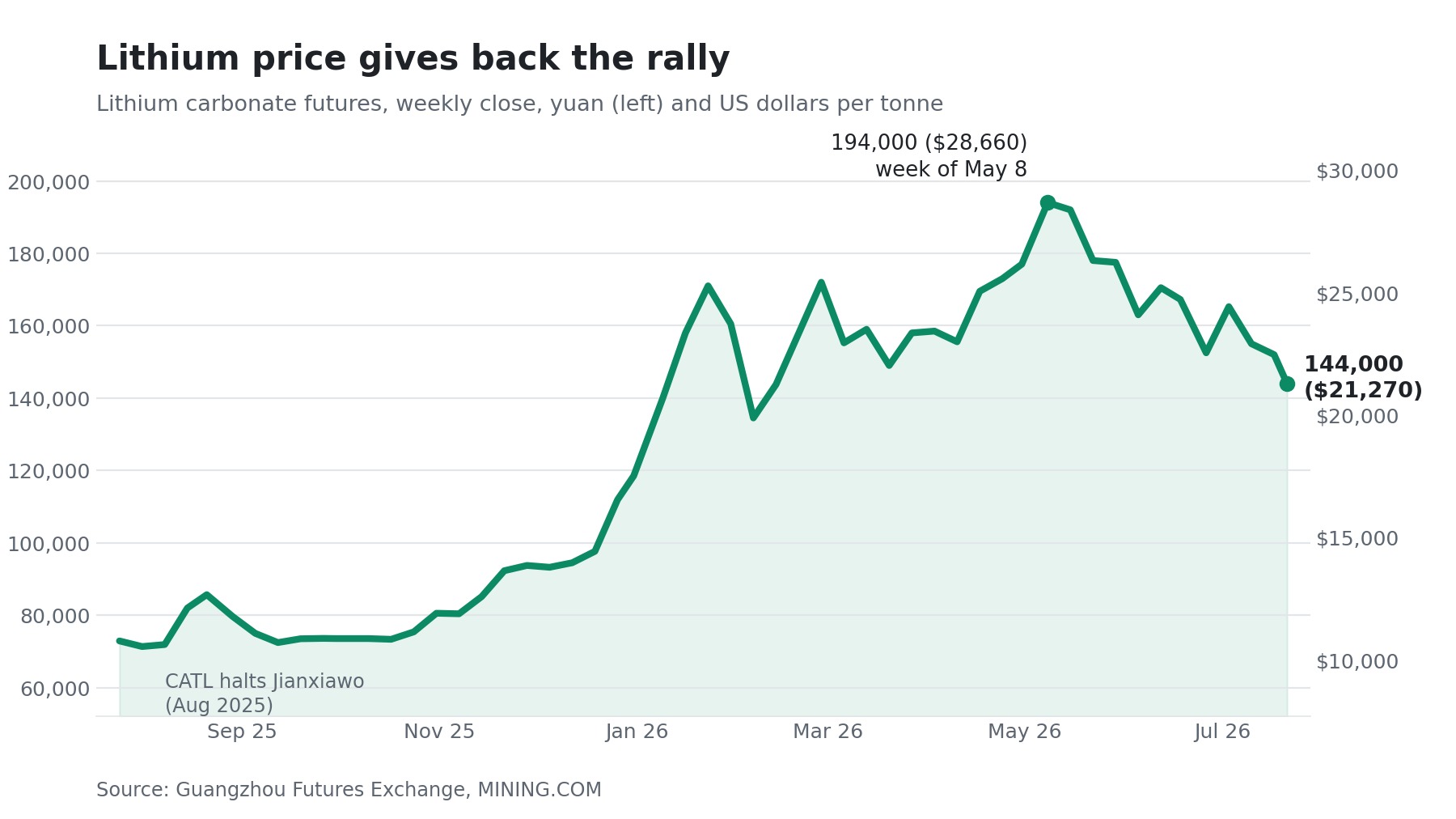
Lithium futures in China fell to a five-month low on Tuesday, as expectations that a series of mine restarts could push the market back into oversupply next year outweighed strong near-term demand from electric vehicles and energy storage.
The most-active lithium carbonate contract on the Guangzhou Futures Exchange dropped to 136,800 yuan ($20,210) per tonne, its lowest level since February 10. It later recovered part of the decline in afternoon trading and closed at 144,000 yuan, still down 4.95% for the session. On Wednesday, the contract slipped another 0.7% to 143,000 yuan ($21,126).
The contract has now retreated nearly 30% from the two-year high above 200,000 yuan reached in mid-May. Even so, it remains more than twice its level from a year earlier, before the shutdown of CATL’s large Jianxiawo mine triggered a rally that lasted for months. Despite Tuesday’s selloff, lithium is still up about 22% in 2026.
The decline comes as Beijing is seeking to establish Guangzhou as a benchmark venue for global lithium pricing. The Guangzhou Futures Exchange opened its lithium carbonate contract to overseas traders this month and plans to introduce a second futures contract, for lithium hydroxide, later this year as part of a broader effort to gain more pricing influence over the battery metal. A deeper futures market would also give producers, battery makers and traders another reference point for hedging and pricing physical supply, at a time when lithium demand is increasingly tied to both electric vehicles and grid storage.
US stockpiling
Washington has also given lithium bulls a new argument this month. The US Defense Logistics Agency posted a solicitation asking suppliers to provide fixed prices for almost 36 million pounds, or about 16,000 tonnes, of battery-grade lithium carbonate for delivery over five years. The purchase, intended for the national defense stockpile, could be worth as much as $300 million.
Bids closed on Friday. The tender requires all processing and testing of the material to take place entirely within the continental United States.
At the full tonnage, the purchase works out to roughly $18,500 per tonne, well below even Wednesday’s reduced Guangzhou price. It is part of a broader US push into critical minerals, including Project Vault, a $12 billion private-sector stockpiling initiative, and a wider effort to rebuild Pentagon metal reserves that were sold down over several decades.
For the lithium market, the volumes are limited. Spread across five years, the purchase would equal only a few days of global consumption. Still, the tender marks Washington’s entry as a buyer in the lithium market for the first time in the battery era, making the award terms and domestic-processing requirement a policy signal even if the tonnage is not large enough to change the global balance on its own.
Supply restarts
The rally is now reversing as supply that was idled during the downturn returns to the market. CATL restarted Jianxiawo in late June after obtaining a new safety permit, restoring about 46,000 tonnes of annual capacity. That represents roughly 3% of global output and returns supply to a market that had priced in the mine’s absence.
Australian producers are also moving to bring capacity back. Mineral Resources is restarting its Bald Hill operation, Core Lithium is bringing its Finniss project back online, and the Mt Marion joint venture has approved an A$490 million expansion. Analysts expect those moves to increase supply through 2027 after two years in which low prices forced production curtailments across the industry. The timing matters because lithium prices have been responding not only to current consumption, but also to how quickly shuttered or delayed tonnes can re-enter the market.
However, not all 2027 signals point toward additional supply. Zimbabwe, which accounted for about 10% of the world’s mined lithium last year, on Friday rejected industry requests to delay a ban on lithium concentrate exports that is scheduled to take effect on January 1.
“We are still sticking with January 1,” mines minister Polite Kambamura told Bloomberg reporters. “They have to run with this.”
Demand still running hot
The price retreat has come despite limited signs of weakness in demand. China’s production of power and energy storage batteries reached 191.7 GWh in May, more than 55% higher than a year earlier. Growth in grid-scale energy storage has continued to absorb material alongside resilient electric vehicle sales.
Beijing is preparing to tax that growth. China will impose a 2% consumption tax on battery products, including primary lithium batteries and lithium-ion batteries, from September 1. The rate will double to 4% one year later. Goldman Sachs said expectations ahead of the tax could pull demand forward before implementation.
When Ganfeng Lithium chairman Li Liangbin said in November that surging demand could lift lithium carbonate to 200,000 yuan per tonne, the forecast appeared ambitious. The market briefly reached that level in May and has been declining since. The next test for the market is whether battery and storage demand can keep absorbing supply as restarted mines ramp up and policy changes, including China’s battery tax and Zimbabwe’s export ban, begin to take effect.
Lithium equities have fallen more sharply than the metal as the rally has unwound. Over the past month, Liontown Resources lost 36% in Sydney, PLS, the former Pilbara Minerals, declined 26%, Mineral Resources fell 21%, Core Lithium dropped 20% and IGO lost 18%. Ganfeng Lithium fell 36% in Hong Kong.
Among US-listed companies, Lithium Americas declined 28%, Albemarle lost 22%, Sigma Lithium fell 21% and SQM dropped 11%. The Global X Lithium ETF was down 15%. Sydney-listed producers declined again on Wednesday, with Liontown falling a further 5.1%, while US-listed names steadied in early trading.
(With files from Reuters and Bloomberg News)

