Lee Orders South Korea to Keep Oil Price Caps Until Uncertainty Fully Recedes
Key Takeaways
- •Lee instructed officials to keep oil price caps in place until volatility in global crude prices subsides.
- •The government may consider additional measures if high oil prices further pressure households and vulnerable workers.
- •Lee ordered closer monitoring of market irregularities such as cornering and price-fixing in essential goods.
- •South Korean and global technology companies agreed to pursue AI-related cooperation projects valued at $950 billion.
- •Lee plans summits and business meetings in Brazil, Chile and Argentina as part of broader South American diplomacy.
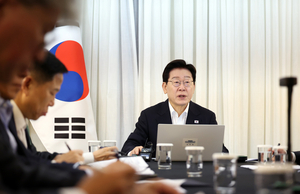
President Lee Jae Myung instructed senior officials on Sunday to keep South Korea’s oil price caps in place until price uncertainty has fully receded, pointing to renewed confrontation in the Middle East as a key risk to domestic inflation.
"Amid the high likelihood that oil prices will remain volatile for some time, preemptive efforts should be made promptly to minimize their impact on domestic prices," Lee said during a meeting with senior aides. He joined the meeting virtually from Brasilia, where he is on a state visit.
Lee also told officials to maintain related measures, including oil tax cuts, and said additional steps should be reviewed if conditions deteriorate. For South Korea, which relies heavily on imported energy, swings in crude prices can quickly feed into transport, logistics and production costs, making fuel policy a direct part of the government’s inflation response.
His remarks came after the renewed conflict in the Middle East drove global oil prices to around $100 per barrel for the first time since May.
The Seoul government introduced fuel price caps in mid-March as part of efforts to stabilize domestic fuel prices amid supply chain disruptions linked to the Middle East conflict.
"If the situation worsens, further measures should be proactively considered to ease the burden on people's livelihoods," Lee told the meeting. He identified truck drivers, heavy equipment operators, farmers and migrant workers as groups particularly vulnerable to high oil prices.
The president also ordered officials to closely examine market irregularities, including market cornering and price-fixing involving goods essential to daily life, while calling for continued efforts to maintain price stability.
Lee also discussed his two-day visit to San Francisco on Friday and Saturday, saying the trip had raised South Korea’s partnerships with global technology companies to the level of what he described as an "artificial intelligence alliance."
During the San Francisco visit, the South Korean president met the heads of four global technology giants, including OpenAI Chief Executive Officer Sam Altman and Nvidia Corp. CEO Jensen Huang. Lee called for closer cooperation between those companies and South Korean firms in artificial intelligence.
At a separate high-level meeting attended by Lee, global technology companies and South Korean tech conglomerates agreed to pursue a set of cooperation projects worth a combined $950 billion. The projects include a long-term agreement under which SK Group will supply $750 billion worth of high-performance semiconductors to Nvidia and others.
Lee also issued the "San Francisco AI Declaration" during the visit, setting out a vision for South Korea to become a trusted production base and supply partner for AI semiconductors. The push comes as AI development has increased demand for advanced chips and data-center hardware, areas where South Korean companies are trying to strengthen their role in global supply chains.
"It constitutes South Korea's bid to become an irreplaceable leader in the AI era," Lee told the virtual meeting with his aides. He instructed officials to ensure that follow-up measures are carried out so the results of the trip can produce concrete benefits for the economy and people’s livelihoods.
The president also pledged to broaden South Korea’s diplomacy with South American countries, citing the region’s large population and abundant natural resources.
"Amid rapid shifts in the international order, efforts to diversify diplomatic networks are essential for the country's stable development," he said.
Lee is scheduled to hold a summit with President Luiz Inacio Lula da Silva in Brasilia on Monday, followed by a business roundtable in Sao Paulo the next day.
He will travel to Chile on Wednesday for a summit with his Chilean counterpart, Jose Antonio Kast, before visiting Argentina for talks with Argentine President Javier Milei. (Yonhap)

