Chinese Port Stocks Rise Further as Steel Demand Softens
Key Takeaways
- •Global seaborne iron ore flows totaled 145 million tonnes in July 2026, marking a 1% year-on-year decline and a more than 5% decrease from the previous month.
- •Chinese iron ore imports rose 2% year-on-year to 108.2 million tonnes, while shipments to all other destinations fell over 6% due to weak global steel sector demand.
- •Chinese port iron ore inventories reached 174 million tonnes in late July, more than 22% higher than a year earlier, indicating that imports are outpacing consumption by steel mills.
- •Exports from Guinea's Simandou project peaked at 2.8 million tonnes in May before declining to 1.8 million tonnes in July as the high-grade deposit continues its controlled ramp-up.
- •The longer shipping distance from Guinea to China compared to the Australian route is expected to increase tonnes-miles and support capesize freight rates despite anticipated weaker iron ore demand.
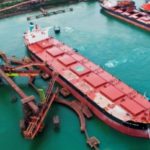
Global seaborne bulk iron ore flows reached 145 million tonnes (mt) in July 2026, down 1% compared to the same period last year and more than 5% lower than the previous month, according to data from the Signal Ocean Platform.
Flows to China, the world's largest seaborne bulk importer, increased by 2% year-on-year to reach 108.2 mt. China accounts for roughly 70% of global seaborne iron ore imports, meaning even modest shifts in its purchasing patterns reverberate across the dry bulk shipping market and exporter revenues. June remains the only month so far in 2026 in which China imported less iron ore than the corresponding month a year earlier. Meanwhile, iron ore flows destined for ports outside of China fell by over 6% year-on-year, reflecting weak demand from the global steel industry.
Australia and Brazil remained the dominant iron ore exporters in July 2026, with exports of 77.4 mt and 34.3 mt, respectively. Together, the two countries account for the overwhelming majority of seaborne supply, making their shipment volumes a key barometer for global dry bulk trade.
Exports from Guinea's Simandou project have slowed over the past two months after peaking at 2.8 mt in May. The July figure stood at 1.8 mt, down from 2 mt in June. Simandou is one of the world's largest known untapped high-grade iron ore deposits, and its gradual ramp-up introduces a new supply source into a market long dominated by Australian and Brazilian producers.
The latest Chinese crude steel production figures from the National Bureau of Statistics (NBS) show the country running 3% behind the volume produced at the same point last year. However, June's monthly figure — the latest available — showed a jump of 20% from May, rising to 24.3% on a daily production basis. China produces roughly half of the world's crude steel, so these figures are closely watched as a leading indicator of iron ore consumption and broader industrial activity.
Chinese iron ore port stocks remain elevated, having risen over the last two weeks of July to 174 mt, more than 22% higher than the same period a year earlier. Port inventories are a closely tracked supply-demand metric: rising stocks typically signal that import flows are outpacing consumption by steel mills, which can weigh on spot prices and future ordering.
The combination of rising port inventories and softer steel sector demand is expected to put pressure on iron ore exports from both Brazil and Australia. Australia is viewed as the more likely to face immediate challenges due to its relatively lower iron ore quality.
The Simandou project is expected to continue its slow and controlled ramp-up. Given its higher iron ore quality, it is likely to establish itself as a preferred source of high-grade feed for the Chinese steel industry.
Despite the anticipated slowdown in iron ore demand, the capesize market is well positioned to benefit. Capesize vessels, the largest class of dry bulk ships typically carrying 150,000–400,000 deadweight tonnes, are the primary transport for iron ore. Any tonnage replaced by iron ore from Simandou represents a significant increase in tonnes-miles, given the considerably longer voyage distance from Guinea to China compared with the Australian route, which should help support capesize market rates.
Source: Signal Group

