Iran's Tanker Blacklist Threatens Hormuz Shuttle Trade Lifeline
Key Takeaways
- •Iran blacklisted 12 VLCCs that had carried around 900,000 barrels per day, or 16% of all crude lifted from inside the Middle East Gulf, since the US-Iran memorandum of understanding collapsed in early July.
- •The targeted vessels accounted for roughly 750,000 barrels per day, or 24%, of crude transferred ship-to-ship outside Hormuz, and Iran warned that ships conducting STS operations with them could also be blacklisted.
- •Reuters reported that at least three Indian refiners and a global energy major plan to stop using the blacklisted vessels because of security concerns.
- •Vortexa data shows Middle East Gulf crude exported via STS transfers in the Gulf of Oman has averaged 3.1 million barrels per day since early July, nearly 30% of the region's 5.6 million barrels per day of crude exports.
- •MB Shipbrokers recorded 284 STS-linked Hormuz transits since the war began, with 54% performed by vessels making four or more crossings, leaving flow resilience dependent on a small group of repeat ships.
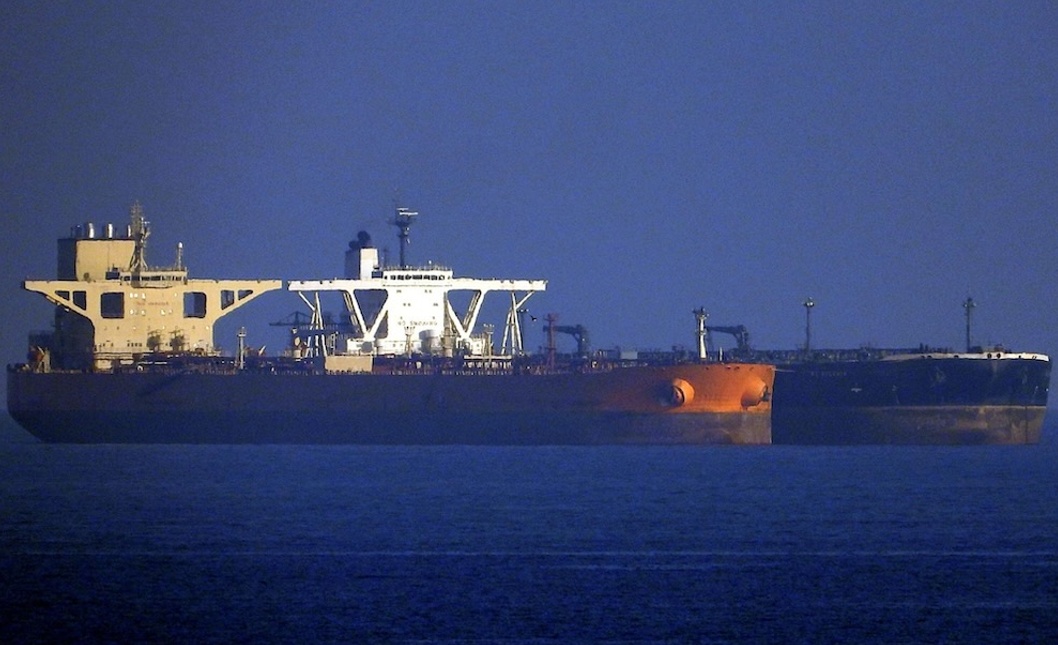
The emerging shuttle tanker trade that carries Middle East crude through the Strait of Hormuz for ship-to-ship transfer in the Gulf of Oman — an increasingly vital lifeline for Gulf exporters — faces a fresh threat after Iran blacklisted several of the vessels at the heart of the operation this week.
Broker Braemar cautioned that the 12 VLCCs named by Tehran had carried around 900,000 barrels per day, equivalent to 16% of all crude lifted from inside the Middle East Gulf since the memorandum of understanding between the US and Iran collapsed in early July. More significantly, those ships accounted for roughly 750,000 barrels per day, or 24%, of the crude subsequently transferred ship-to-ship outside Hormuz.
Iran has threatened the blacklisted vessels with fines, detention and cargo confiscation, and warned that ships conducting STS operations with them could themselves be added to the list. Tehran has repeatedly seized or detained commercial tankers in Gulf waters in recent years, a track record that gives the warnings weight among owners and charterers.
The threat is already having an impact. Reuters reported this week that at least three Indian refiners and a global energy major planned to stop using blacklisted vessels because of security concerns. India, the world's third-largest crude importer, is a mainstay buyer of Middle East Gulf barrels — the very cargo the shuttle trade exists to move.
"If owners begin avoiding these highly active shuttle tankers, the ships yet unnamed by Iran and still willing to transit Hormuz are likely to command higher premiums," Braemar noted.
An essential workaround
The shuttle system has become an essential workaround for Gulf exporters during the crisis. It took hold after the war made many owners reluctant to run fully laden tankers through the strait, with war-risk insurance premiums for Hormuz transits climbing sharply.
Middle East Gulf crude exported through STS transfers in the Gulf of Oman has averaged 3.1m barrels per day since early July, according to Vortexa — almost 30% of the region's 5.6m barrels per day of crude exports. The UAE has accounted for around 1.3m barrels per day and Kuwait 940,000 barrels per day, with additional volumes originating in Saudi Arabia, Iraq and Qatar.
The strait itself is the world's most important oil transit chokepoint, normally carrying around 20m barrels per day of crude, condensate and refined products — roughly a fifth of global oil consumption — and the land-based bypass pipelines across Saudi Arabia and the UAE can absorb only a fraction of that throughput, leaving exporters dependent on tankers.
Product tankers are exposed too. An LR2 carrying jet fuel and diesel and an LR1 used for diesel shuttle voyages were among the vessels targeted by Iran.
The scale of the workaround was showcased this week by TankerTrackers.com, which counted at least 20 STS operations underway in the Gulf of Oman on Tuesday alone, involving crude and refined products as well as LPG.
Concentrated risk
The shuttle trade works by concentrating the most dangerous part of the voyage among a relatively small group of ships repeatedly crossing Hormuz.
"STS activity has been instrumental in moving west-of-Hormuz volumes to Asia, lifting Asia's crude imports above seasonal averages in August," MB Shipbrokers noted in a report issued last Friday.
Most STS-linked transits are carried out by the same small group of vessels making repeated shuttle runs, MB Shipbrokers explained. As of August 21, there had been 284 such runs since the war began, 54% of them by vessels repeating four or more transits.
"With the highest-risk part of the voyage increasingly concentrated among few repeat vessels, flow resilience depends disproportionately on their willingness to keep returning. If these vessels are targeted and subsequently avoid the trade, Hormuz flows would tighten further from its already low levels," MB Shipbrokers observed.
How far Tehran extends the list, and whether the ships still willing to run the strait keep coming back, are the open questions on which the trade's resilience now rests.
A busy day in the Gulf of Oman, where there are at least fifteen sets of STS transfer sessions taking place. We count 25 million barrels of crude oil; plus some refined products. The oil originates from almost every country in the region, minus Iran. #OOTT #IranWar #Tankers pic.twitter.com/TAba26mJiW
— TankerTrackers.com, Inc. (@TankerTrackers), August 25, 2026
Source: Splash247

