Hyundai Steel Targets $4 Billion Annual Revenue from Louisiana Electric Arc Furnace Plant
Key Takeaways
- •Hyundai Steel's $5.8 billion Louisiana plant is expected to generate about $4 billion in annual revenue once it reaches full production.
- •The plant is scheduled to start commercial production in 2029 with an annual capacity of 2.7 million tons of steel, including 1.8 million tons of automotive steel sheets.
- •Hyundai Steel holds a 50 percent stake in the venture, Posco holds 20 percent, and Hyundai Motor and Kia hold 15 percent each.
- •Hyundai Motor, Kia and Posco have committed to purchasing a combined 1.4 million tons of steel annually from the plant.
- •The facility's direct reduced iron and electric arc furnace technology is expected to cut carbon emissions by up to 70 percent compared with conventional blast-furnace steelmaking.
Hyundai Steel expects its planned $5.8 billion electric arc furnace steel plant in Louisiana to generate approximately $4 billion in annual revenue once it reaches full production, positioning the facility as a "game changer" in the low-carbon steel market.
The South Korean steelmaker held a groundbreaking ceremony Friday for Hyundai-Posco Louisiana Steel (HPLS) in Donaldsonville, Louisiana. Scheduled to begin commercial production in 2029, the plant will have an annual capacity of 2.7 million tons of hot-rolled and cold-rolled steel sheets, comprising 1.8 million tons of automotive steel sheets and 900,000 tons of general-purpose steel.
The investment comes as steelmakers serving the US market face tariff pressures on imported steel, adding to the strategic logic of producing automotive-grade steel domestically rather than shipping it from Korea.
"If we sell the full 2.7 million tons annually, we estimate the plant could generate about $4 billion in revenue," said Kim Taek-joon, Hyundai Steel's vice president in charge of its North America steel business strategy planning, at a press conference on Thursday at the project site.
Ownership Structure
Hyundai Steel is developing the project with Posco, Hyundai Motor and Kia. Hyundai Steel holds a 50 percent stake, followed by Posco with 20 percent, and Hyundai Motor and Kia with 15 percent each.
According to executives, these partnerships have already secured a substantial customer base for the Louisiana plant, one that is set to grow as Hyundai Motor Group expands its US manufacturing footprint, including its electric vehicle and battery plant in Georgia.
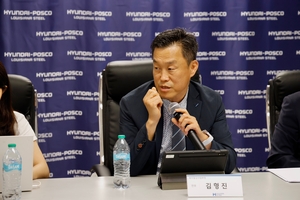
"Hyundai Motor and Kia are planning to purchase 400,000 tons of steel annually from HPLS, for a combined 800,000 tons, while Posco plans to take about 600,000 tons," said Kim Hyeong-jin, CEO of Hyundai-Posco Louisiana Steel. "We believe the remaining automotive steel can be sold through the sales and export channels we have already established."
The CEO also expressed confidence in finding buyers for the plant's 900,000 tons of general-purpose steel, citing strong demand in the US market. He said the company does not expect significant difficulties in selling the output if it begins preparing its sales strategy well ahead of commercial production.
When asked whether Hyundai Steel was already in specific talks with other automakers, Kim Hyeong-jin said, "It is still too early to say that any concrete negotiations are underway."
Low-Carbon Production Technology
At the core of the Louisiana project is an integrated production system pairing direct reduced iron with electric arc furnace technology, designed to significantly cut carbon emissions. Automakers have increasingly sought lower-carbon steel as they work to reduce emissions across their supply chains, which fall under so-called Scope 3 emissions accounting.
According to Hyundai Steel, Hyundai-Posco Louisiana Steel will be the first integrated electric arc furnace steel mill in the US specifically designed to produce automotive steel sheets. Similar facilities are under construction in other parts of the world, but none has yet entered commercial operations.
Vice President Kim Taek-joon said this production method could ultimately cut carbon emissions by as much as 70 percent compared with conventional blast-furnace steelmaking, which depends heavily on coal to reduce iron ore.
"At the initial stage of operations, we plan to begin the reduction process using natural gas, which is economically viable," Kim said. "With natural gas, combined with carbon capture and storage and renewable electricity, we can reduce carbon emissions by 70 percent compared with steel produced in blast furnaces."
Kim added that the company is also considering the use of hydrogen as a fuel source over the long term, although the timing has yet to be decided.
"If hydrogen is added in the future, we will ultimately be able to bring carbon emissions close to zero," he said.
Hyundai Steel–Posco Partnership
The project also marks a deepening partnership between Hyundai Steel and Posco, South Korea's two largest steelmakers and longtime domestic rivals.
Hyundai Steel brings its electric arc furnace operating experience to the venture, while Posco is expected to contribute steelmaking technology and sales capabilities.
"We reviewed and worked together with Posco on virtually every aspect of the project," Kim Hyeong-jin said. "We believe Posco's technological capabilities will create significant synergies and we are also considering areas where we can cooperate in sales and other parts of the business."
